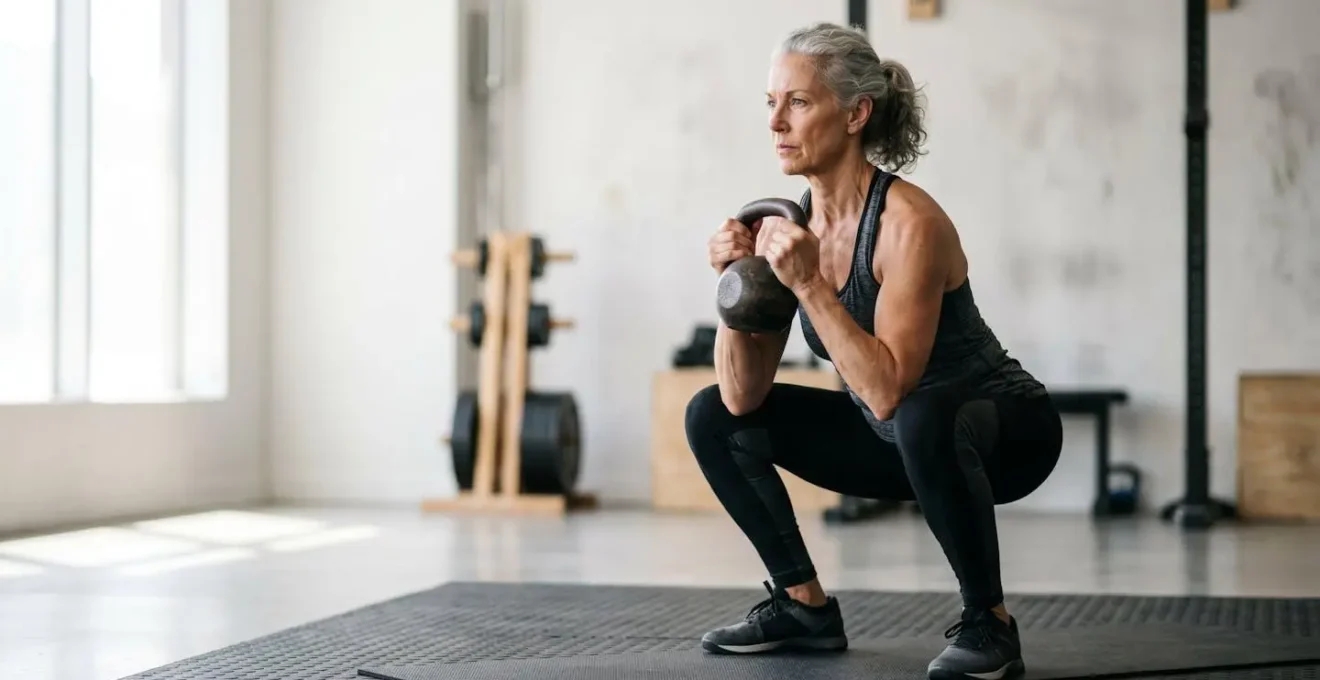
Contrary to the myth that women over 60 should stick to ‘gentle’ exercise, lifting heavy is the single most effective way to command your body to rebuild bone and reverse muscle aging.
- Lifting weights triggers a biological process called mechanotransduction, forcing your bones to absorb calcium and grow stronger.
- The fear of ‘bulking up’ is a misconception; post-menopausal hormonal realities make it nearly impossible, ensuring you build strength, not size.
Recommendation: Instead of guessing, invest in a few sessions with a qualified trainer to learn core movements safely. This initial investment pays lifelong dividends in strength and independence.
For decades, women have been told a gentle story about aging: embrace yoga, enjoy long walks, and be careful not to overdo it. This well-meaning advice, however, sidesteps a harsh biological truth that arrives with menopause. The fear of getting “bulky” from lifting weights has pushed millions of women toward activities that, while beneficial for the mind, do very little to combat the silent erosion of our physical structure: osteoporosis and sarcopenia. Walking is lovely, but it doesn’t place enough demand on your skeleton to fight significant bone loss.
The conversation needs to change. What if the key to a vibrant, strong, and independent life after 60 wasn’t about being gentle with your body, but about demanding more from it? What if lifting heavy things wasn’t a path to a bulky physique, but a direct, non-negotiable instruction to your bones and muscles to stay young and resilient? This isn’t about becoming a bodybuilder. It’s about engaging in a powerful dialogue with your own biology, using targeted stress to trigger profound rejuvenation.
This article will dismantle the myths holding you back. We will explore the science of how mechanical load signals bone growth, why “heavy” is a relative and safe term, and how to begin this journey with intelligence and confidence. You will learn not just what to do, but why it is the most empowering decision you can make for your long-term health, turning fear into informed action and reclaiming authority over your body’s aging process.
This guide breaks down the essential science, techniques, and tools to help you begin. From understanding the biology to choosing the right equipment, each section is designed to empower you with the knowledge to lift safely and effectively.
Summary: Why Lifting Heavy After 60 Is a Woman’s Best Defense Against Aging
- How Weightlifting Signals Your Bones to Absorb Calcium?
- Machines vs Free Weights: Which Is Safer for Senior Balance?
- High Reps or Heavy Weight: What Actually Builds Senior Muscle?
- The “Rounded Back” Deadlift Error That Ruptures Discs
- Why Hiring a PT for 3 Sessions Is Better Than a Year of Guessing?
- Why Does Bone Density Drop by 20% in the First 5 Years of Menopause?
- Yellow or Black: How to Know When to Upgrade Your Resistance Level?
- Why Are Elastic Bands Safer Than Dumbbells for Senior Joints?
How Weightlifting Signals Your Bones to Absorb Calcium?
Your bones are not inert, rock-like structures; they are living, dynamic tissues in a constant state of renewal. This process, called bone remodeling, involves cells called osteoclasts breaking down old bone and osteoblasts building new bone. For your bones to get stronger, the osteoblasts need a clear signal to get to work. Gentle activities like walking don’t provide a strong enough message.
This is where weightlifting performs its magic through a process called mechanotransduction. When you lift a heavy weight, you place a mechanical stress on your skeleton. Your bone cells (osteocytes) sense this force and translate it into a biochemical signal. This signal is essentially a demand notice sent to the osteoblasts, commanding them to migrate to the stressed area and deposit new bone tissue by pulling in calcium and other minerals. This is not theory; it is a direct biological cause and effect.
As this image metaphorically illustrates, this cellular activity strengthens the entire bone matrix from the inside out. Without the “heavy” signal from resistance training, this crucial bone-building response remains dormant. Lifting heavy is the most potent, non-pharmaceutical way to awaken your body’s innate ability to build a resilient skeleton, making your bones denser and far more resistant to fractures.
Machines vs Free Weights: Which Is Safer for Senior Balance?
When entering a gym, the rows of shiny weight machines can seem like the safest, most intuitive starting point. They guide your movement along a fixed path, which feels secure. However, this security comes at a cost, especially when your goal is to improve real-world stability and prevent falls. Life does not move on a fixed track.
Free weights, such as dumbbells and kettlebells, demand more from your body. To lift a dumbbell, you must not only move the weight but also actively stabilize your entire body. This process recruits dozens of small, ancillary muscles around your joints and in your core, muscles that are critical for proprioception and balance. This neuromuscular activation is precisely what you need to navigate an icy sidewalk or catch yourself from a stumble. As experts have noted, machine-based exercises can sometimes fall short in this area.
Resistance training guidelines for older adults are often based on free-weight and machine exercises, which may be inaccessible and lack carryover to activities of daily living.
– Pagan et al., Frontiers in Aging – Task-specific resistance training adaptations
While machines can be excellent for isolating specific muscles, free weights train your body to work as an integrated system, just as it does in daily life. The key is to start with very light weights to master the form before increasing the load. This approach builds not just strength, but a profound connection between your brain and your body, leading to superior balance and functional independence.
As you can see, the challenge of maintaining stability while performing an exercise with free weights directly translates to the skills needed to remain upright and confident in your daily movements. This is functional training at its best.
High Reps or Heavy Weight: What Actually Builds Senior Muscle?
For years, the prevailing advice for seniors, and especially women, has been to stick with light weights for high repetitions (15-20 reps). The goal was “toning” and endurance. However, when the primary objective is to build bone density and combat age-related muscle loss (sarcopenia), this advice is fundamentally flawed. To trigger significant adaptation, the stimulus must be challenging.
Building and maintaining muscle after 60 requires recruiting Type II muscle fibers, which are responsible for strength and power. These fibers respond best to heavier loads lifted for fewer repetitions (typically in the 5-10 rep range). “Heavy” is a relative term; it means a weight that is challenging for *you* to lift with perfect form for the target number of reps. The last one or two repetitions should feel difficult, but achievable. This level of effort is what signals your body that it needs to build stronger muscle tissue to handle the demand. For a beginner, this might be a 5-pound dumbbell; for someone more advanced, it could be much more. It’s the *effort* that matters.
Case Study: Reversing Muscle Aging After 70
The question “Is it too late for me?” is a common and valid concern. The answer is a resounding no. Research from the Mayo Clinic confirms that resistance training can reverse muscle fiber aging, even in those who start after age 70. After studying muscle tissue from nearly 200 people, researchers found that strength training not only slowed but actively reversed age-related changes in muscle fibers. This proves that your muscles retain their ability to adapt and grow stronger at any age, provided they are given the right challenge.
A typical routine focusing on strength might involve 2-3 sessions per week, allowing for adequate recovery. By focusing on heavier, controlled lifts, you are sending the most powerful possible signal for both muscle growth and bone densification, achieving two critical goals with one efficient strategy.
The “Rounded Back” Deadlift Error That Ruptures Discs
The deadlift is one of the most powerful exercises for building full-body strength and bone density, as it engages the legs, glutes, core, and back. However, it is also the exercise most associated with fear of injury, specifically to the lower back. This fear is valid, but it stems from performing the movement incorrectly. The most dangerous error is allowing the back to round, which shifts the load from the powerful leg and hip muscles onto the vulnerable spinal discs.
The key to a safe and effective deadlift is not lifting with your back, but mastering the hip hinge. This is the fundamental movement of pushing your hips backward while keeping your spine perfectly straight and neutral, then driving them forward to return to a standing position. Think of the motion of closing a car door with your rear end when your hands are full. Your spine remains rigid; the movement comes entirely from the hips.
Before ever attempting to lift a weight from the floor, you must master the hip hinge pattern. It retrains your brain and body to use the glutes and hamstrings—the strongest muscles in your body—as the primary movers. The broomstick drill is the gold standard for learning this pattern safely.
Your Action Plan: Master the Perfect Hip Hinge
- Stand tall with feet hip-width apart. Place a broomstick along your spine, ensuring it touches three points: the back of your head, your upper back, and your tailbone.
- Initiate the movement by pushing your hips straight back as if trying to touch a wall behind you. Keep a slight bend in your knees but do not squat down.
- Focus on keeping the broomstick in contact with all three points throughout the entire movement. If the stick loses contact at any point, your back is rounding.
- Hinge as far as your flexibility allows while maintaining a neutral spine. You should feel a stretch in your hamstrings.
- Return to the starting position by powerfully squeezing your glutes and driving your hips forward, not by lifting with your lower back.
Practicing this drill consistently will build the neuromuscular pattern necessary to perform deadlifts and other lifting movements with impeccable form, making them an asset to your health, not a liability.
Why Hiring a PT for 3 Sessions Is Better Than a Year of Guessing?
The idea of hiring a personal trainer (PT) can seem like an expensive luxury. But when starting a strength training journey after 60, it’s more accurately described as a strategic, short-term investment in your long-term health and safety. A year of guessing at exercises, using improper form, and not knowing how to progress can lead to frustration, lack of results, and worst of all, injury. This is not about vanity; it’s about preventing a catastrophic event, with global data showing around 650,000 fall-related deaths annually, a risk that is dramatically reduced with improved strength and balance.
Just three to five focused sessions with a qualified trainer who specializes in working with older adults can provide an incredible return. In these sessions, you can accomplish several critical goals:
- Form Mastery: Get hands-on, personalized feedback on the core compound movements like squats, deadlifts (or hip hinges), rows, and presses. This ensures you are safe and effective from day one.
- Personalized Program: A trainer can assess your current fitness level, limitations, and goals to create a simple, effective starting program you can do on your own with confidence.
- Confidence Building: A good trainer is also a coach who can demystify the gym environment, teach you how to use equipment correctly, and empower you to feel capable and independent.
As leading health institutions recommend, professional guidance is a key component of a successful resistance training program for older adults. Think of it like taking a few driving lessons before getting your license. You are learning the rules of the road to ensure a lifetime of safe and effective travel. This initial investment in knowledge prevents the costly and painful “accidents” that can happen from a year of aimless guessing.
Why Does Bone Density Drop by 20% in the First 5 Years of Menopause?
The onset of menopause marks a profound hormonal shift in a woman’s body, the most significant of which is the steep decline in estrogen levels. While often associated with hot flashes and mood swings, estrogen plays another critical, though less discussed, role: it is a primary guardian of your skeleton. Estrogen acts as a natural brake on the cells that break down bone (osteoclasts).
When estrogen levels plummet during perimenopause and menopause, this brake is released. The osteoclasts become more active, breaking down bone at a much faster rate than the osteoblasts can rebuild it. This creates a dangerous deficit, leading to a rapid and significant loss of bone mineral density. The statistics are sobering. In fact, research shows that women can lose up to 20% of their bone density in the first five to seven years after menopause. This period represents the single greatest window of vulnerability for developing osteoporosis later in life.
Once women start to enter menopause, they lose on average 1 to 2% of their bone density every year, sometimes even as high as 3 to 5% every year.
– Dr. Sharon Chou, Mass General Brigham – Menopause and Osteoporosis
This is why simply taking calcium and Vitamin D is not enough. You can supply all the building blocks you want, but without a compelling reason for your body to use them, they won’t be integrated into your skeleton. Heavy resistance training provides that compelling reason. It is the only intervention that creates a strong enough mechanical signal to counteract the hormonal chaos and command your body to prioritize bone preservation and reinforcement.
Yellow or Black: How to Know When to Upgrade Your Resistance Level?
Whether you’re using resistance bands, dumbbells, or machines, the principle of progressive overload is the secret to continuous improvement. It simply means that for your muscles and bones to keep adapting, you must gradually increase the challenge over time. But “more” doesn’t always mean a heavier weight or a thicker band. Knowing when and how to progress is key to getting stronger without getting injured.
The most obvious sign you’re ready to upgrade is when an exercise becomes too easy. If you are aiming for 10 repetitions and you can easily perform 12 or 13 with perfect form, it’s time for a greater challenge. However, there are more nuanced ways to apply progressive overload than simply grabbing the next color band:
- Increase Repetitions: Before increasing the weight, try adding one or two reps to your set. If you can do this for a couple of workouts in a row, you’re ready for more resistance.
- Decrease Rest Time: Shortening your rest periods between sets from 90 seconds to 60 seconds makes the workout more metabolically demanding and is a form of progression.
- Improve Form and Range of Motion: Sometimes the best way to progress is to perfect your technique. Are you squatting deeper? Are you controlling the negative (lowering) phase of the lift for a full three seconds? This increases the time under tension and is a powerful stimulus.
Filming your last set can be an incredibly insightful tool. Watch for any breakdown in form, such as using momentum, shrugging your shoulders, or arching your back. If your form remains flawless to the very last rep, that’s a strong indicator that you have mastered that level and are ready to increase the challenge. True progress is about quality of movement first, quantity of weight second.
Key Takeaways
- Menopause causes a rapid drop in estrogen, which can lead to a loss of up to 20% of bone density in just a few years.
- Lifting heavy weights creates mechanical stress that signals your body to build new, denser bone tissue (mechanotransduction).
- Focusing on heavier weights for fewer, controlled reps is more effective for building strength and bone than high reps with light weights.
Why Are Elastic Bands Safer Than Dumbbells for Senior Joints?
While free weights are a gold standard for building maximum strength, elastic resistance bands offer unique advantages, particularly for those with joint pain, arthritis, or who are just beginning their fitness journey. The primary difference lies in how they apply resistance. A dumbbell has a constant weight; a 10-pound dumbbell weighs 10 pounds at the bottom of a movement and 10 pounds at the top. This can put significant stress on the joint in its most vulnerable, fully extended or flexed positions.
Elastic bands, however, provide variable linear resistance. This means the resistance increases as you stretch the band. At the beginning of a movement, when the joint is often at a weaker angle, the resistance is very light. As you move through the range of motion and your muscles engage more powerfully, the resistance increases, peaking at the point of maximum contraction where the joint is most stable and supported. This ascending resistance curve naturally accommodates your body’s strength curve, challenging the muscle without over-stressing the joint.
Study: Elastic Bands Proven Effective for Bone and Muscle in Older Women
Don’t mistake the joint-friendly nature of bands for ineffectiveness. They are a powerful tool for building strength and bone. Indeed, a landmark 24-week study of 40 obese women aged 73-89 demonstrated that simple elastic band exercises significantly improved body composition, bone mineral density, functional fitness, and muscle strength. The findings highlighted major benefits for preventing falls and functional disorders related to osteoporosis and sarcopenia, proving bands are a credible and effective tool.
Bands are also portable, inexpensive, and incredibly versatile, allowing you to perform a full-body workout anywhere. They are an excellent starting point and a valuable tool to have in your arsenal for warm-ups, travel workouts, or on days when your joints need a gentler approach.
The journey to a stronger, more resilient body after 60 begins not with a leap, but with a single, informed step. You now have the knowledge to dismantle the myths and fears that have held you back. The conversation with your body is waiting to begin. Start today by mastering the foundational movements, and commit to challenging yourself with intention and intelligence. Your future self, standing tall and moving with confidence, will thank you for it.