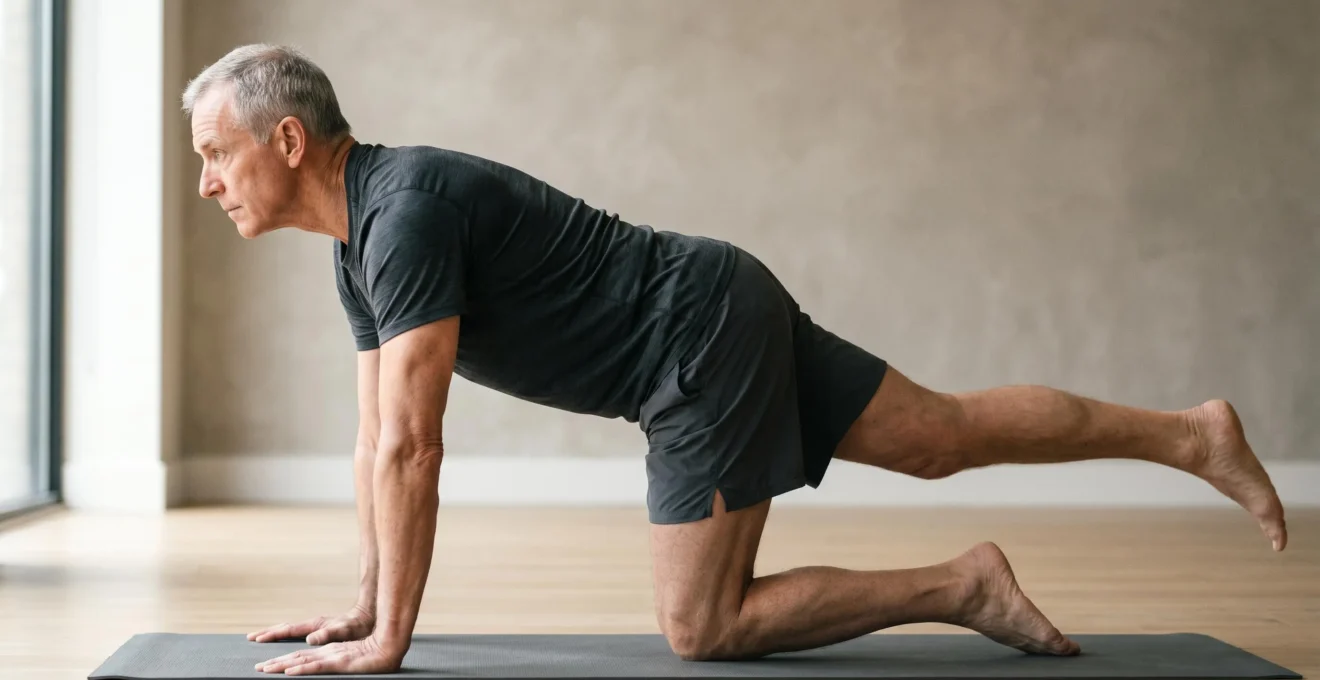
Endless crunches fail to improve posture because they target superficial muscles, ignoring the deep “inner corset” essential for true stability.
- Functional strength comes from activating deep stabilizing muscles like the Transverse Abdominis (TVA), multifidus, and side-glutes.
- Weakness in this deep core system is the root cause of common issues like inward-collapsing knees, poor balance, and even “text neck.”
Recommendation: Shift your focus from traditional ab exercises to precise, gentle activation of your deep core to build a strong, stable foundation from the inside out.
You’ve been diligent, incorporating abdominal crunches and planks into your routine, hoping to strengthen your core, stand taller, and feel more stable. Yet, the slouched posture persists, you feel unsteady on your feet, and that nagging ache in your lower back hasn’t budged. This frustrating paradox is common, and it stems from a fundamental misunderstanding of what the “core” truly is. The visible “six-pack” muscle (rectus abdominis) that crunches work is only the outermost layer. It’s designed for flexing the spine, not for stabilizing it.
The real powerhouse for posture and stability lies much deeper. Imagine an inner corset that wraps around your entire midsection, from your lower ribs to your pelvis. This is your Transverse Abdominis (TVA), the deepest layer of your abdominal wall. Working in concert with other deep muscles like the tiny multifidus along your spine and your side-glutes (gluteus medius), it creates intra-abdominal pressure. This internal support system stabilizes your spine and pelvis *before* you even move a limb. When this foundational system is weak or inactive, no amount of superficial strengthening can fix the resulting instability. The body is forced to compensate, leading to a cascade of issues from your neck down to your knees.
But what if the key wasn’t more effort, but more awareness? What if, instead of crunching, the solution was to gently reawaken this deep, intelligent system? This article will guide you through the anatomy of true stability. We will explore why a weak “inner corset” manifests in surprising ways, from wobbly ankles to bumping into doorframes. More importantly, you will learn precise, anatomy-focused techniques to reactivate these essential deep muscles, building a foundation for safer movement, better posture, and lasting strength, no crunches required.
To help you navigate this deep dive into functional strength, this guide is structured to address the most common symptoms of deep core weakness and provide targeted solutions for each. Discover how to build stability from the inside out.
Summary: Unlocking Your Deep Core for Postural Strength
- Why Weak Side-Glutes Cause Your Knees to Collapse Inward?
- The One-Leg Stand: How to Wobble-Proof Your Ankles?
- Multifidus Muscles: The Deep Back Muscles That Stop Spasms
- The “Text Neck” Fix: Strengthening Deep Neck Flexors
- How Core Stability Helps You Get Out of a Low Car Seat?
- Yoga or Pilates: Which Is Better for Arthritic Spines?
- What Is Proprioception and Why Does It Fade After 60?
- Why Do You Keep Bumping Into Doorframes and How to Stop It?
Why Weak Side-Glutes Cause Your Knees to Collapse Inward?
A common and telling sign of deep core weakness is a movement pattern called “knee valgus,” where the knees collapse inward during activities like walking, climbing stairs, or standing up from a chair. While it may seem like a knee or leg issue, its origin is often much higher up the kinetic chain: in your hips. The gluteus medius, or “side-glute,” is a critical muscle located on the side of your hip. Its primary job is to stabilize your pelvis when you are on one leg—which happens with every single step you take.
When the gluteus medius is weak, it can’t hold the pelvis level. This causes the thigh bone (femur) to rotate inward and adduct (move toward the midline), pulling the knee along with it. This creates a dysfunctional alignment that puts immense stress on the knee joint, potentially leading to pain and cartilage wear over time. This isn’t just theory; research has consistently demonstrated that weakness in hip abduction and external rotation muscles is linked to knee valgus during dynamic tasks. It’s a classic example of how a weak link in the body’s core structure forces dangerous compensations elsewhere.
The solution isn’t to simply think “knees out.” You must retrain the brain-to-muscle connection with the gluteus medius. It’s about teaching this key stabilizer to fire at the right time. By focusing on hip stability, you provide the structural support that allows your knees, ankles, and feet to track correctly and safely. A simple way to begin integrating this is by being mindful during everyday movements, such as getting up from a chair.
- Before standing from a chair, engage your TVA with a gentle hollowing sensation (feel for a tightening just inside your hip bones).
- As you begin to rise, consciously activate your side-glutes by thinking of pressing your knees slightly outward against an imaginary resistance band.
- Maintain a stable “foot tripod” with the base of your big toe, little toe, and heel firmly planted throughout the movement.
- Complete the stand with your pelvis level and your knees tracking straight over your second toe.
- Practice 5-10 repetitions during your normal chair transfers to retrain this healthy pattern.
The One-Leg Stand: How to Wobble-Proof Your Ankles?
If you feel excessively wobbly when standing on one leg, your first instinct might be to blame weak ankles. While ankle strength is a factor, persistent instability often points back to a disengaged core. Your body’s balance system works from the center outwards. The deep “inner corset,” particularly the Transverse Abdominis, acts as your central anchor. When it’s properly engaged, it creates a rigid, stable trunk, providing a solid platform from which your limbs can move and balance.
If this central stability is missing, your body is like a flagpole with a loose base. Your nervous system will desperately recruit smaller muscles further down the kinetic chain—like those in your ankles and feet—to try and manage the instability. This over-recruitment leads to the frantic, wobbly corrections you feel in your ankle. It’s an inefficient and exhausting strategy. By adopting a “core-first” approach to balance, you can significantly reduce the burden on your ankles. Personal trainers working with seniors have observed that focusing on deep core activation before attempting balance exercises dramatically improves stability and decreases wobbling during single-leg stands.
This method trains your deepest muscles to do their primary job: stabilizing the body. This allows your ankles to focus on their job: making small, fine-tuning adjustments. This not only makes you feel more secure but also improves your proprioception—your brain’s sense of where your body is in space.
As you see in the image, true balance is a full-body endeavor originating from a strong center. The goal is not to “freeze” the ankle but to create such profound central stability that the ankle can relax and respond with greater precision. It’s about building a solid foundation so the rest of the structure can stand firm.
Multifidus Muscles: The Deep Back Muscles That Stop Spasms
Lower back pain and sudden spasms are often blamed on weak “back muscles” in a general sense. However, the true culprit is frequently the atrophy of a very specific and deep set of muscles: the multifidus. These small but mighty muscles run along both sides of your spine, connecting individual vertebrae to one another. They don’t produce large movements; instead, their crucial function is to provide segmental stabilization. They make tiny adjustments to control the position of each vertebra, protecting your spinal cord and discs from excessive shearing forces during movement.
When the multifidus muscles are weak or inactive—a common consequence of a sedentary lifestyle or previous injury—the larger, more superficial back muscles (like the erector spinae) are forced to take over this delicate stabilizing role. This is a job they are not designed for. They are “mobilizers,” meant for large movements like bending and extending. When forced into a constant state of tension to guard the spine, they quickly become fatigued, overworked, and prone to painful spasms. As the Yoga Journal Editorial Team notes, this deep muscle is uniquely vital for spinal health.
Because the multifidus muscles are positioned close to the bones of the spine and cross over multiple joints, they are crucial to each vertebra’s position in relation to its neighbors above and below.
– Yoga Journal Editorial Team, This Little-Known Muscle Can Help Prevent Big Back Pain
Reactivating the multifidus requires a subtle, internal focus, not heavy lifting. It’s about developing neuromuscular awareness. The following visualization technique can help you find and engage these deep spinal stabilizers without tensing the larger, superficial muscles.
Your Action Plan: The Multifidus Swell Technique
- Lie on your back with your knees bent, feet flat on the floor, and spine in a neutral position (maintaining the small, natural curve in your lower back).
- Place your fingertips on the muscles of your lower back, just to the side of your spine on both sides.
- Without arching or flattening your back, visualize the deep muscles under your fingertips gently ‘swelling’ or ‘plumping up’ to fill the space.
- Imagine you are creating length and support from within, like an internal cushion for your spine.
- Hold this gentle internal pressure for 10 seconds while breathing naturally, then release. Repeat for 3 sets.
The “Text Neck” Fix: Strengthening Deep Neck Flexors
That familiar forward head posture, often dubbed “text neck,” is a growing concern for people of all ages, but it becomes particularly problematic as we get older. The common advice is to do “chin tucks” and strengthen the neck. While not wrong, this approach misses the root of the problem. In many seniors, forward head posture isn’t an isolated neck issue; it’s a compensation for a collapsed core and poor thoracic (mid-back) posture. This becomes more critical as we age, since research on aging demonstrates that starting around our mid-40s, we lose muscle mass, with deep stabilizers often declining the most.
Think of your spine as a stack of blocks. If the foundation—your pelvis and lumbar spine—is unstable due to a weak TVA, the thoracic spine will slump forward. To keep your eyes level with the horizon, your brain’s only option is to jut your head forward and up. Your head, which weighs about 10-12 pounds, is now cantilevered out in front of your body, putting enormous strain on the muscles in the back of your neck and compressing the vertebrae. Merely trying to pull your head back without first fixing the foundation is like trying to straighten the top of a leaning tower without addressing its base. It’s a temporary fix at best.
Case Study: The Core-First Approach to Text Neck
Physical therapists have documented that forward head posture in older adults often signifies a compensation for a collapsed core rather than isolated neck weakness. When the torso slumps due to a weak TVA and mid-back muscles, the head juts forward to counterbalance. Clinical experience shows that treatment protocols strengthening the deep core foundation alongside neck-specific exercises produce superior and more lasting improvements in head alignment compared to interventions focusing only on the neck.
The solution is a two-pronged approach. First, re-establish your foundational support by engaging your TVA and strengthening your mid-back postural muscles. This creates a stable platform for your head and neck. Once that support is in place, you can then effectively work on strengthening the deep neck flexors with exercises like gentle, supported chin nods. This integrated strategy addresses the cause, not just the symptom.
How Core Stability Helps You Get Out of a Low Car Seat?
Getting out of a low, soft car seat is one of the most challenging everyday movements for many seniors. It requires a significant amount of strength, coordination, and stability. Often, people try to solve this with momentum, rocking back and forth, or by pulling on the door frame, which can be unstable and unsafe. The secret to a safe and efficient exit lies not in your arms or legs, but in your ability to generate and maintain intra-abdominal pressure—the core function of your TVA.
When you engage your TVA, it tightens like a corset, increasing pressure within your abdominal cavity. This turns your flexible, vulnerable torso into a rigid, solid cylinder. This “bracing” strategy provides immense support for your lumbar spine, allowing you to transfer force effectively from your legs through your trunk to initiate the lift. Without this internal brace, your spine is unstable. Attempting to stand forces your lower back to hinge and twist under load, a primary mechanism for disc injury and muscle strain. This is why you may feel a “tweak” or sharp pain in your back during this exact movement.
The key is to create this stability *before* you even start to move. It’s a preparatory step that protects your spine and makes the entire movement more powerful and efficient. The following “pre-flight check” can be performed in just a few seconds before you exit any vehicle.
Your Checklist: Auditing Your Movement for Core Engagement
- Points of Contact: Identify a daily movement where you feel weak or unstable (e.g., standing from a low chair, lifting groceries, stepping over a curb).
- Collect Data: For one day, pay close attention to how you perform this movement. Do you hold your breath? Do you twist your back? Do you use your arms to pull yourself up?
- Analyze for Coherence: Compare your current strategy to the “foundation-first” principle. Are you bracing your core *before* you move, or is your core an afterthought?
- Assess Sensation: During the movement, can you feel a deep, gentle tension inside your hip bones (your TVA), or do you only feel strain in your back or neck?
- Plan Integration: For the next week, practice the “10-Second Pre-Flight Check” before performing this specific movement every single time to build a new, safer habit.
Yoga or Pilates: Which Is Better for Arthritic Spines?
When managing an arthritic spine, movement is medicine, but the *type* of movement is critical. Both Yoga and Pilates are renowned for improving flexibility and core strength, but they approach spinal stability from different perspectives, making one potentially more suitable than the other depending on your specific needs. For arthritis, the goals are typically to strengthen deep stabilizing muscles, improve mobility without going into painful end-ranges, and decompress the spine.
Yoga often involves holding static postures (asanas) and flowing through sequences. While many poses are excellent for building strength and balance, some styles of yoga can emphasize deep spinal flexion (forward folds) or extreme twisting, which may aggravate arthritic joints. The focus on deep core muscles like the multifidus can vary significantly depending on the instructor’s training and cues.
Pilates, particularly equipment-based Pilates on the Reformer, was designed from the ground up with a focus on controlled movement originating from a stable core. Every exercise begins with the engagement of the TVA and other deep stabilizers. The spring-based resistance of the Reformer is unique in that it can be used to either challenge muscles or to *support* and offload the joints, allowing for movement through a safe range of motion without compression. This makes it highly adaptable for individuals with spinal limitations. The emphasis is consistently on slow, precise movements, which helps avoid the momentum that can lead to injury.
The following table breaks down the core training principles of each discipline as they relate to an arthritic spine. A recent comparative analysis of core exercises highlights these distinctions.
| Evaluation Criteria | Yoga | Pilates |
|---|---|---|
| Deep Core Focus (TVA/Multifidus) | Emphasized in specific poses (Warrior III, Bird Dog, planks) | Primary focus in all exercises with consistent cueing |
| Equipment Support | Primarily mat-based, minimal equipment | Reformer provides spring-based resistance to offload spine |
| Controlled Movement Emphasis | Static holds dominant, some flow sequences | Slow, controlled movement throughout full range |
| Spinal End-Range Avoidance | Varies by style—some include deep twists/forward folds | Generally avoids extreme spinal flexion/rotation |
| Modification Availability | Depends heavily on instructor training | Built into progressive reformer spring settings |
What Is Proprioception and Why Does It Fade After 60?
Have you ever closed your eyes and known exactly where your hands are in space? That “sixth sense” is proprioception: your body’s ability to perceive its own position, movement, and orientation. It’s a constant stream of information sent from millions of tiny sensors in your muscles, tendons, and joints to your brain. This sense is fundamental to every coordinated movement you make, from buttoning a shirt to walking on an uneven surface. It’s what allows you to navigate the world without constantly looking at your own feet.
Unfortunately, proprioception naturally declines with age. The sensors become less sensitive, and the speed at which the brain processes their signals slows down. This is a significant, though often invisible, aspect of aging. In fact, a 2023 study published in Frontiers in Human Neuroscience found that older adults show considerable decline in nearly all proprioceptive parameters compared to younger adults. This fading body awareness is a major contributor to an increased risk of falls. When your brain has a “fuzzy” map of where your body is, it’s slower to react to a sudden trip or loss of balance.
The good news is that proprioception can be retrained. Just like a muscle, the system benefits from being challenged. The key is to introduce novel, safe challenges that force your brain to pay closer attention to the signals it’s receiving from your body. This isn’t about heavy lifting; it’s about waking up the nervous system and recalibrating your internal GPS. The following simple challenges can help reboot your body awareness.
- Balance on Different Surfaces: Practice standing on a firm pillow or a folded towel for 30 seconds daily to challenge your ankle sensors.
- Walk Backward: Slowly walk backward in a clear, safe hallway. This forces your brain to process spatial information in a non-habitual way.
- Use Your Non-Dominant Hand: Practice picking up small, light objects (like a sock) with your non-dominant hand to activate different neural pathways.
- Head Turns on One Leg: While standing on one leg (holding onto a counter for support), slowly turn your head from left to right. This integrates your vestibular (inner ear balance) and proprioceptive systems.
- Close Your Eyes: During a familiar and safe movement like marching in place, briefly close your eyes to remove visual compensation and force your body to rely on its internal sense.
Key Takeaways
- True core strength is about the deep “inner corset” (TVA, multifidus), not superficial ab muscles.
- Many common senior issues like knee pain, poor balance, and text neck are symptoms of a weak deep core.
- Reactivating deep core muscles requires gentle, precise, and conscious activation, not brute force exercises like crunches.
Why Do You Keep Bumping Into Doorframes and How to Stop It?
It’s a frustrating and surprisingly common experience: consistently misjudging your space and bumping a shoulder or hip on a doorframe or piece of furniture. This isn’t just a matter of being clumsy; it’s a direct, physical manifestation of declining proprioception. Your brain maintains an internal “map” of your body, known as your body schema. This map includes your dimensions—your height, your width, and the space you occupy. When your proprioceptive feedback is sharp, this map is accurate, and you navigate your environment effortlessly.
As proprioception fades with age, this internal map can become outdated or “fuzzy.” Your brain may still be operating on a schema from a decade ago, or it simply isn’t receiving clear, real-time data about your body’s outline. This is why you might think you have enough room to pass through a doorway, only to find out you were off by an inch. These minor bumps are more than just an annoyance; they are warning signs of the same sensory decline that contributes to major falls. Indeed, according to CDC data, more than one out of four older people falls each year, and these seemingly small spatial misjudgments are part of that risk profile.
The solution is to actively retrain your brain and update its body map. You can do this by consciously bringing your attention to your body’s dimensions and its relationship to the space around it. The “Doorframe Drill” is a simple but powerful exercise in mindfulness and proprioceptive recalibration. It forces your brain to pay attention and create a more reliable spatial reference.
Your Action Plan: The Doorframe Drill for Spatial Awareness
- Stand facing a doorway in a comfortable, relaxed stance.
- Gently engage your TVA (the “inner corset” zipping up) and draw your shoulders back and down, creating a sense of your body’s true width.
- Consciously “shrink” your body schema by drawing your awareness to your centerline, imagining a plumb line running through your body.
- Walk through the doorway very slowly, maintaining full awareness of the space between your shoulders and the frame on both sides.
- Repeat this 5-10 times daily, gradually increasing your speed only as your confidence and spatial accuracy improve.
By shifting your focus from superficial muscles to this deep, intelligent system, you are not just exercising; you are investing in a foundation of stability that will support every move you make. To apply these principles effectively, the next logical step is to seek guidance from a qualified Pilates or physical therapy professional who can assess your specific movement patterns and provide personalized instruction.