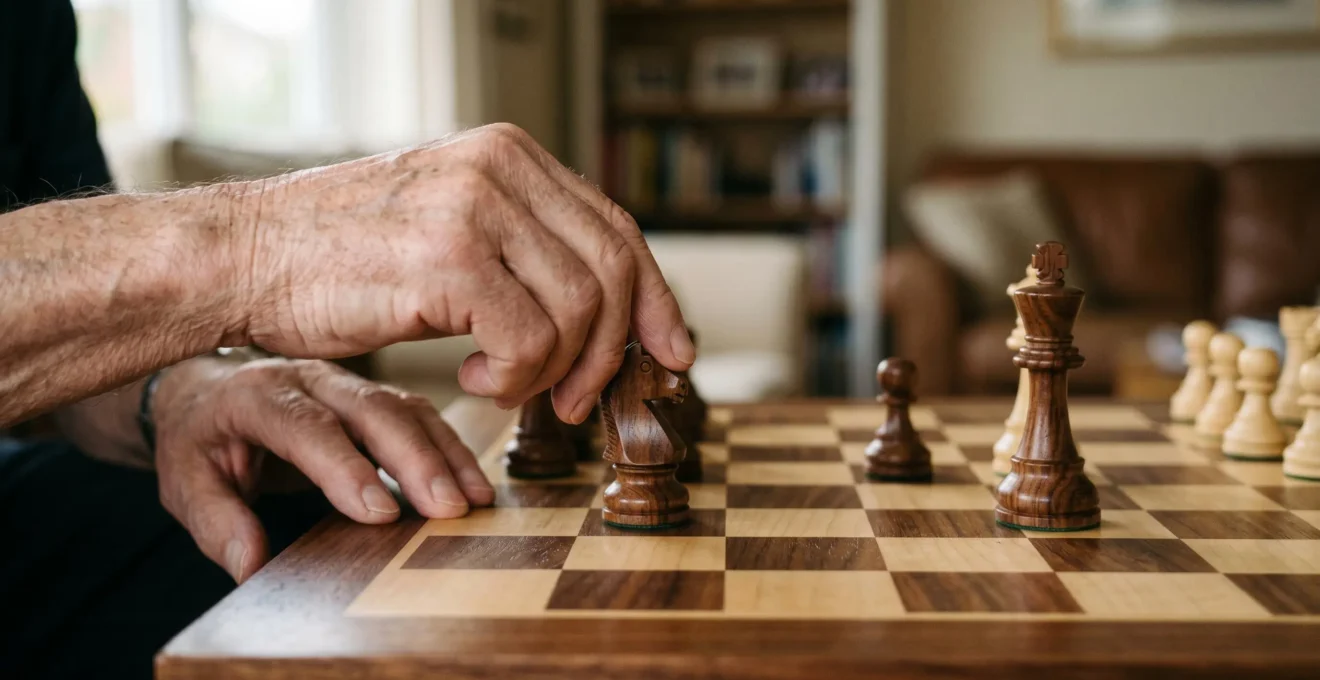
Playing ‘brain games’ isn’t enough; the key to preventing cognitive decline lies in choosing games that create specific, challenging cognitive loads, not just occupying time.
- Strategy games like Chess and Bridge actively build executive functions in the brain’s frontal lobe, a benefit not found in games of pure chance like Bingo or Ludo.
- The social and emotional demands of partner games are a crucial form of brain training, enhancing empathy and emotional regulation circuits.
Recommendation: Actively seek out games that cause slight frustration and require new learning. This feeling of “effortful struggle” is the most potent sign that you are triggering genuine neuroplasticity and building a more resilient brain.
For any senior keen on maintaining mental sharpness, the advice to “play brain games” is as common as it is vague. The market is flooded with apps, puzzles, and books all promising to be a workout for your mind. We’re told that completing a daily crossword or a Sudoku puzzle is a non-negotiable part of a brain-healthy routine. But as a ludologist—someone who studies games—I can tell you that not all games are created equal. The belief that any mental stimulation is as good as another is a comforting but ultimately misleading platitude.
The real question isn’t whether you should play games, but *which* games you should play, and *why*. Does a fast-paced game of Bingo offer the same cognitive protection as a slow, deliberate game of Chess? Is your solo word game on a tablet building the same mental muscles as a boisterous Scrabble match with friends? The answer, based on a growing body of evidence, is a definitive no. The cognitive benefits of a game are not magical; they are the direct result of the specific, measurable demands it places on your brain’s intricate networks.
This article moves beyond the generic advice. We will dissect the mechanics of popular games to reveal what’s really happening inside your brain when you play. Instead of just accepting that games are “good for you,” we’ll explore why the calculated planning in Chess strengthens your frontal lobe, how navigating a difficult partner in Bridge is a form of emotional resilience training, and why the frustrating process of learning something new is the most powerful catalyst for cognitive growth. The goal is to equip you with a new framework for choosing activities that don’t just entertain, but actively build a more robust and resilient mind for years to come.
This guide breaks down the science behind effective brain-training games, providing a clear roadmap to help you distinguish between mere diversion and genuine cognitive enhancement. By understanding the underlying principles, you can make informed choices about how to invest your leisure time for the greatest possible return on your brain health.
Summary: Bridge or Bingo: A Ludologist’s Guide to Brain-Boosting Games
- Why Chess Beats Ludo for Frontal Lobe Activation?
- Words with Friends App vs Scrabble Club: Is the Brain Benefit the Same?
- Why Managing a Bad Partner in Bridge Is Emotional Training?
- The Frustration Phase: Why You Must Lose to Grow New Neurons?
- Daily Crossword or Weekly Poker: What Is the Optimal Dose?
- The 3-Month Rule: How Long Must You Persist for Brain Changes?
- Memorising the “Form”: Why Tai Chi Is Also Brain Training?
- Why Watching “Countdown” Is Not Enough to Keep Your Brain Sharp?
Why Chess Beats Ludo for Frontal Lobe Activation?
At first glance, both Chess and Ludo are board games involving strategy and turn-based play. However, from a neurological perspective, they are worlds apart. The difference lies in the type and intensity of the cognitive load they impose. Ludo is primarily a game of chance; your decisions are heavily constrained by the roll of a die. Chess, in contrast, is a game of perfect information and deep strategy. It demands foresight, pattern recognition, and the ability to hold multiple future scenarios in your mind at once—a set of skills known as executive functions.
These executive functions are primarily managed by the frontal lobe, the brain’s command center. When you contemplate a multi-step checkmate sequence or sacrifice a piece for a long-term positional advantage, you are giving your frontal lobe a strenuous workout. This isn’t just a metaphor; neuroscience research shows that the cognitive architecture of expert players is different. A deep dive into player neurology by Grandmaster chess players reveals more activity in their frontal and parietal lobes compared to non-players. Their brains aren’t just working harder; they’re working differently, with functionally reorganized modules orchestrated by the frontal lobe.
This is why Chess is neurologically superior to Ludo for cognitive preservation. Ludo provides light engagement, but Chess forces the brain to practice the very skills—planning, inhibition, and flexible thinking—that are most vulnerable to age-related decline. It’s the difference between a leisurely stroll and a session of high-intensity interval training; both are movement, but only one fundamentally improves the system’s capacity.
Words with Friends App vs Scrabble Club: Is the Brain Benefit the Same?
In the digital age, the classic word game has split into two distinct experiences: the asynchronous, often solitary, play of an app like Words with Friends, and the face-to-face, real-time engagement of a traditional Scrabble club. While both involve vocabulary and spatial reasoning, the neurological and social benefits are not interchangeable. The difference is rooted in the rich, multi-sensory feedback of physical interaction versus the streamlined, often isolated, nature of screen-based play.
The physical act of handling tiles, placing them on the board, and interacting with opponents in the same room engages more than just the visual and language centers of the brain. It involves fine motor skills, tactile feedback, and a complex layer of social negotiation. This distinction is supported by science; a 2023 study in PLOS One found that board gaming specifically enhances fluid intelligence and social performance, while video gaming tends to improve different areas like attention and visuospatial working memory. The social component of a Scrabble club—reading opponents’ reactions, engaging in friendly banter, sharing in the collective experience—activates entirely different neural pathways related to empathy and social cognition.
As the image above so vividly captures, the tactile connection to a game is a powerful, often overlooked, element of cognitive engagement. The app might offer convenience and a quick dopamine hit from a high-scoring word, but it strips away the rich sensory and social context that makes a physical board game a more holistic brain workout. While any active wordplay is better than none, the evidence suggests that for building well-rounded cognitive and social resilience, the tangible, communal experience of a Scrabble club holds a distinct advantage.
Why Managing a Bad Partner in Bridge Is Emotional Training?
Bridge is widely recognized as one of the most cognitively demanding card games, renowned for its requirements of memory, logic, and strategic bidding. It consistently ranks as a top activity for preserving mental acuity. However, its most unique and perhaps most powerful brain-training element is often overlooked: the partner. Unlike solo games, your success in Bridge is inextricably linked to the performance of another person, creating a complex dynamic of cooperation, communication, and, frequently, frustration.
When your partner makes an inexplicable bid or a disastrous play, your reaction is more than just a social moment; it’s a real-time test of your emotional regulation, a key executive function. The ability to manage your frustration, suppress a critical impulse, and adapt your strategy to your partner’s unexpected move is an intense workout for the parts of the brain responsible for emotional control and social cognition. This is not just theory; the social layers are integral to the game’s cognitive impact. As the Bridge Champ Research Team notes, “Reading your partner’s intentions, interpreting opponents’ strategies, and managing emotions are all essential parts of the experience.”
They explain that these social layers activate areas of the brain linked to empathy, emotional regulation, and theory of mind. In essence, navigating a “bad” partner is not a bug, but a feature. It forces you to become a better mentalist—to infer another person’s thought process from limited clues and to adjust your own behavior for a better collective outcome. A long-term study across retirement communities documented the profound effects, showing superior preservation of working memory among regular bridge players. While the card-play sharpens logic, it is the partnership dynamic that hones the crucial social and emotional intelligence that is vital for healthy aging.
The Frustration Phase: Why You Must Lose to Grow New Neurons?
In our goal-oriented culture, we often see failure and frustration as signs to quit. In the world of neuroscience and effective learning, however, they are signals that you are doing something profoundly right. The feeling of struggling, of making errors, of not quite being able to master a new skill—this is the very sensation of neuroplasticity at work. It’s the moment your brain is being pushed beyond its current capabilities, creating the perfect conditions for growth.
This “frustration phase” is not just a psychological phenomenon; it’s a biological one. When you are engaged in what researcher Eva Keiffenheim calls “effortful, error-filled practice,” your brain chemistry changes. This struggle triggers the release of a crucial protein called Brain-Derived Neurotrophic Factor (BDNF). As Keiffenheim puts it, BDNF “shows up when your brain is working hard — in the gap between what you’re trying to do and what you can currently do.” It is the brain’s own fertilizer, encouraging the growth of new neurons and strengthening the connections between existing ones.
This link is fundamental to learning at any age. As neuroscience research shows, BDNF is regarded as the most active neurotrophin and is crucial to learning and memory. This means that if a new game or skill feels easy from the start, it’s likely not providing a significant cognitive benefit. You must seek out the challenge, embrace the mistakes, and persist through the discomfort. Losing a game of Chess, fumbling a new chord on the guitar, or forgetting a step in a new dance routine are not failures; they are the necessary ingredients for building a stronger, more adaptable brain.
Your Neuroplasticity Check-up: 5 Signs You’re Truly Training Your Brain
- Identify the Struggle: Can you pinpoint a specific moment in your game or activity this week where you felt genuinely stuck or frustrated? (e.g., A specific Chess puzzle, a difficult Bridge hand).
- Analyze the Error: Review one mistake you made. Can you articulate exactly what you did wrong and what a better move would have been? Write it down.
- Seek New Knowledge: Have you actively looked up a new strategy, rule, or technique related to your game in the last seven days? (e.g., Watched a tutorial, read an article).
- Measure Micro-Progress: Can you identify one small thing you can do now that you couldn’t do last month? (e.g., “I now consistently spot the ‘fork’ tactic in Chess”).
- Schedule the Next Challenge: Plan your next session. Intentionally choose a slightly harder opponent, a more complex puzzle, or a new variation of the game to tackle.
Daily Crossword or Weekly Poker: What Is the Optimal Dose?
Once you’ve chosen a cognitively demanding game, the next question is one of dosage: how much is enough? Is it better to engage in a light, daily activity like a crossword puzzle, or a more intense but less frequent session like a weekly poker night? The research suggests that both frequency and intensity play important, but different, roles in cognitive maintenance. The optimal “dose” likely involves a combination of both.
Daily, consistent practice reinforces existing neural pathways and can have a significant protective effect over time. This is particularly true for activities that target memory. For example, research from UCLA Health found that regular use of crossword puzzles held off memory decline by a remarkable 2.5 years compared to non-players. This demonstrates the power of consistent, low-stakes engagement in a familiar skill. It’s like daily stretching for the mind—it maintains flexibility and prevents atrophy.
On the other hand, intense, less frequent activities can provide a different kind of benefit by introducing novelty and a higher level of strategic complexity. A weekly poker game, for instance, demands not just mathematical calculation but also social reading, bluffing, and risk management—a multifaceted cognitive challenge. This is supported by studies on the importance of high-level engagement.
Case Study: The Power of High-Level Participation
A Texas A&M University study of older adults with mild cognitive impairment found a striking difference based on their level of engagement in cognitive activities. The group with “high-level participation” in hobbies and games didn’t just slow their decline; they maintained their levels of memory, attention, and processing speed throughout the study. This contrasts with the mid- and low-level groups, who showed a decline. This suggests that the depth and intensity of engagement—the “dose”—are critical factors in whether an activity provides a true protective benefit.
Ultimately, the ideal prescription is not an “either/or” but a “both/and.” A routine of daily, familiar puzzles can keep memory sharp, while periodic deep dives into more complex, strategic games can build and challenge a wider range of executive functions.
The 3-Month Rule: How Long Must You Persist for Brain Changes?
In our world of instant gratification, we expect to see results quickly. But when it comes to rewiring the brain, patience is not just a virtue; it’s a biological necessity. While there’s no single magic number, a common observation in habit formation and skill acquisition is the “3-Month Rule.” This isn’t a strict scientific law, but a practical guideline: it often takes about 90 days of consistent effort for a new behavior to become automatic and for the underlying neurological changes to begin solidifying.
When you start learning a new, complex game, your brain is in a state of high alert and high effort. It’s building new connections, pruning unused ones, and increasing the efficiency of the neural circuits involved. This process, as we’ve seen, is mediated by molecules like BDNF. These changes don’t happen overnight. As highlighted by research in Frontiers in Cellular Neuroscience, “BDNF is a key molecule involved in plastic changes related to learning and memory,” and its expression is critical in brain structures vital for memory. Stabilizing these new pathways requires repetition and time.
Giving up after a few weeks because a game is “too hard” or you’re “not getting it” is like stopping a course of antibiotics before it’s finished. You’ve experienced the initial discomfort without sticking around long enough for the long-term benefits to take root. The first three months are often the most challenging but also the most critical. This is the period where you push through the “frustration phase” and lay the foundational wiring for future mastery. Committing to a new cognitive hobby for a full season is a powerful way to ensure you give your brain the time it truly needs to change.
Memorising the “Form”: Why Tai Chi Is Also Brain Training?
While we often categorize “brain training” as activities involving cards, boards, or screens, this is a narrow view. One of the most potent cognitive workouts involves no equipment at all: Tai Chi. Though practiced for its physical benefits like balance and flexibility, Tai Chi is, at its core, a profound exercise in brain training that engages multiple cognitive systems simultaneously.
The central challenge of Tai Chi is memorizing and executing the “form”—a long, continuous sequence of slow, deliberate movements. This task is a powerful workout for several types of memory. First, there’s procedural memory, the same system used to learn how to ride a bike or type on a keyboard. The brain must encode the complex motor sequence so it can be performed without conscious thought. Second, it heavily taxes spatial memory and proprioception. You must be constantly aware of your body’s position in space—the angle of your arms, the weight distribution on your feet, the turn of your waist—all while moving through a three-dimensional pattern.
Unlike a board game where the “board” is external, in Tai Chi, your body *is* the board, and the game pieces are your limbs. This requires immense concentration and mindfulness, forcing you to link intention, physical movement, and spatial awareness in a continuous flow. This integration of mind and body is a holistic form of cognitive engagement that strengthens the communication between the brain’s motor cortex, cerebellum (for coordination), and hippocampus (for spatial navigation). While it may not feel like a “game,” the act of learning, remembering, and refining a complex physical form is a deeply effective way to build a more integrated and resilient brain.
Key Takeaways
- Active vs. Passive: The core principle of effective brain training is active participation. You must be the one solving, strategizing, and doing, not just watching.
- Challenge is the Catalyst: If a game feels easy, it is likely not providing a significant cognitive benefit. The feeling of effort and even frustration is a sign of neuroplasticity at work.
- Specificity Matters: Different games train different skills. A well-rounded cognitive “fitness” routine should include activities that challenge logic, memory, social/emotional regulation, and spatial reasoning.
Why Watching “Countdown” Is Not Enough to Keep Your Brain Sharp?
Many people feel they are getting a good mental workout by following along with a TV quiz show like *Countdown* or *Jeopardy!*. They try to solve the anagrams or answer the questions before the contestants. While this is certainly more engaging than passive television viewing, it’s crucial to understand the vast neurological difference between being a spectator and being a player. Watching the game is not the same as playing the game, and the cognitive benefits are not transferable.
The fundamental distinction is active participation versus passive observation. When you are the one holding the letters in a Scrabble rack or the cards in a Bridge hand, you are under cognitive pressure. You must generate possibilities, evaluate strategies, make a decision, and live with the consequences. Your brain is fully engaged in a cycle of planning, executing, and receiving feedback. This active, effortful process is what drives neuroplasticity. When watching from the sofa, you are a critic, not a creator. You may spot a solution, but you are not shouldering the cognitive load of generating it from a field of infinite possibilities under pressure.
Even when comparing active digital games to passive viewing, the benefit of “doing” becomes clear. A comprehensive review of studies confirmed that for older adults, computerized brain games can be effective in improving executive function and memory. This benefit comes from the interactive, goal-oriented nature of the activity. It is the act of struggling with the puzzle and finding the solution for yourself that fortifies the brain, not the simple exposure to the puzzle. The brain, like a muscle, does not get stronger by watching others lift weights. It needs to bear the load itself.
The most effective strategy for your cognitive health is to be a discerning player. Don’t just accept a game’s “brain-boosting” claims at face value. Instead, analyze its mechanics. Does it challenge you? Does it force you to think in new ways? Does it involve other people? Does it sometimes make you feel frustrated? If the answer to these questions is yes, you’ve likely found an activity that will do more than just pass the time—it will actively build a stronger, more flexible, and more resilient mind. Your next move is to choose your game and commit to playing it, not just for fun, but for the profound and lasting benefits to your brain.