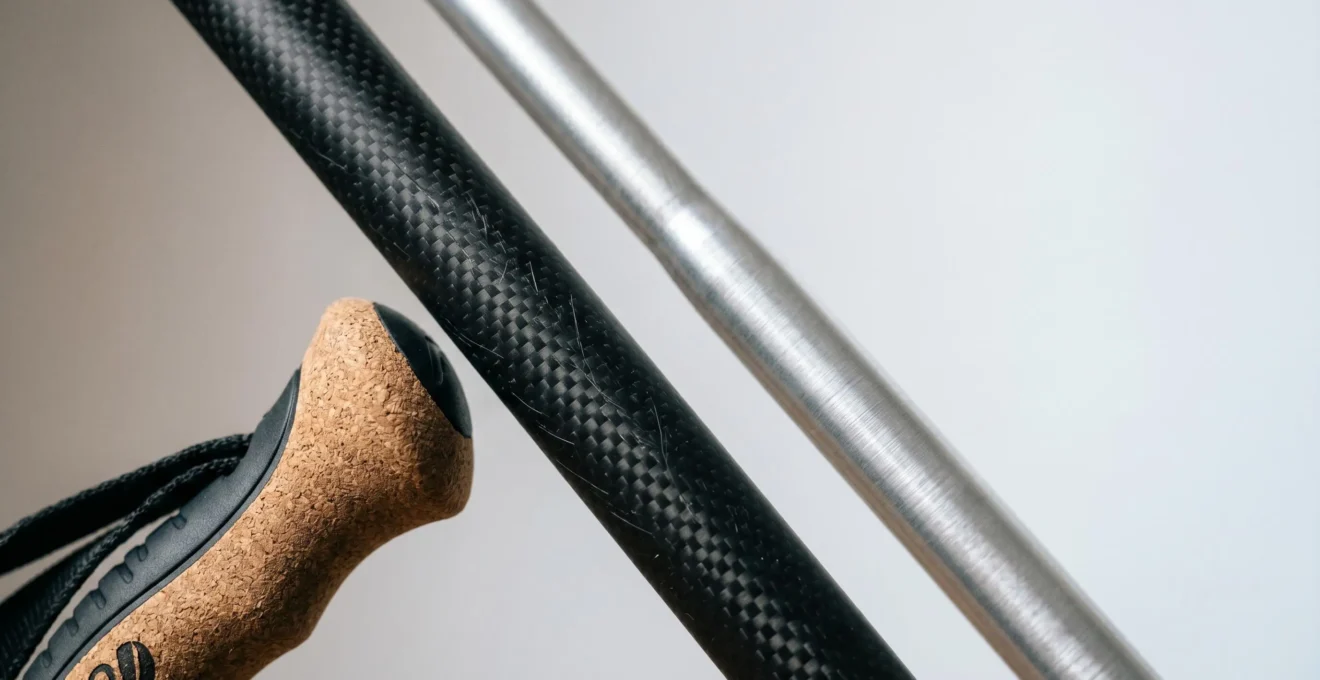
For arthritic wrists, the debate isn’t carbon vs. aluminium, but how the entire pole system minimises vibration and grip force.
- Handle ergonomics and shape are often more critical for pain relief than the pole’s shaft material.
- An effective strap system turns your arm into a lever, transferring power to the ground without requiring a forceful, painful grip on the handle.
Recommendation: Prioritise poles with anatomically shaped grips and gauntlet-style straps to protect your joints, and treat the material (carbon or aluminium) as a secondary choice based on your budget and weight preference.
For seniors looking to maintain an active lifestyle, walking is an unparalleled form of exercise. Yet for many, the very act of moving can be a painful reminder of arthritis. Walking poles are frequently recommended as a solution, offering stability and reducing strain on the lower body. However, this introduces a new problem: what about the hands and wrists, where arthritis is often just as debilitating? A significant portion of the population is affected, with studies indicating that wrist arthritis has a prevalence ranging from 14% to 23% in individuals over 70 years of age.
The common debate quickly becomes “carbon or aluminium?” Carbon is lauded for being lightweight, while aluminium is praised for its durability and lower cost. This is the surface-level discussion, the platitude that misses the point entirely for an arthritis sufferer. The relentless vibrations from the pole striking the ground can travel straight up the shaft and into sensitive wrist joints, potentially making the problem worse. The real question isn’t about a single material, but about the pole as a complete system of levers and dampers designed to protect, not punish, your joints.
But what if the most important feature wasn’t the pole’s shaft at all? What if the secret to comfortable, pain-free walking lay in the design of the handle, the mechanics of the strap, and the way you transfer force to the ground? This guide moves beyond the simplistic material debate. We will dissect the walking pole piece by piece, from the handle you hold to the tip that meets the pavement, to reveal which features truly provide protection and which are just marketing gimmicks. We will analyze the system as a whole to help you select a tool that works with your body, not against it.
This article breaks down the critical components of a walking pole system to help you make an informed decision. The following sections will guide you through each feature, always from the perspective of maximising joint protection and walking comfort.
Summary: Carbon or Aluminium: Which Walking Pole Protects Arthritic Wrists Best?
- The Elbow Angle Rule: How to Set Your Pole Height to Avoid Shoulder Pain?
- Cork vs Rubber Handles: Which Stops Blisters on Fragile Skin?
- Gauntlet Strap vs Loop: Which Offers Better Propulsion for Weak Hands?
- Anti-Shock Springs: Are They a Gimmick or Essential for Knees?
- Telescopic vs Fixed: How to Pack Your Poles for a Coach Trip?
- Grip vs Push: Why Levers Save Your Thumb Joints from Grinding?
- Pavement or Grass: Where Should You Plant Your Tips for Safety?
- Why Is Nordic Walking More Effective Than Regular Walking for Senior Hearts?
The Elbow Angle Rule: How to Set Your Pole Height to Avoid Shoulder Pain?
Before we analyze any component, we must address the most fundamental setup for safety and efficiency: pole height. An incorrectly adjusted pole can cause more problems than it solves, leading to shoulder strain, neck pain, and inefficient posture. The goal is to create a frame that supports your body without forcing your joints into unnatural positions. Getting this right is the first step in creating a functional system.
The universally accepted starting point is the 90-degree elbow rule. When you are standing upright in your walking shoes, holding the pole grip with the tip on the ground by your foot, your elbow should form a roughly 90-degree angle. This position ensures your arm can swing naturally from the shoulder, providing propulsion without unnecessary lifting or shrugging, which can aggravate shoulder joints.
As one expert from the Arthritis Foundation advises, this is a guideline, not an ironclad law. According to Martica Heaner, PhD:
your elbows should generally be at about 90 degrees when you hold the pole tips by your toes, although that may vary for comfort
– Martica Heaner, PhD, Arthritis Foundation – Why Try Nordic Walking
This “variation for comfort” is crucial for individuals with existing shoulder issues. If a strict 90-degree angle causes discomfort, try shortening the pole by a centimetre or two. This slightly more open angle can reduce the strain on the rotator cuff during the push-off phase. Conversely, for steep downhill sections, lengthening the poles can provide better stability and braking power. The key is to listen to your body and treat the 90-degree rule as your baseline for flat terrain, adjusting as needed for comfort and topography.
Cork vs Rubber Handles: Which Stops Blisters on Fragile Skin?
The handle is the primary interface between you and the pole; for an arthritis sufferer, it’s the most critical component for comfort. While material is part of the story, the shape, or ergonomics, is paramount. The wrong handle forces your hand into a stressful gripping position, aggravating thumb and wrist joints. The right handle supports the natural curve of your hand, allowing you to push off without a tight, painful grip.
Common materials include cork, rubber, and EVA foam. Cork is excellent at absorbing sweat and has a natural feel, but it can be firm and potentially abrasive on very fragile skin. Rubber offers a secure grip but can become slick with sweat and may cause friction hotspots. EVA foam is soft and light, but it absorbs moisture and can feel less secure. The illustration below highlights the distinct surface textures of these materials.
As you can see, the texture varies significantly. Cork’s cellular structure provides a unique feel, while foam is more uniform. However, for severe arthritis, the material choice is often secondary to the handle’s ergonomic design. An anatomically shaped handle can distribute pressure across the palm, drastically reducing the strain on any single joint, a principle powerfully illustrated in the following case.
Case Study: Ergonomic Grip Effectiveness
A hiker with severe arthritis, carpal tunnel syndrome, and nerve damage reported that specialised ergonomic grips were the only solution that eliminated hand and wrist pain. The anatomically shaped grips allowed them to continue hiking despite multiple wrist fractures, demonstrating that handle design, which promotes a pushing motion rather than a squeezing grip, can be far more critical than the surface material for managing arthritis.
This shows that focusing solely on “cork vs. rubber” misses the bigger picture. Look for handles that are shaped to fit a relaxed hand, with a distinct ledge for the heel of your hand to push against. This design transforms the handle from something you must grip tightly into a lever you can simply push.
Gauntlet Strap vs Loop: Which Offers Better Propulsion for Weak Hands?
If the handle is the primary interface, the strap is the key to unlocking true efficiency and reducing hand strain. The purpose of a good strap system is to transfer the propulsive force from your arm directly to the pole shaft, largely bypassing the need for a strong grip. For someone with weak or painful hands, this is not a luxury; it’s a necessity.
There are two main types of straps. The first is the simple loop strap, common on budget and trekking poles. This is a basic webbing loop that goes around your wrist. While it prevents you from dropping the pole, it does little to aid in propulsion and can even cause chafing on the wrist. To push off effectively with a loop strap, you still need to maintain a firm grip on the handle.
The second, and far superior for this purpose, is the gauntlet strap or “glove” strap, a hallmark of true Nordic walking poles. This system functions like a fingerless glove that attaches directly to the pole. It cradles your hand, allowing you to completely relax your grip on the push-off phase of your stride. The force is transferred from your arm, through the strap, and into the pole. Your hand simply guides the pole; it doesn’t need to squeeze it. This is the ‘push’ technique that saves joints, as opposed to the painful ‘grip’ technique.
Even with a good strap, some minimal gripping might be required for control, but the reduction in constant pressure is significant. The strap allows you to have a relaxed, open hand for much of the walking motion, which is a game-changer for reducing fatigue and pain in arthritic finger and thumb joints. When evaluating poles, the presence of a well-designed, comfortable gauntlet strap should be a high-priority feature, often more important than the pole’s material.
Anti-Shock Springs: Are They a Gimmick or Essential for Knees?
The concept of “anti-shock” systems in walking poles is immediately appealing, especially for someone with sore joints. The promise is simple: a spring mechanism inside the pole compresses on impact, absorbing the jarring force before it travels up to your wrists, elbows, and shoulders. But does the reality match the marketing, and is it a necessary feature?
For low-frequency, high-impact events—like a sharp pole plant on hard asphalt—an anti-shock spring does provide a degree of cushioning. This can be beneficial for those with sensitive knees or hips, as it dampens the initial shockwave. However, the system has drawbacks. Firstly, it adds weight, complexity, and cost to the pole. The spring mechanism is another potential point of failure. Secondly, some walkers find the “bouncy” feeling disconcerting and feel it reduces their sense of connection with the ground.
More importantly for arthritic wrists, a simple spring doesn’t address the full spectrum of forces at play. While it dampens the initial large impact, it may not be effective against the high-frequency vibrations that can be a major source of aggravation for arthritic joints. A carbon fibre shaft, due to its material properties, may naturally dampen these smaller, more persistent vibrations better than an aluminium pole, even one with a spring. The feel can be a dull “thud” with carbon versus a sharper “ping” with aluminium.
The verdict? Anti-shock is not a pure gimmick, but it’s not a magic bullet either. It can be helpful for downhill walking on hard surfaces to protect knees. However, for wrist arthritis, its benefits are less clear. A better “system” for vibration dampening might be a combination of a carbon shaft, a thick cork handle, and padded gloves, rather than relying solely on a mechanical spring. From a budget-aware perspective, it’s often a feature you can forgo in favour of investing in better grips or straps.
Telescopic vs Fixed: How to Pack Your Poles for a Coach Trip?
The choice between fixed-length and telescopic (adjustable) poles is primarily one of convenience versus performance. Telescopic poles, which collapse into two or three sections, are undeniably practical for travel and storage. If you plan to take your poles on a coach trip, plane, or simply want to stow them in a small car boot, their collapsibility is a major advantage.
However, this convenience comes at a technical price. Each joint in a telescopic pole is a potential point of weakness and a source of vibration. As the image below shows, the locking mechanism, whether a twist-lock or a flick-lock, interrupts the structural integrity of the shaft. A lower-quality lock can slip under pressure—a significant safety concern—or rattle during use, creating the kind of high-frequency vibration that is particularly irritating to arthritic wrists.
Fixed-length poles, on the other hand, are a single, continuous shaft. They are inherently stronger, lighter, and better at dampening vibration because there are no joints to interrupt the flow of energy. The feeling is one of superior stability and connection to the ground. The downside is obvious: they are cumbersome to transport. You must also purchase the exact correct length for your height, with no room for adjustment.
For the senior walker, the choice depends on lifestyle. If you exclusively walk from your front door, a pair of fixed-length carbon poles will offer the best performance in terms of low weight and vibration dampening. For example, well-made carbon fiber poles are typically 20-30% lighter than their aluminum counterparts. However, if travel is part of your routine, a high-quality telescopic pole with a reliable locking system is the more practical choice. In this case, it is worth investing in a reputable brand known for secure, silent locking mechanisms to minimise the inherent compromises.
Grip vs Push: Why Levers Save Your Thumb Joints from Grinding?
We now arrive at the core biomechanical principle that separates painful walking from protected walking: using the pole as a lever to push, not an object to grip. For a person with arthritis, especially in the basal joint of the thumb, the act of forcefully squeezing an object is a primary trigger for pain. The goal of a well-designed pole system is to eliminate this need to grip.
Think of your arm and the pole as a single lever system. When you use a gauntlet strap, your hand is securely connected to the pole. You can push forward and downward through the strap, and the force is transferred directly into the pole shaft to propel you forward. Your fingers can be almost completely relaxed. This is the “push” method. The “grip” method, in contrast, requires you to clench the handle and use your hand and wrist muscles to control the pole. This constant tension and pressure is exactly what an arthritic joint doesn’t need.
This is why, as one expert panel concluded, the handle’s shape is so vital. As they note, “The ergonomics, or shape of the pole handle is probably the single most important factor concerning how comfortable a pole is”. An ergonomically shaped handle with a supportive ledge provides a platform for the heel of your hand to push against, reinforcing the lever action and further reducing the need to squeeze with your fingers and thumb.
This principle—that the system should enable a “push” rather than a “grip”—is the ultimate test for any pole you consider. It’s not about carbon vs. aluminium. It’s about whether the combination of the handle and strap allows you to walk with a relaxed hand. An inexpensive aluminium pole with a superb ergonomic grip and gauntlet strap will always be better for your wrist than a top-of-the-line carbon pole with a poorly designed, cylindrical handle.
Your Action Plan: Pole Audit for Joint Protection
- Handle Shape Test: Hold the grip with a relaxed hand. Does it fill your palm and support the heel of your hand, or does it force you to clench your fingers to hold on? Look for a defined ledge, not a simple cylinder.
- Strap System Check: Is it a simple loop or a supportive gauntlet? Can you completely open your hand during the push-off phase without losing contact or control?
- Zero-Grip Push-off: With the strap on, try pushing the pole backward using only pressure from the heel of your hand and the strap. You should not need to squeeze with your fingers.
- Vibration “Ping” Test: Gently tap the pole tip on a hard floor. Does it produce a high-pitched, metallic “ping” (more vibration) or a dull “thud” (less vibration)? This can give a rough idea of its dampening properties.
- Locking Mechanism Security: On telescopic poles, lean your full weight on it. Does the lock slip, creak, or rattle? A secure, silent lock is a non-negotiable safety feature.
Pavement or Grass: Where Should You Plant Your Tips for Safety?
The pole tip is the final point of contact in our system, and using the right one for the surface is critical for both safety and performance. Using the wrong tip can lead to a dangerous slip or can fail to provide the grip needed for effective propulsion. Most quality poles offer an interchangeable system to handle different terrains.
The primary, built-in tip is usually made of a very hard metal like tungsten carbide. This sharp, durable point is designed to bite into soft surfaces. It’s perfect for walking on grass, dirt trails, mud, or even snow and ice. The small, aggressive point provides excellent traction, preventing the pole from sliding out from under you as you apply pressure. Using a carbide tip on pavement or concrete, however, is a mistake. It will slip, make a loud, unpleasant clicking noise, and wear down quickly.
For hard, man-made surfaces, you must use a rubber cover, often called a “paw” or “boot”. This rubber tip fits over the metal spike. Its purpose is twofold: first, it provides a much larger, grippier surface area for asphalt and concrete, preventing slips. Second, it acts as an initial shock absorber, dampening the jarring “clack” of the pole hitting the ground and reducing the vibration sent up the shaft. As Martica Heaner, PhD, explains it simply:
Good poles should have a metal spike on the bottom to be used in dirt or snow if needed that can be covered with a rubber ‘paw’ to be used on asphalt
– Martica Heaner, PhD, Arthritis Foundation – Why Try Nordic Walking
From a budget-aware perspective, these rubber paws are consumables. They will wear down with use and need to be replaced. When purchasing poles, check that replacement paws are readily available and affordable. Always carry a spare pair with you, as walking with a worn-out or missing rubber paw on pavement compromises your safety and the comfort of your walk.
Key Takeaways
- The ‘best’ pole for arthritis is a system; ergonomic handle shape and strap design are more important than shaft material (carbon vs. aluminium).
- Prioritise a ‘push’ technique using a gauntlet strap and shaped grip, which allows for a relaxed hand and transfers force through the arm, not the fragile thumb joint.
- Use the right tip for the terrain: a rubber ‘paw’ for hard pavement to provide grip and shock absorption, and the metal spike for soft ground like grass or dirt.
Why Is Nordic Walking More Effective Than Regular Walking for Senior Hearts?
After dissecting the technical details of the pole system, it’s worth zooming out to ask: why go to all this trouble? The answer lies in the profound health benefits that this equipment unlocks, particularly when used with the Nordic walking technique. It transforms a simple walk into a full-body workout that is uniquely suited to improving cardiovascular health in seniors, without the high impact of other exercises.
The fundamental difference is engagement. Regular walking primarily uses the muscles of the lower body. By incorporating poles and the “push” technique we’ve discussed, you actively engage the muscles of your arms, shoulders, chest, and back. This increased muscle activation requires more oxygen, which makes your heart and lungs work harder. The result is a more significant cardiovascular workout at the same walking speed. In fact, research by The Cooper Institute shows that Nordic walking burns about 20% more calories than regular walking.
The benefits are not just theoretical. A major 2024 meta-analysis published in PubMed looked at 22 different studies with over 1,200 older adults. The findings were conclusive: Nordic walking led to significant reductions in BMI, blood pressure, and harmful LDL cholesterol. The study specifically concluded that the activity is highly effective in mitigating cardiovascular risk factors in older adults, making it a powerful tool for heart health.
For seniors managing arthritis, this is the perfect synergy. The pole system, when chosen correctly, offloads stress from painful joints in the knees, hips, and wrists, making movement more comfortable. This newfound comfort allows for longer, more frequent walks. These walks, empowered by the Nordic technique, provide a superior cardiovascular workout that strengthens the heart. It’s a virtuous cycle where the right equipment doesn’t just enable activity—it enhances its health-giving power.
Ultimately, the choice between carbon and aluminium is a final, minor decision based on budget and feel. The real work is done by selecting a pole with the right systemic design—ergonomic grip, gauntlet strap, and appropriate tip—that allows you to walk with power and without pain. Begin your search by focusing on these critical system components to find the pole that will truly protect your joints and support your active lifestyle.