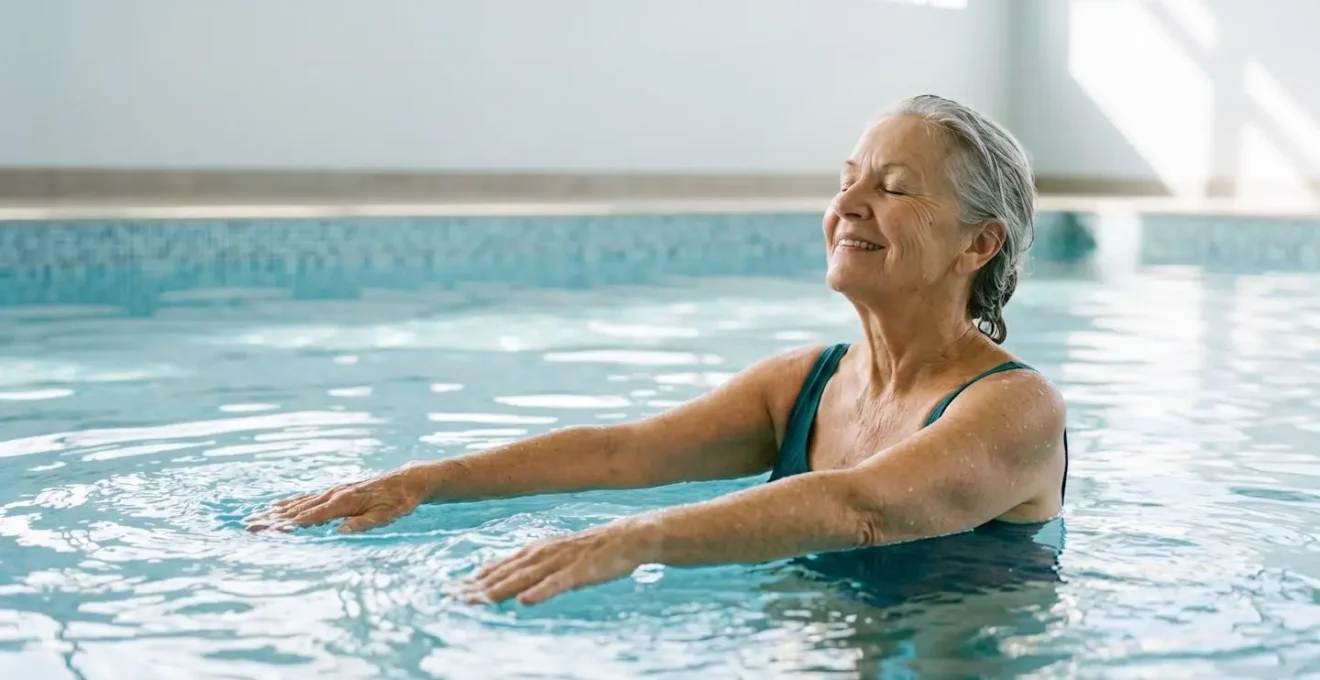
Warm water hydrotherapy is a clinical intervention, not a luxury, that provides quantifiable relief from arthritic pain by directly targeting its physiological drivers: joint loading, inflammation, and swelling.
- Buoyancy offloads up to 90% of your body weight, creating a safe space for movement that is impossible on land.
- Hydrostatic pressure acts as a full-body compression garment, actively reducing swelling and fluid retention in inflamed joints.
Recommendation: Use this guide to discuss the specific mechanisms of hydrotherapy with your physiotherapist or GP to determine if it is a suitable component of your arthritis management plan.
For anyone living with the daily reality of rheumatoid arthritis, the search for effective, non-pharmaceutical pain relief is a constant journey. You have likely been advised on various strategies, from medication regimens to land-based exercises, which often meet a frustrating barrier: the pain of movement itself. Hydrotherapy is frequently mentioned, yet it is often misunderstood and relegated to the category of a ‘soothing spa treatment’. This perspective overlooks its potent clinical efficacy.
The true value of warm water therapy lies not in simple comfort, but in a powerful combination of physics and physiology. It is a precise therapeutic environment that systematically counteracts the very mechanics of arthritic pain. When you step into a hydrotherapy pool, you are not just having a warm bath; you are engaging with three fundamental forces—buoyancy, hydrostatic pressure, and thermal regulation—that work in concert to reduce inflammation, alleviate joint stress, and restore function.
This guide will move beyond the generic advice. We will deconstruct the science of why hydrotherapy works, examining how each property of water provides a specific, measurable benefit for inflamed joints. Crucially, we will also address the non-negotiable safety protocols, because a tool this powerful requires respect and understanding to be wielded effectively and safely. Understanding these principles is the key to transforming hydrotherapy from a pleasant diversion into a cornerstone of your arthritis management strategy.
This article provides a detailed clinical breakdown of how hydrotherapy functions and the critical safety considerations involved. The following summary outlines the key areas we will explore to give you a comprehensive understanding.
Summary: A Clinical Look at Hydrotherapy for Arthritis
- Why Is Inflammation the Hidden Driver Behind Your Joint Pain and Fatigue?
- Why You Weigh 90% Less in Water and What That Means for Your Joints?
- How Hydrostatic Pressure Reduces Swollen Ankles Instantly?
- How to Exercise vigorously When Your Knees Can’t Take the Impact?
- 20 Minutes or an Hour: When Does Warm Water Become Exhausting?
- Hot and Cold Plunges: Are They Safe for Senior Hearts?
- The Dizziness Risk: Getting Out of a Hot Pool Safely
- Can You Get Hydrotherapy on the NHS for Back Pain?
Why Is Inflammation the Hidden Driver Behind Your Joint Pain and Fatigue?
In conditions like rheumatoid arthritis, pain is not merely a mechanical issue of ‘wear and tear’. It is the direct result of a systemic inflammatory process. Your immune system mistakenly attacks the synovium—the lining of your joints—triggering a cascade of inflammatory chemicals called cytokines. These chemicals cause the characteristic swelling, heat, and persistent pain. This chronic inflammatory state is also a significant drain on your body’s resources, leading to the profound, often debilitating, fatigue that accompanies flare-ups.
Treating arthritic pain effectively means addressing this underlying inflammation. While medication plays a crucial role, therapeutic modalities that can influence this process are invaluable. Warm water hydrotherapy has a direct effect on the inflammatory cycle. The gentle heat promotes vasodilation, an expansion of the blood vessels. This increased circulation helps to flush out inflammatory by-products from the joint area while delivering oxygen-rich blood and nutrients to the damaged tissues, promoting a healthier joint environment.
This is not just a theoretical benefit; it is a measurable outcome. In fact, specific research cited by Johns Hopkins Medicine shows that aquatic therapy leads to decreased inflammatory markers in patients with rheumatoid arthritis. This demonstrates that exercising in water does more than just make you feel good; it actively helps to turn down the dial on the very biological process causing your pain and fatigue.
Systematic Review: The Evidence for Hydrotherapy in Rheumatoid Arthritis
To solidify its clinical standing, a 2013 systematic review published in Musculoskeletal Care analyzed data from six different studies on the topic. The combined results provided strong evidence that patients with rheumatoid arthritis who undertook hydrotherapy experienced significant reductions in pain and joint tenderness. Furthermore, they reported improvements in mood and expressed high levels of satisfaction with the treatment, validating hydrotherapy as a credible, evidence-based intervention for managing inflammatory arthritis.
By creating a therapeutic environment that reduces the inflammatory load, hydrotherapy sets the stage for the next crucial benefit: reducing the physical load on the joints themselves.
Why You Weigh 90% Less in Water and What That Means for Your Joints?
The sensation of feeling ‘lighter’ in water is a phenomenon known as buoyancy, governed by Archimedes’ principle. For a person with arthritis, this is not just a pleasant feeling; it is a profound therapeutic advantage. Every step you take on land sends impact forces through your feet, ankles, knees, and hips—joints that are already inflamed and painful. Buoyancy effectively ‘offloads’ these joints by counteracting the force of gravity.
The degree of offloading is directly related to water depth, and the effects are dramatic. Clinical studies have demonstrated that in waist-deep water, your body is bearing only 50% of its normal weight. Submerged to the neck, that figure plummets, and you are supporting a mere 10% of your body weight. This is the “90% less” effect, and its implication for arthritic joints is monumental. It creates a uniquely safe and pain-free environment for movement.
This drastic reduction in joint loading means that exercises and movements that would be excruciating on land become not only possible but comfortable. It allows you to move your joints through a fuller range of motion, which is critical for maintaining flexibility and preventing stiffness. This ‘joint decompression‘ helps to reduce compressive pain, improve circulation within the joint capsule, and break the vicious cycle where pain leads to immobility, and immobility leads to more pain and stiffness.
Essentially, the water provides a temporary reprieve from gravity, allowing you to strengthen the muscles that support the joint without subjecting the joint itself to damaging impact forces.
How Hydrostatic Pressure Reduces Swollen Ankles Instantly?
Beyond buoyancy, another powerful force at play in hydrotherapy is hydrostatic pressure. This is the pressure exerted by the water on your body, and it increases with depth. Think of it as a ‘smart’ compression garment that applies pressure most intensely on the most deeply submerged parts of your body—typically your feet and ankles—and gradually decreases as it moves up your limbs. This creates a natural pressure gradient that is exceptionally effective for managing edema, or swelling.
When a joint is inflamed, fluid tends to pool in the surrounding tissues, causing visible swelling, stiffness, and further pain. Hydrostatic pressure physically counteracts this. The external pressure on your skin and underlying tissues helps to push this excess interstitial fluid back into the lymphatic and venous systems, allowing it to be circulated and processed by the body. Research even suggests this mechanism is most effective when the pressure is greater than 15 mmHg, a threshold easily achieved in a standard therapy pool.
This paragraph introduces a complex concept. To well understand it, it’s useful to visualize its main components. The illustration below breaks down this process.
As this image illustrates, the effect is akin to wearing a full-body compression stocking that dynamically assists your body’s natural fluid management system. The result can be an almost immediate reduction in the visible swelling of ankles and a corresponding decrease in the feeling of tightness and discomfort. This effect also enhances proprioceptive feedback to the brain, improving your sense of joint position and stability.
This pressure gradient not only helps manage swelling but also provides a gentle, supportive resistance that is ideal for strengthening muscles safely.
How to Exercise vigorously When Your Knees Can’t Take the Impact?
The combination of buoyancy and hydrostatic pressure creates the perfect environment to reclaim exercise. As Dr. Soo Yeon Kim, an expert at Johns Hopkins Medicine, explains, the unique properties of water are twofold. The elimination of gravity reduces pain, which in turn allows for greater muscle engagement.
Water creates resistance, which is what builds strength in muscles. The big plus, though, is the elimination of gravity. Underwater, patients feel better. They have less pain and engage muscles more.
– Dr. Soo Yeon Kim, Medical Director of Musculoskeletal Medicine, Johns Hopkins Medicine
The water itself provides viscous resistance to movement. Unlike weights, this resistance is accommodating; the faster you move, the harder it pushes back. This allows you to precisely control the intensity of your workout, building strength in the muscles that support your painful joints without the jarring impact of land-based exercise. Strengthening these muscles—your quadriceps, hamstrings, and glutes—is clinically proven to improve stability and reduce the load on the knee joint.
A structured approach is key to maximizing these benefits without overdoing it. A typical progression would involve several levels of activity:
- Level 1 – Pain-Free Range of Motion: The initial focus is simply on re-establishing comfortable movement. Gentle, slow movements like knee bends, leg swings, and ankle circles help to lubricate the joint and reduce stiffness.
- Level 2 – Resistance Training: Once a comfortable range of motion is achieved, you can progress to strengthening. This involves walking against the water’s resistance or using tools like foam dumbbells or paddles to increase drag and challenge your muscles.
- Level 3 – Functional and Balance Training: The final stage is to translate these gains into real-world function. This includes practicing single-leg stances to improve balance, performing gentle twists for core stability, and simulating activities like climbing stairs.
However, this powerful therapeutic tool demands respect. Understanding the physiological limits and safety protocols is just as important as understanding the benefits.
20 Minutes or an Hour: When Does Warm Water Become Exhausting?
While the warmth of a hydrotherapy pool is therapeutic, it also places a metabolic demand on your body. Maintaining your core temperature in water that is warmer than your skin requires energy. The clinical guidelines from Arthritis UK recommend that hydrotherapy pools for arthritis should be maintained between 33-35°C (91-95°F). This temperature is optimal for muscle relaxation and pain relief but is significantly higher than a typical swimming pool.
Because of this thermal load, hydrotherapy sessions are intentionally kept short to prevent overheating and exhaustion. A common misconception is that ‘more is better,’ but prolonged immersion can lead to fatigue, dehydration, and an undesirable drop in blood pressure. Clinical protocols are designed to maximize benefits while minimizing these risks. As patient guidelines from the University Hospitals of Derby and Burton NHS state, duration is strictly managed.
Your first session will last for approximately 20 minutes and all sessions thereafter will last for a maximum of 30 minutes. If you feel unwell/overheated at any time, please alert a member of staff.
– University Hospitals of Derby and Burton NHS, NHS Hydrotherapy Patient Guidelines
This 20 to 30-minute window is the therapeutic sweet spot. It is long enough to achieve the desired effects of vasodilation, muscle relaxation, and pain reduction, but short enough to avoid undue physiological stress. It is crucial to listen to your body and communicate immediately with a therapist if you begin to feel lightheaded, excessively tired, or unwell during a session.
This careful management of thermal stress is particularly important for older adults, whose cardiovascular systems may respond differently to abrupt temperature changes.
Hot and Cold Plunges: Are They Safe for Senior Hearts?
The recent wellness trend of contrast therapy—alternating between hot and cold water—is not appropriate in the context of senior health and arthritis management without strict medical supervision. The rapid shifts in temperature can place a significant and potentially dangerous strain on the cardiovascular system. The primary concern is the body’s vascular response to sudden temperature changes.
Immersion in hot water causes widespread vasodilation, lowering blood pressure. A sudden plunge into cold water triggers the opposite: rapid vasoconstriction, which can cause a sharp, sudden spike in blood pressure. For a senior heart, which may have reduced elasticity or underlying conditions, this rapid cycling can be hazardous. The focus of hydrotherapy for arthritis is sustained, gentle warmth, not cardiovascular shock.
Case Study: Cardiovascular Response to Hot Bathing in the Elderly
A revealing comparative study published on PubMed examined the effects of a 10-minute hot bath (40°C) on elderly men (mean age 75) versus young men (mean age 27). The elderly group exhibited a much more abrupt increase in heart rate and a blood pressure spike upon entering the water. More importantly, their sympathetic nervous system, which regulates blood pressure, showed a decreased ability to adapt. The researchers concluded that this dysregulation significantly increases the risk of hypotensive syncope (fainting due to low blood pressure) during hot bathing, which poses a serious drowning risk.
This evidence underscores why a controlled, stable thermal environment is the gold standard for therapeutic hydrotherapy in seniors. The goal is to gently coax the body into a state of relaxation and reduced pain, not to challenge it with extreme temperature fluctuations.
Even without extreme plunges, the simple act of getting out of a warm pool carries its own physiological risk that must be managed.
Key takeaways
- Warm water hydrotherapy is a clinical tool that uses buoyancy, hydrostatic pressure, and temperature to reduce joint load and inflammation.
- Safety is paramount: sessions are short (20-30 mins) to prevent fatigue, and a specific protocol is required when exiting to avoid dizziness.
- Access on the NHS is not guaranteed and is often limited; understanding the benefits can help you advocate for a referral.
The Dizziness Risk: Getting Out of a Hot Pool Safely
One of the most immediate and critical risks associated with warm water hydrotherapy is dizziness or lightheadedness upon exiting the pool. This phenomenon, known as orthostatic hypotension, is a direct result of the therapy’s positive effects. The warm water causes your peripheral blood vessels, particularly in your legs, to dilate widely. While you are in the water, the hydrostatic pressure helps to support circulation and prevent blood from pooling in your lower extremities.
The moment you stand up and exit the water, you lose that external compression. Gravity takes over, and blood can rapidly pool in your legs, causing a sudden drop in the amount of blood returning to your heart and, consequently, your brain. This can lead to a sharp drop in blood pressure, causing dizziness, blurred vision, and in severe cases, fainting—a highly dangerous event on a wet, hard pool deck. This risk is not trivial; a 2023 study published in Experimental Physiology found that symptoms were experienced by 94% of middle-aged adults and 77% of young adults after hot water immersion.
To mitigate this significant risk, a specific, multi-step exit protocol is not just recommended—it is essential for patient safety. Every hydrotherapist will insist on a slow, staged exit to allow your cardiovascular system time to readjust.
Your action plan: Safe Exit Protocol After Warm Water Immersion
- After completing the therapy session, move to a shallower area or sit on the pool steps for 1-2 minutes to begin vascular readjustment while still supported by some water pressure.
- Perform ankle pumps by flexing your feet up and down 10-15 times. This activates the muscle pumps in your calves, actively helping to push venous blood back toward your heart.
- Rise slowly from the water using handrails for firm support. Avoid any sudden or abrupt movement from a seated to a standing position.
- Sit on the edge of the pool or a nearby bench for another 1-2 minutes. This provides a final opportunity to ensure you are not feeling lightheaded before you stand and walk away.
- If available, use a fan or a cool, damp towel on your face. Research shows that facial cooling can help to counteract the symptoms of orthostatic hypotension.
With a clear understanding of both the profound benefits and the critical safety protocols, the final practical question remains: how can you access this therapy?
Can You Get Hydrotherapy on the NHS for Back Pain?
Given the clear clinical benefits, it is natural to ask whether hydrotherapy is readily available through the National Health Service (NHS). The answer is complex and varies significantly by region. While hydrotherapy is a recognized treatment, it is often not classified as a core or essential service, which directly impacts its availability and funding. Many patients who could benefit from it may face barriers to access.
Typically, to be considered for NHS hydrotherapy, you will need a referral from a GP or a specialist like a rheumatologist or physiotherapist. The decision to refer will be based on your specific clinical need and, crucially, on the local availability of services. As an official NHS commissioning policy states, access is contingent on provision.
Hydrotherapy is not considered to be an essential service, this policy applies only where local provision is available. Where local provision is not available, patients should receive land-based physiotherapy.
– NW Knowledge Now NHS, NHS Clinical Commissioning Policy on Hydrotherapy Access
Even when you do get a referral, the course of treatment is often limited. It is common for an initial NHS hydrotherapy course to be capped. For example, it is not unusual for a referral to be limited to a 6 session limit according to clinical practice guidelines. The goal of these short courses is often to introduce you to the exercises and principles so that you can continue them independently at a local public pool, which may not have the ideal therapeutic temperature.
Therefore, being able to clearly articulate the specific physiological benefits discussed in this guide—from joint offloading to hydrostatic pressure—can be a powerful tool when discussing your treatment options with your healthcare provider. A well-informed patient is the best advocate for their own care, whether seeking an NHS referral or exploring private treatment options.