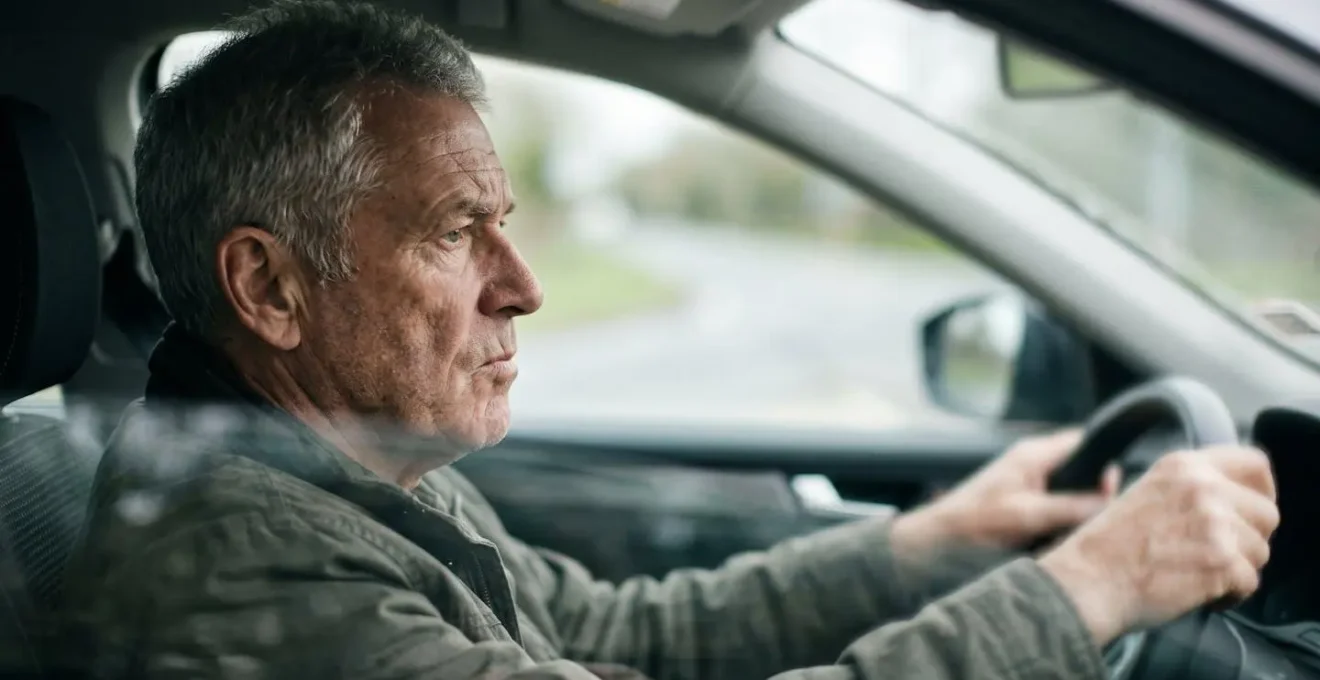
Keeping your driving licence after 70 is less about passing a single, flawed test and more about proactively managing your entire visual world to demonstrate holistic fitness.
- The DVLA’s number plate test is an inconsistent measure of real-world driving ability; many with legally acceptable vision can fail it.
- Common eyewear like bifocals and varifocals, while helpful, introduce significant risks for falls and misjudgements that undermine overall independence.
Recommendation: Shift your focus from just your eyes to your total ‘visual environment’—including task-specific glasses, home lighting, and glare reduction—to build a powerful case for your continued, safe autonomy.
The arrival of the DVLA’s licence renewal form for your 70th birthday can feel less like a milestone and more like a threat. The fear it triggers is palpable and one I see in my practice every day: the terror of losing your independence, symbolised by the car keys on your kitchen counter, all because of a single eyesight test. Many drivers believe the solution is simply to practice reading number plates or to get a new pair of glasses just before the renewal. This approach is understandable, but it’s dangerously incomplete.
The common advice to “get regular eye tests” and “inform the DVLA of any changes” is legally sound but strategically passive. It puts you on the defensive, waiting for a problem to be flagged. But what if the key wasn’t simply to meet the bare minimum standard, but to demonstrate a comprehensive, proactive approach to your safety? The truth is, your fitness to drive isn’t just determined by what you can see 20 metres down the road. It’s revealed in how you navigate your own staircase, how you prepare a meal in your kitchen, and even whether you can still safely cut your own toenails. This isn’t about just keeping your licence; it’s about protecting your autonomy as a whole.
This guide will shift your perspective. We will move beyond the simple number plate test and explore the interconnectedness of your vision, your environment, and your independence. We’ll examine the hidden risks in common solutions like varifocals, uncover how to optimise your home for aging eyes, and build a powerful argument that your ability to drive safely is part of a much larger picture of continued, confident living.
To help you navigate this critical topic, this article is structured to build a complete understanding, from specific conditions to holistic strategies. Explore the sections below to gain the insights needed to protect your independence.
Summary: A Proactive Guide to Vision and Driving for Seniors
- Glaucoma: The “Thief of Sight” That Shows No Symptoms Until Too Late
- The Number Plate Test: Can You Pass the DVLA Requirement Today?
- Varifocals or Separate Pairs: Which Is Safer for Walking Down Stairs?
- The Bifocal Mistake That Causes Trips on Pavements
- How to Light Your Kitchen to Cook Safely with Macular Degeneration?
- The Loss of Driving: How to Maintain Autonomy Without a Car?
- Matte vs Gloss: How to Stop Light Bouncing into Sensitive Eyes?
- Can You Still Cut Your Own Toenails: The Litmus Test for Independence?
Glaucoma: The “Thief of Sight” That Shows No Symptoms Until Too Late
Glaucoma is one of the most insidious threats to your driving career precisely because it is asymptomatic in its early stages. It doesn’t cause pain or immediate blurriness; instead, it quietly steals your peripheral vision, the very thing you rely on to detect a merging car, a cyclist, or a pedestrian stepping off the curb. By the time you notice “tunnel vision,” significant and irreversible damage has already occurred. This gradual loss is why it’s often called the “silent thief of sight.”
The practical implications for driving are severe. Even with good central vision (the ability to read the number plate), the loss of peripheral awareness can be catastrophic. Research from a Collaborative Initial Glaucoma Treatment Study confirms this, showing that more than 50% of drivers with glaucoma reported difficulty with tasks involving glare, a common issue at night or in low sun. The condition compromises your ability to process the full visual scene, making you slower to react to unexpected events.
Case Study: The Real-World Impact of Glaucoma on Driving
An on-road driving assessment starkly highlighted the risks. In the study, drivers with glaucoma were found to be six times as likely to have difficulty detecting peripheral hazards compared to a control group. The most common errors were not just about seeing things, but about processing and planning: difficulty maintaining lane position, poor planning for lane changes, and inadequate observation of the road environment. This demonstrates that glaucoma doesn’t just narrow your vision; it fundamentally impairs the cognitive tasks of driving that rely on a complete visual picture.
Because you cannot feel glaucoma developing, regular eye examinations with an optometrist are non-negotiable. We don’t just check your prescription; we measure your eye pressure and assess your visual fields, catching this thief before it robs you of your sight and your licence.
The Number Plate Test: Can You Pass the DVLA Requirement Today?
The cornerstone of the DVLA’s vision standard for driving is the ability to read a post-2001 number plate from a distance of 20 metres. It’s a simple, pass/fail test that hangs over every driver over 70. However, as an optometrist, I must tell you that this test is a deeply flawed and unreliable proxy for actual driving safety. It measures only one specific skill—static visual acuity in broad daylight—and ignores countless other critical visual functions.
The test’s variability is its greatest weakness. The legibility of a number plate can depend on the specific letter and number combinations, the lighting conditions, and even the cleanliness of the plate. In fact, research published in the journal Eye revealed that among people with vision technically good enough to pass, only 92.3% could read all number plates at the legal distance. This proves that a person can have acceptable vision for driving yet still fail the test due to chance.
The image above visualises the core problem: driving requires dynamic visual acuity—the ability to see and react to moving objects from a moving vehicle. The static number plate test does not assess this. It doesn’t measure your contrast sensitivity (seeing a grey car on a grey day), your ability to recover from glare (oncoming headlights), or the speed of your visual processing. Relying solely on it is like judging a chef’s skill by only tasting their salt.
As the researchers who studied the test’s flaws concluded:
The current test protocol used to obtain a driving licence is highly variable and is unlikely to give consistent repeatable results. The performance of those with equally good visual acuity is unpredictable and is highly dependent on the number-plate they are asked to read.
– McGraw, Winn, Gray, and Elliott, Eye journal research on visual acuity and legal driving requirements
While you must be able to pass this test, it should be seen as the absolute minimum requirement, not the goal. True fitness to drive is demonstrated by a much broader set of visual and cognitive skills.
Varifocals or Separate Pairs: Which Is Safer for Walking Down Stairs?
Varifocal (or progressive) lenses are often hailed as the perfect “all-in-one” solution, providing clear vision for distance, intermediate, and near tasks without the tell-tale line of a bifocal. They are incredibly convenient for activities like shopping, where you might glance from an aisle sign to a price tag. However, this convenience comes with a hidden and significant risk, particularly when you’re not in the driver’s seat. The most common danger zone? Stairs.
The bottom portion of a varifocal lens is designed for reading. When you look down to take a step, your eyes naturally drop into this reading zone. This magnifies the step and creates peripheral distortion, making the edge of the step appear blurry, warped, or in a different position than it actually is. This perceptual error is a primary contributor to falls, a major threat to senior independence. In the UK, stair falls in older adults’ homes cause up to 575 deaths and hundreds of thousands of injuries annually.
This is where the concept of a ‘visual environment’ becomes critical. The best glasses for driving are not necessarily the best glasses for walking around your house. Acknowledging this and using ‘task-specific’ eyewear is not a sign of failure; it is a sign of superior situational awareness. For many, a strategy of using separate pairs of glasses—one for distance (driving, watching TV) and one for reading—is far safer. Here is a simple guide:
- Driving: Use separate single-vision distance glasses for stable, clear far vision and safer lane changes. The field of view is wide and free of distortion.
- Shopping: Varifocals can work well for switching between reading price tags and viewing distant aisle signs.
- Reading books or close work: Single-vision reading glasses provide the widest, most comfortable field for sustained near tasks.
- Navigating stairs or uneven ground: Remove multifocals or, ideally, switch to your distance-only glasses to avoid lower-lens distortion of step edges.
Choosing the right tool for the job is a mark of expertise. The same applies to your glasses. Using a dedicated pair of distance-vision glasses for driving and walking provides a stable, predictable visual world, which is the foundation of both safety and confidence.
The Bifocal Mistake That Causes Trips on Pavements
If varifocals have a hidden risk, traditional bifocals have a well-documented and dangerous flaw that directly impacts your mobility and safety outdoors. The “bifocal mistake” is looking down through the reading segment of your lenses while navigating a curb, an uneven pavement, or any change in ground level. This simple act creates a zone of blur right where you need clear vision the most, dramatically increasing the risk of a trip or fall.
The science is clear and compelling. When you glance down through the reading portion of your bifocals, the distant ground is magnified and blurred. Your brain receives incorrect information about the distance and height of obstacles. This isn’t a minor inconvenience; it’s a significant safety hazard. Research has shown that study participants who switched from bifocals to single-vision glasses for outdoor activities were 40% less likely to have a fall compared to those who continued wearing bifocals. This is a staggering statistic that underscores the danger.
This close-up view of navigating pavement highlights the critical connection between your vision and your sense of balance (proprioception). When your visual input is unreliable, your brain struggles to place your feet confidently, leading to hesitation and errors in foot placement.
The “Understepping” Error: A Queensland University Study
Researchers at Queensland University of Technology provided a clear explanation for this phenomenon. They studied older adults performing precision stepping tasks and found that when participants looked through the bottom part of their bifocal lenses, they consistently made “understepping errors”—they didn’t lift their feet high enough or step far enough. The blur caused by the reading lens led them to misjudge the obstacle, which in the real world translates directly to tripping over a curb or missing the edge of a step.
The solution, as with varifocals, is to adopt a task-specific approach. A dedicated pair of single-vision distance glasses for all outdoor activities, including driving and walking, eliminates this blur zone entirely. It provides a consistently clear and stable view of the world, allowing you to walk with confidence and proving that you are actively managing risks to your mobility.
How to Light Your Kitchen to Cook Safely with Macular Degeneration?
For individuals with conditions like Age-Related Macular Degeneration (AMD), which affects central vision, the kitchen can become a high-risk environment. The ability to read recipes, measure ingredients, and handle hot pans and sharp knives all depend on clear, well-lit vision. Managing your home’s lighting and contrast is not just a matter of comfort; it’s a direct demonstration of your ability to maintain an independent, safe lifestyle—a key component of the argument for your continued fitness to drive.
The goal is to eliminate shadows and enhance contrast. A three-layer lighting strategy is the most effective approach for a senior-friendly kitchen:
- Ambient Layer: Start with bright, even overhead lighting. Modern LED ceiling fixtures (using a warm-to-neutral white of 3000K-4000K) provide excellent general illumination and reduce the harsh shadows that can obscure hazards.
- Task Layer: This is the most critical layer. Install focused under-cabinet LED strips directly above your countertops, sink, and stove. This puts bright, shadow-free light exactly where you are chopping, washing, and cooking.
- Accent Layer: Small lights inside cupboards or along the toe-kick at floor level can make it easier to find items without bending into your own shadow or leaving doors wide open as a trip hazard.
Beyond lighting, simple modifications to increase contrast can make a world of difference. Your choice of tools and dishware can be optimised for aging eyes. A white onion on a white cutting board can be nearly invisible to someone with AMD; a white plate on a white tablecloth can make it difficult to see the edge of the plate.
The following table outlines simple, high-impact changes to improve kitchen safety by enhancing contrast. This isn’t about a costly renovation; it’s about smart, targeted adjustments.
| Kitchen Element | Standard Setup (Low Contrast) | High-Contrast Modification | Safety Benefit |
|---|---|---|---|
| Cutting Boards | Single wooden board for all foods | Black board for light foods (onions, garlic), white board for dark foods (carrots, meat) | Food edges clearly visible against contrasting background |
| Appliance Controls | Smooth flat buttons/dials | Tactile markers (bump dots) on frequently used settings | Operate by touch without relying solely on vision |
| Utensil Storage | Drawer with mixed items | Organized by muscle memory zones (knives always left, spoons always right) | Retrieve items by position memory, reducing visual search |
| Countertop Edges | Same color as floor | Contrasting tape or paint on counter edges | Prevent bumping into counters when peripheral vision limited |
| Dishware | White plates on white table | Dark plates on light table or vice versa | Food portions and plate edges clearly delineated |
The Loss of Driving: How to Maintain Autonomy Without a Car?
As your optometrist, my primary goal is to help you see well enough to drive safely for as long as possible. However, part of a responsible, long-term plan is to acknowledge the possibility that there may come a day when you choose, or are required, to stop driving. Contemplating this is not defeatist; it is strategic. Having a robust plan in place is the ultimate expression of autonomy, as it ensures your life continues with vibrancy and connection, with or without a car.
The psychological blow of losing a licence can be immense, often leading to social isolation and a decline in mental health. This is why building a “Personal Mobility Portfolio” *before* it becomes a necessity is so empowering. It’s about diversifying your transportation assets, just as you would with a financial portfolio. This removes the car as a single point of failure for your independence. For some, vision changes make this a statistical reality; a prospective study found that 23% of glaucoma subjects had ceased driving compared to just 6.9% of those without the condition.
A proactive plan ensures that your ability to go to the shops, visit friends, or attend medical appointments is never in jeopardy. Here are the key components of a modern mobility portfolio:
- Digital Ride-Sharing: Set up Uber or Lyft on a smartphone. You can pre-save favourite destinations (like your home, your doctor, your children’s houses) and connect a payment method, making it seamless to order a car. Many apps now have accessibility features like larger text.
- Community Transport: Research and register with your local council or charities like Age UK. They often run minibus services or have volunteer driver schemes that provide affordable, door-to-door transport for essential trips.
- Grocery & Pharmacy Delivery: Almost every major supermarket now offers online ordering and delivery. Setting up an account and learning the system while you are still mobile is a wise move. The same goes for pharmacies that offer prescription delivery.
- Volunteer Drivers: Local faith groups and community centres often have networks of volunteers who can help with transport for social outings and errands, maintaining those vital community connections.
- Walking & Public Transport: Re-familiarise yourself with local bus routes and map out safe, well-lit walking paths to nearby amenities like a local shop or park. This also provides valuable physical exercise.
Thinking through these options and even trying them out “for practice” can transform the fear of losing your licence into a managed transition. It puts you back in the driver’s seat of your own life, regardless of who is behind the wheel of the car.
Matte vs Gloss: How to Stop Light Bouncing into Sensitive Eyes?
As our eyes age, the crystalline lens can develop opacities (like cataracts) and the vitreous humour can become less clear. This causes light to scatter more as it enters the eye, resulting in increased sensitivity to glare. What was once an acceptable reflection from a glossy magazine or a polished dashboard can become a disabling source of visual discomfort. Managing glare is a critical component of optimising your ‘visual environment’ for both comfort and safety.
This increased light sensitivity is compounded by natural changes in our field of vision. Vision experts note that by your 70s, you may have lost around 20 degrees of peripheral vision. This makes unexpected flashes of light from the side—like reflections off a chrome wing mirror or a glossy interior trim—more startling and disorienting, impacting your ability to safely monitor your surroundings.
The solution is a conscious and deliberate shift away from glossy, reflective surfaces towards matte, light-absorbing finishes. This principle applies to everything from your home décor to your car’s interior. A living space designed with matte walls, non-reflective furniture, and diffused lighting, as shown above, is not just a style choice; it is a medical necessity for comfortable vision. It creates a calm, predictable visual environment that reduces strain on the aging eye.
You can perform a ‘glare audit’ of your environment to identify and neutralise these sources of visual noise. It’s a practical, empowering exercise that yields immediate benefits.
Your Comprehensive Glare Audit Checklist
- Identify Glare Sources: Systematically list all reflective surfaces in your main living areas (kitchen, living room) and your car. Check walls, floors, countertops, appliance fronts, and vehicle dashboard/trim.
- Categorise by Severity: Inventory existing items. Note which reflections are most distracting. Is it the low evening sun on the TV screen or the reflection of overhead lights on the granite worktop?
- Evaluate Against Comfort: Confront each item. Does this surface serve a purpose, or does it create unnecessary visual stress? A high-gloss paint might look “clean” but feel aggressive to sensitive eyes.
- Assess Emotional Impact: Distinguish between gentle sheen and sharp, disabling glare. Make a quick grid: note which surfaces feel calm and which feel visually “loud” or jarring.
- Create an Action Plan: Prioritise changes. Start with simple fixes like applying a matte screen protector to your tablet or using a matte dashboard spray in your car before considering bigger changes like repainting a wall with an eggshell finish.
Key Takeaways
- Your fitness to drive is a reflection of your overall independence, not just a single eye test.
- Common eyewear like bifocals and varifocals carry hidden risks for mobility that must be managed with task-specific glasses.
- Proactively managing your ‘visual environment’ through lighting, contrast, and glare reduction is a powerful way to ensure safety.
Can You Still Cut Your Own Toenails: The Litmus Test for Independence?
It may seem like a strange, almost absurdly personal question to ask in an article about driving. But the ability to see, reach, and safely trim your own toenails is one of the most potent, unvarnished litmus tests for the physical and sensory skills that underpin independence. It is a microcosm of the very abilities required to be a safe driver. If driving is at the peak of the pyramid of autonomy, tasks like this form its essential, load-bearing foundation.
Consider what this simple act requires. It demands:
- Good Near Vision: To see the nail, the skin, and the clipper blades clearly.
- Flexibility and Range of Motion: To bend and position yourself correctly.
- Balance and Stability: To hold a potentially awkward position without losing your footing.
- Fine Motor Skills and Hand-Eye Coordination: To control the clippers with precision.
These are the exact same core abilities, scaled up, that you use to drive a car. You need vision to read signs, flexibility to check your blind spot, balance to get in and out of the vehicle, and fine motor skills to operate the controls. When the UK Department for Transport finds that 42% of incidents involving drivers over 70 were due to sight issues, it’s referring to a breakdown in this holistic system, not just a failed number plate test.
Therefore, your ability to manage a range of self-care tasks provides a compelling narrative about your overall capability. It demonstrates that you are maintaining the fundamental building blocks of safe and independent living. Toenail cutting is just one example in a hierarchy of self-assessment tests you can use to gauge your own functional fitness.
- The Floor Recovery Test: Can you get up from the floor unassisted? (Tests balance, strength, proprioception).
- The Medicine Label Test: Can you read the instructions on a medicine bottle quickly and accurately? (Tests functional near vision).
- The Blind Spot Check Test: Can you physically turn your head and torso to check your car’s blind spot? (Tests neck flexibility).
- The Pedal Control Test: Can you smoothly alternate between accelerator and brake? (Tests ankle flexibility and fine motor control).
If you can confidently manage these tasks, you are building a powerful, evidence-based case for your continued fitness to drive. It shifts the conversation with your family, your doctor, and even yourself from “Can you pass the test?” to “Are you holistically managing your independence?”
Ultimately, the goal is not merely to cling to your driving licence but to embrace a strategy of proactive life management. By understanding your vision, choosing the right tools for each task, and adapting your environment, you demonstrate the highest level of responsibility and competence. This approach provides the strongest possible foundation for maintaining your independence, both on the road and in all other aspects of a life well-lived.