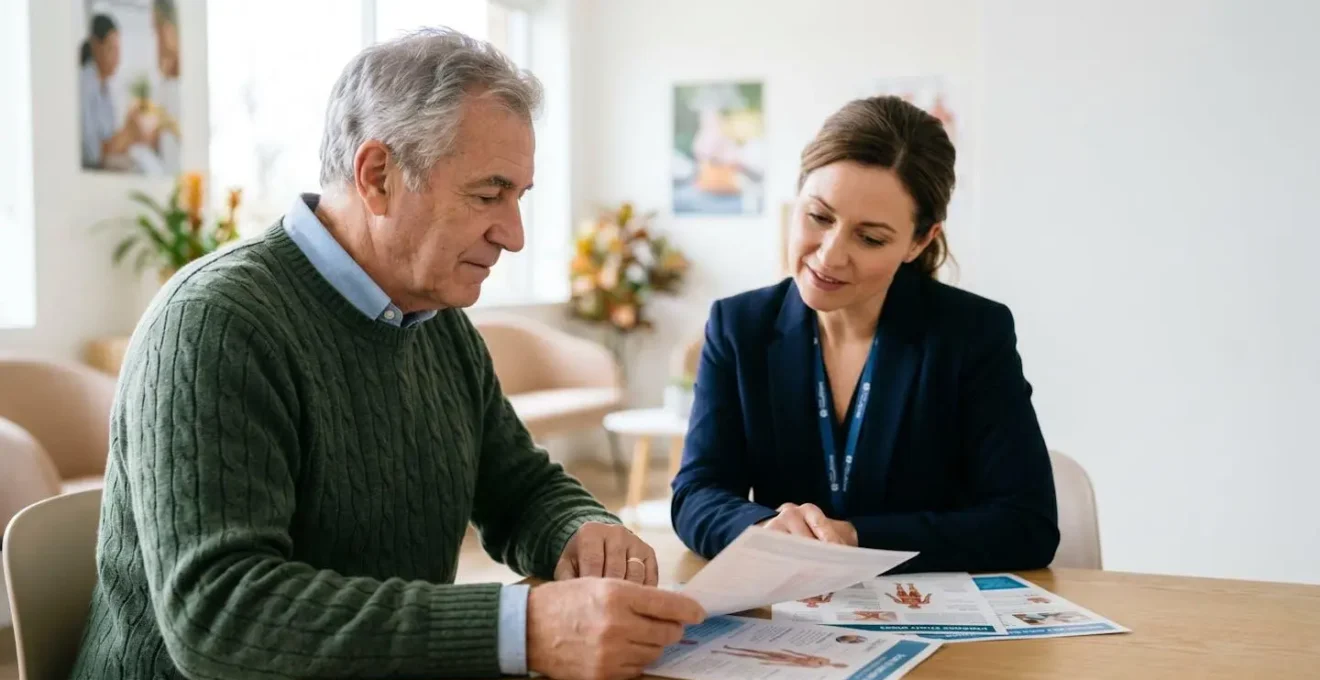
Your T-score is not a final diagnosis, but a critical piece of a larger puzzle about your bone health and fracture risk.
- The T-score is the most important number for seniors, comparing your bone density to a healthy 30-year-old.
- Factors like menopause, stress, and medications have a significant, measurable impact on your bone density.
Recommendation: Use this report as a guide to have an informed conversation with your GP about your personal risk factors and a proactive health plan.
Receiving your DEXA scan report can feel like being handed a complex code. A series of numbers, like a T-score of -1.8 or a Z-score of -0.5, are presented with little context, often leaving you with more questions than answers. You might wonder: Am I now labelled with a disease? Is a fracture inevitable? Many people immediately turn to generic advice about calcium and exercise, but this misses the crucial point of the report.
The true value of a DEXA scan lies not in these isolated numbers, but in what they represent within the broader context of your life and health. It’s a snapshot in time, a data point that helps build a more complete picture. But if the key isn’t just about the number itself, what should you be focusing on? The real power comes from understanding that your T-score is not a diagnosis; it’s a highly valuable risk factor. It’s the start of a conversation, not the end of one.
This article will guide you through interpreting that report from a radiographer’s perspective. We will decode the jargon, place the numbers in their proper context, and transform that confusing sheet of paper into a powerful tool. We will explore not just what the scores mean, but why they matter, what influences them, and how you can use this knowledge to proactively manage your bone health in collaboration with your doctor.
To help you navigate this important topic, this guide breaks down everything from the core definitions to the practical steps you can take. Explore the sections below to build a clear understanding of your bone health.
Summary: What Does Your T-Score Actually Mean for Your Fracture Risk?
- T-Score vs Z-Score: Which One Matters for a 70-Year-Old?
- How to Get a DEXA Scan on the NHS Without a Fracture History?
- Osteopenia: Is It a Disease or Just Normal Ageing Bones?
- Is the Radiation from a DEXA Scan Dangerous for Seniors?
- Why Scanning Every Year Is a Waste of NHS Resources?
- Why Does Bone Density Drop by 20% in the First 5 Years of Menopause?
- How High Cortisol Levels Destroy Bone Density in Seniors?
- Which 3 Health Screenings Do Private GPs Recommend That the NHS Misses?
T-Score vs Z-Score: Which One Matters for a 70-Year-Old?
When you look at your DEXA report, the T-score and Z-score are the two headline numbers, but they tell very different stories. For a senior, the T-score is the critical metric. It compares your bone mineral density (BMD) to that of a healthy, young adult (around age 30) at their peak bone mass. This comparison is vital because it directly relates to fracture risk. A lower T-score indicates a greater departure from peak strength, and according to the National Institute of Arthritis and Musculoskeletal and Skin Diseases, the risk of broken bones increases by 1.5 to 2 times with each 1-point drop in the score. The World Health Organization defines osteopenia as a T-score between -1.0 and -2.5, and osteoporosis as -2.5 or lower.
The Z-score, on the other hand, compares your BMD to that of an average person of your same age, sex, and ethnicity. For a 70-year-old, a “normal” Z-score of 0 simply means you have the same bone density as other 70-year-olds—a group that already has, on average, lower bone mass. As Tom Kelly, a co-inventor of the T-score, highlighted in a Hologic scientific interview, “If you’re an older woman and you’ve lost a lot of bone, your Z-score might still look normal… But your bone fracture risk is higher.” Therefore, relying on the Z-score can create a false sense of security.
Clinical Example: When a “Normal” Z-Score Is Misleading
A clinical case reported by Dr. Roach perfectly illustrates this point. An elderly woman presented with a T-score of -2.6 (indicating osteoporosis) but a Z-score of 0 (normal for her age). This highlights a crucial concept: her bone loss was ‘as expected’ for her peer group, but that expected rate is still high-risk for fracture. The Z-score becomes more clinically significant when it’s very low (e.g., below -2.0), as this suggests an underlying medical cause for bone loss beyond typical aging, prompting clinicians to investigate secondary causes like thyroid issues or medication side effects.
Ultimately, while both scores are provided, your focus—and your doctor’s—will be on the T-score. It is the most reliable indicator of your fracture risk relative to a strong, healthy baseline, which is the most important measure for preventive care.
How to Get a DEXA Scan on the NHS Without a Fracture History?
Securing a DEXA scan on the NHS before you’ve had a fracture can feel challenging, as resources are often prioritized for those with a confirmed history. However, access is not impossible; it simply requires a proactive and well-prepared approach. The key is to shift the conversation with your GP from “I want a DEXA scan” to “I would like to assess my fracture risk profile.” The latest 2024 UK clinical guidelines recommend considering fracture risk assessment in all women aged 65 and over and all men aged 75 and over, which provides a strong basis for your discussion.
To build your case, you need to present your GP with a clear summary of your personal risk factors. This is not about self-diagnosing but about providing the necessary data for your doctor to make an informed decision. The FRAX tool, an online calculator developed by the University of Sheffield, is your most powerful ally. It estimates your 10-year probability of a major fracture, and presenting these results to your GP can be a compelling reason for further investigation. Beyond the FRAX score, other factors are highly relevant, such as significant height loss, a family history of hip fractures, or the use of certain long-term medications.
Your Action Plan: Presenting a Case for a DEXA Scan to Your GP
- Risk Calculation: Use the online FRAX tool at sheffield.ac.uk/FRAX before your appointment. Print the results to show your GP.
- Document Height Loss: Measure and note any loss of height. A loss of 1.5 inches (around 4 cm) or more since young adulthood is a significant red flag.
- List Medications: Compile a list of all long-term medications, especially corticosteroids (like prednisolone), certain stomach acid reducers (PPIs), or aromatase inhibitors used in cancer treatment.
- Detail Family History: Be specific. Note if a parent had a hip fracture, as this is a strong independent risk factor.
- Note Hormonal History: If you are female, emphasize if you experienced early menopause (before age 45) or had a hysterectomy before 45, as this is a key risk factor in NICE guidelines.
By presenting this information as a “risk profile requiring diagnostic investigation,” you empower your GP with the clinical evidence needed to justify a referral for a DEXA scan, even without a prior fracture.
Osteopenia: Is It a Disease or Just Normal Ageing Bones?
Receiving a report that says you have “osteopenia” (a T-score between -1.0 and -2.5) is one of the most common and confusing outcomes of a DEXA scan. It’s often perceived as “pre-osteoporosis,” a worrying label that can cause significant anxiety. However, it’s more accurate and empowering to view osteopenia not as a disease, but as a critical “window of opportunity.” It signifies that your bone density is lower than that of a young adult, but not yet at the level of osteoporosis. It’s a signal from your body that now is the ideal time to take proactive steps.
Paradoxically, while the individual fracture risk is lower in people with osteopenia compared to those with osteoporosis, a surprising fact is that the majority of fractures occur in the osteopenic population. As research published in The Lancet Diabetes & Endocrinology reveals, this is because the number of people in this category is so much larger. The journal’s editorial board emphasizes this point perfectly:
The diagnosis of osteopenia is not an indication for either intervention or reassurance, but BMD is a risk factor that should be incorporated into a quantitative fracture risk calculation.
– The Lancet Diabetes & Endocrinology Editorial Board, Osteopenia: a key target for fracture prevention
This statement reframes the entire issue. Osteopenia is not a diagnosis to be treated, but a risk factor to be managed. Your T-score is one piece of the puzzle, which should be combined with other factors in a tool like FRAX to understand your true, personalized fracture risk.
Seeing osteopenia on your report is a call to action. It’s the perfect moment to discuss lifestyle interventions with your doctor, such as optimizing your diet, starting weight-bearing exercise, and addressing other risk factors. It’s not a sentence to a future of fractures, but a chance to actively change that future.
Is the Radiation from a DEXA Scan Dangerous for Seniors?
Any medical procedure involving radiation naturally raises concerns, especially for seniors who may be undergoing multiple health screenings. However, when it comes to DEXA scans, the level of radiation exposure is exceptionally low and widely considered to be very safe. It’s helpful to put the dose into perspective with everyday sources of radiation that we are all exposed to. As rheumatologists at the London Osteoporosis Clinic confirm, the amount of radiation from a standard hip and spine DEXA scan is incredibly small—often less than a single day’s exposure to natural background radiation from our environment.
This natural background radiation comes from sources like cosmic rays from the sun and trace radioactive elements in the soil, air, and even our food. A DEXA scan uses a very low-dose X-ray beam, significantly less than a standard chest X-ray and orders of magnitude lower than a CT scan. The benefit of accurately assessing your fracture risk far outweighs the negligible risk associated with this minimal radiation dose.
To provide a clear comparison, the following table breaks down the radiation dose from a DEXA scan compared to other common activities, measured in microsieverts (µSv), a standard unit of radiation dose.
| Activity / Procedure | Radiation Dose (µSv) | Comparison |
|---|---|---|
| DEXA Scan (spine + hip) | 1–15 µSv | Baseline for comparison |
| Natural background radiation (1 day) | ~10 µSv | Similar to DEXA scan |
| Flight London to Paris | ~10 µSv | Comparable to DEXA |
| Chest X-ray | 20–50 µSv | 2–5× more than DEXA |
| CT scan (abdomen) | 8,000–10,000 µSv | 500–1,000× more than DEXA |
As the data clearly shows, the radiation exposure from a DEXA scan is on par with a short flight or a normal day on Earth. It is a safe, effective, and indispensable tool for protecting your bone health.
Why Scanning Every Year Is a Waste of NHS Resources?
After receiving a concerning T-score, the natural instinct is to want to monitor it closely, perhaps even annually. However, this is one area where more testing is not better. Bone is living tissue, but its metabolism is very slow. Tracking meaningful changes in bone mineral density requires patience, as significant shifts are not visible on a short-term basis. In fact, clinical research on bone remodeling shows that bone density changes are typically only 1-2% per year, even with effective treatment. This small change is often within the margin of error of the DEXA machine itself, making annual scans an unreliable measure of progress and an inefficient use of healthcare resources.
For this reason, clinical guidelines recommend much longer intervals between scans. The UK’s National Osteoporosis Guideline Group (NOGG) provides clear recommendations on this. As their guidelines state, for patients undergoing treatment, reassessment should occur much later:
Reassess patients on bisphosphonate treatment with FRAX and DXA, no later than after 5 years of oral treatment and 3 years of intravenous treatment.
– National Osteoporosis Guideline Group (NOGG), NOGG Clinical Guidelines on Follow-up Scanning
So, if a DEXA scan isn’t the right tool for short-term monitoring, how can you and your doctor know if a treatment or lifestyle change is working? The answer may lie in bone turnover markers. These are blood or urine tests that measure the rate of bone breakdown (resorption) and formation. Markers like CTX (for resorption) can show changes in as little as 3-6 months after starting treatment, providing much faster feedback on whether a therapy is having the desired effect on bone metabolism.
This approach allows for more dynamic management of bone health, using DEXA scans for long-term strategic assessment and bone turnover markers for more immediate tactical adjustments. This is a much more efficient and clinically useful strategy than simply repeating scans every year.
Why Does Bone Density Drop by 20% in the First 5 Years of Menopause?
The link between menopause and bone health is profound and direct. Women can lose up to 20% of their bone density in the five to seven years following menopause, a rapid decline that significantly increases fracture risk. The primary reason for this accelerated loss is the sharp drop in the hormone estrogen. Estrogen acts as a powerful protector of the skeleton throughout a woman’s life. It helps to regulate the constant process of bone remodeling—the balanced cycle where old bone is broken down (resorption) and new bone is built (formation).
Specifically, estrogen works by restraining the activity of osteoclasts, the cells responsible for breaking down bone. When estrogen levels plummet during menopause, the osteoclasts become more active and numerous. The “demolition” phase of bone remodeling starts to outpace the “construction” phase. As a result, more bone is lost than is created, leading to a net decrease in bone mass, a weakening of bone architecture, and a higher susceptibility to fractures. This hormonal shift is the single most significant factor contributing to osteoporosis in women.
This rapid bone loss is why the years immediately following menopause are such a critical period for bone health assessment and intervention. It’s often during this time that the foundation for future fractures is laid. Understanding this mechanism underscores the importance of discussing bone health with a GP as you approach menopause, as this is the period where preventative strategies can have the most impact.
How High Cortisol Levels Destroy Bone Density in Seniors?
While estrogen loss is a well-known factor in bone health, another powerful hormone plays a silent but destructive role: cortisol. Often called the “stress hormone,” chronically elevated cortisol levels, whether from persistent life stress or from medical treatments like corticosteroids, can wreak havoc on the skeleton. Cortisol disrupts the delicate balance of bone remodeling in two primary ways. First, it directly boosts the activity of osteoclasts (the bone-demolishing cells) while simultaneously suppressing the activity of osteoblasts (the bone-building cells). This dual-action attack tips the scales heavily towards net bone loss.
Second, high cortisol interferes with the body’s ability to absorb calcium from the gut and increases calcium excretion through the kidneys. This effectively starves the body of the primary raw material needed for bone formation. For seniors, who may already have challenges with nutrient absorption, this effect is particularly damaging. The impact is so significant that long-term use of oral corticosteroid medications is a major cause of secondary osteoporosis.
Case Study: Corticosteroid-Induced Bone Loss
NHS Homerton Healthcare notes that patients on long-term glucocorticoid therapy (e.g., prednisolone) face a much faster rate of bone loss. The effect is so severe that guidelines often recommend extending osteoporosis treatment duration for patients on concurrent steroid therapy. This demonstrates the powerful multiplicative effect of high cortisol levels on the aging skeleton, making management of both external (medication) and internal (stress) sources of cortisol a key strategy in preserving bone density.
Fortunately, managing cortisol levels is possible through lifestyle interventions. Simple, consistent habits can help regulate the body’s stress response and protect bone health. Key strategies include ensuring adequate sleep, getting morning light exposure to regulate circadian rhythms, engaging in gentle exercise, maintaining strong social connections, and practicing mindfulness or deep breathing exercises.
Key takeaways
- Your T-score is a risk factor, not a disease. Context is everything.
- Osteopenia is a “window of opportunity” to act, not a diagnosis to fear.
- Monitoring is a long-term game; annual scans are unnecessary and inefficient.
Which 3 Health Screenings Do Private GPs Recommend That the NHS Misses?
While the NHS provides excellent care, its focus is often on treating existing disease rather than proactive prevention, largely due to resource constraints. This reactive approach means some valuable health insights can be missed. A 2024 study on opportunistic screening during knee surgery found that nearly 60% of patients had undiagnosed low bone density, highlighting a significant gap in proactive assessment. Private GPs often recommend a more comprehensive, proactive screening panel for seniors to identify risks before they become problems. Here are three key areas where private screening often goes further.
This proactive philosophy extends beyond just bones. It encompasses a holistic view of aging, where cardiovascular health, nutritional status, and body composition are seen as interconnected pillars of overall well-being and resilience. A private approach often uses advanced testing to get a much more granular picture of these pillars, allowing for highly personalized and preventative health strategies that the standard NHS checks may not cover.
The table below compares the standard NHS approach with the proactive screenings commonly offered in the private sector for three critical areas of senior health.
| Screening | NHS Standard Approach | Private Proactive Approach | Why It Matters for Seniors |
|---|---|---|---|
| 1. Advanced Cardiovascular Markers | Basic lipid panel (total cholesterol, LDL, HDL) | Lp(a), ApoB, hs-CRP, advanced lipid subfraction analysis | Cardiovascular health directly impacts mobility and fracture recovery; many seniors with normal cholesterol have elevated Lp(a) indicating hidden risk. |
| 2. Comprehensive Vitamin & Mineral Panel | Reactive testing only when deficiency symptoms are severe. | Proactive panel: Vitamin D, K2, Magnesium, Ferritin, B12, Folate | Sub-clinical deficiencies cause fatigue and cognitive fog long before clinical disease. Vitamin K2 and magnesium are critical for directing calcium to bones. |
| 3. Body Composition Analysis | BMI calculation only (weight/height²) | DEXA for body composition: fat mass vs. lean muscle mass. | Sarcopenia (muscle loss) is a major fall risk. BMI cannot distinguish muscle from fat, but a DEXA body composition scan can, guiding exercise plans. |
While not accessible to everyone, understanding whatこれらの高度なスクリーニングが何を評価するのかを知ることは、あなたの健康に関する議論を豊かにすることができます。これらの検査についてGPに尋ねることで、特定の懸念に基づいた、より的を絞った調査につながる可能性があります。
Your DEXA report is the beginning of a proactive journey for your bone health. The next logical step is to use this information not as a source of anxiety, but as a detailed agenda for your next doctor’s appointment. Schedule a consultation to discuss your T-score in the context of your overall fracture risk and create a personalized plan together.