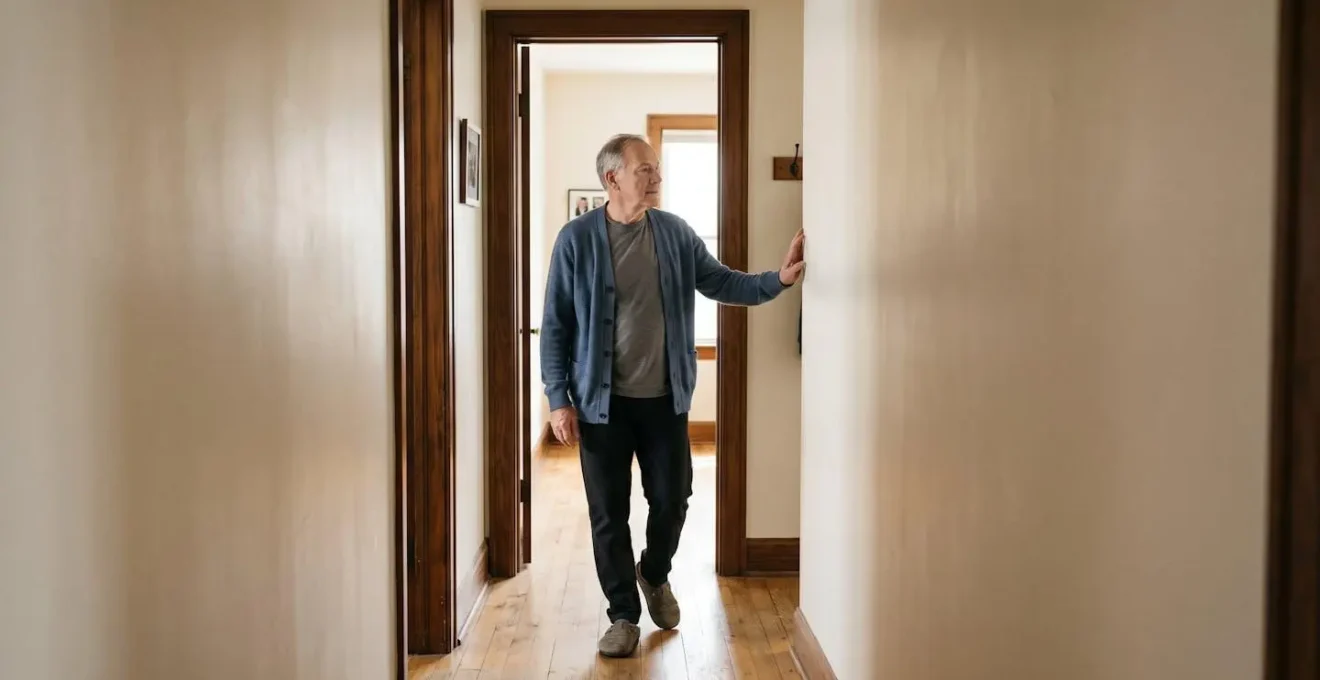
That recurring bump into the doorframe isn’t just ‘clumsiness’; it’s a sign your brain’s internal ‘GPS’ for your body—proprioception—is failing, but it can be retrained.
- Your body’s sense of position fades with age due to neurological changes, not just muscle weakness.
- Modern life, with its flat floors and cushioned shoes, actively ‘de-skills’ your brain’s ability to balance.
Recommendation: Start by performing simple, targeted exercises—like balancing on one leg while brushing your teeth—to actively ‘re-wire’ these lost connections and rebuild your spatial confidence.
It’s a frustratingly familiar moment. You walk through a doorway you’ve passed a thousand times, and—thump. Your shoulder or hip collides with the frame. It’s not a big deal, but it’s unnerving. You might dismiss it as a moment of distraction, or worse, a simple, unavoidable sign of getting older. You might have even had your eyes checked, only to be told your vision is fine. So why does your body seem to be misjudging its own boundaries in space?
The truth is more fascinating and far more fixable than you might think. This isn’t about your eyes or simple clumsiness. It’s a neurological glitch. Your brain operates an incredible, invisible system for knowing where your body is at all times, a kind of biological GPS called proprioception. After 60, the signals for this internal map can start to fade, get distorted, or arrive with a delay. The result? You miscalculate the width of your own body relative to the doorframe.
But here’s the crucial insight: this is not an irreversible decline. Your brain has a remarkable ability to adapt and relearn, a quality known as neuroplasticity. The problem isn’t that the GPS is broken forever; it’s that it needs recalibration. This guide moves beyond generic advice to “be more careful.” We will delve into the brain science of why this happens and give you a series of precise, targeted actions to reboot your body’s internal map, transforming your sense of balance from a source of anxiety into a skill you can consciously improve.
This article provides a detailed roadmap to understanding and retraining your body’s sense of position. Explore the sections below to discover the specific mechanisms behind your balance and the actionable steps you can take to regain control.
Contents: How to Stop Bumping into Doorframes
- What Is Proprioception and Why Does It Fade After 60?
- The Toothbrush Balance: How to Retrain Your Brain While Brushing?
- Pavement vs Grass: Why Walking on Flat Surfaces Makes You Clumsier?
- Thick Soles vs Barefoot: Can Your Shoes Blind Your Proprioception?
- Why Does a Sprained Ankle Permanently Damage Your Balance If Untreated?
- Why Closing Your Eyes Makes You Fall Over and How to Fix It?
- The One-Leg Stand: How to Wobble-Proof Your Ankles?
- Why Crunching Abs Is Useless If Your Transverse Abdominis Is Weak?
What Is Proprioception and Why Does It Fade After 60?
Proprioception is often called the “sixth sense.” It’s your brain’s silent, constant awareness of your body’s position, movement, and force. It’s how you can touch your nose with your eyes closed, know how hard to press a keyboard key, or walk without looking at your feet. This sense doesn’t come from your eyes or ears; it comes from millions of tiny sensors in your muscles, tendons, and joints called muscle spindles and Golgi tendon organs. They constantly send a torrent of data to your brain, creating a dynamic, real-time “body map.”
After the age of 60, this high-speed data connection begins to degrade. It’s a natural, but not irreversible, part of aging. Research confirms that older adults show significantly greater proprioceptive positioning errors, making it harder to judge joint angles and movement distances accurately. This explains why you might slightly misjudge a step or, yes, the width of a doorway. The reason for this decline is neurological. As one study notes:
An age-related decline in the proprioception is most likely associated with a decrease in the dynamic response of muscle spindles and the atrophy of axons that cause defects in the processing and input of sensory information.
– Researchers at PMC, The Importance and Role of Proprioception in the Elderly: a Short Review
In simple terms, the sensors become less responsive, and the “wiring” (axons) that carries the signal to the brain thins out. Your brain receives a slightly fuzzier, slower signal from your body’s GPS. The good news is that by challenging this system, you can encourage your brain to pay closer attention to the signals it does receive and even strengthen those pathways.
The Toothbrush Balance: How to Retrain Your Brain While Brushing?
The best way to rebuild neurological pathways is through consistent, daily practice. The secret is not to add another hour-long workout to your day, but to “stack” a new habit onto an existing one. Since you brush your teeth every day for a few minutes, this is the perfect opportunity to perform a powerful proprioceptive recalibration exercise: the single-leg toothbrush stand.
When you stand on one leg, you create an unstable environment. Your ankle begins to wobble, which might feel like a failure, but it is the exact opposite. Every tiny wobble is your nervous system in action. The sensors in your foot and ankle are firing off thousands of signals to your brain, which in turn sends instructions back to the tiny muscles in your leg to make micro-adjustments. This is active neurological training in real-time. You are forcing your brain to listen intently to the faint signals from your body’s GPS and respond with precision.
Starting this practice is simple but should be done with safety in mind. Stand near a wall or countertop for light support if needed. The goal is not perfect stillness but controlled instability. Here is a progressive plan to turn your daily dental hygiene into a balance masterclass:
- Week 1: Stand on one leg for the full two minutes while brushing, keeping your eyes open. Place your hand near a wall for safety. Switch legs for the next brushing.
- Week 2: While balancing, add short 5-second eye closures. This dramatically increases the difficulty by removing visual input, forcing your brain to rely solely on proprioception.
- Week 3: Stand on a slightly unstable surface, like a folded towel or a yoga mat. This further challenges your ankle’s stabilizing muscles and sensors.
- Week 4: While balancing, add slow, controlled head turns from left to right. This engages your vestibular system (inner ear) and trains your brain to maintain balance while your head is in motion, simulating real-world scenarios.
By integrating this simple exercise into your routine, you are consistently sending a clear message to your brain: “Pay attention to these signals; they are important.”
Pavement vs Grass: Why Walking on Flat Surfaces Makes You Clumsier?
Modern life has made us comfortable, but it has also made our nervous systems lazy. We live in a world of flat surfaces: smooth pavements, level floors, and perfectly engineered carpets. While easy on the joints, this predictable environment is a sensory desert for your feet. When you walk on a perfectly flat surface every day, your brain learns that it doesn’t need to pay much attention. It can run on autopilot because there are no surprises. This is how your proprioceptive skills become “de-skilled” and atrophy from lack of use.
Think of your feet as having their own “brains,” packed with sensors ready to detect subtle changes in texture, angle, and pressure. Walking on varied, uneven surfaces like grass, sand, or a forest trail is like a complex workout for these sensors. Every step is different, forcing your brain to wake up, process novel information, and make constant, tiny adjustments to maintain balance. This is why a short walk in a park can feel more neurologically engaging than a long walk in a shopping mall.
The science backs this up. A fascinating study explored how different surfaces impact proprioception, highlighting that exposure to natural, rugged terrain can be highly beneficial. This principle is even being applied to footwear.
Case Study: The Power of Minimalist Shoes on Rugged Terrain
A recent 2024 study published in the journal Biomechanics found that just three-minute walking bouts on surfaces mimicking rugged natural terrain significantly enhanced foot proprioception. Participants wore ultra-minimalist shoes, which filter out painful sharp sensations but still allow crucial sensory information about the ground’s texture and shape to reach the foot. This demonstrates that even brief, controlled exposure to varied sensory input can rapidly improve the brain’s awareness of joint position and enhance balance control.
You don’t need to live in the wilderness to reap these benefits. Simply making a conscious effort to walk on the grass instead of the pavement, or even walking barefoot at home on different floorings, can begin to reawaken those dormant sensory pathways.
Thick Soles vs Barefoot: Can Your Shoes Blind Your Proprioception?
Following the logic that varied surfaces awaken your brain, it stands to reason that what you put between your foot and the surface is critically important. For decades, the footwear industry has promoted thick, cushioned, supportive shoes as the pinnacle of comfort and safety. While they can be beneficial for high-impact sports, for everyday walking, these shoes can act like sensory deprivation chambers for your feet.
A thick slab of foam and rubber effectively mutes the conversation between your foot and the ground. Your brain, deprived of the rich sensory data about the texture and micro-angles of the surface, receives a muffled, indistinct signal. It’s like trying to read braille while wearing thick winter gloves. Over time, your brain learns to ignore the low-quality information coming from your feet and relies more heavily on vision to maintain balance. This over-reliance on vision is a fragile strategy, as it fails you in low-light conditions or when you’re simply not looking where you’re going.
The solution isn’t to throw out all your shoes and walk on gravel. It’s about a strategic approach called “shoe cycling” and reintroducing your feet to the world. The goal is to spend more time either barefoot in safe environments or in “minimalist” footwear—shoes with thin, flexible soles and a wide toe box that allows your foot to function naturally. This re-establishes the crucial brain-foot connection.
Your Action Plan: Shoe-Cycling for Proprioceptive Reawakening
- Morning Barefoot Routine: Spend 30-60 minutes walking barefoot at home each morning. The varied textures of hardwood, tile, and carpet provide excellent sensory input after a night of rest.
- Create a Proprioceptive Path: Arrange a sequence of textures at home—a fluffy bathmat, a folded yoga mat, a towel, the bare floor—and walk across them several times a day.
- Transition Footwear: For short walks outside, choose flexible, thin-soled shoes. Start with 15-30 minutes and gradually increase the duration as your foot strength improves.
- Balance Your Shoe Wardrobe: Reserve your cushioned shoes for specific high-impact activities. For everyday, controlled walking environments, default to minimal footwear to keep your brain engaged.
Why Does a Sprained Ankle Permanently Damage Your Balance If Untreated?
Have you ever sprained an ankle, perhaps decades ago? You rested it, the swelling went down, and you thought it was “healed.” Yet, you might notice that this is the ankle that feels less stable, the one you’re more likely to roll again. This is because an ankle sprain is not just a physical injury to ligaments; it is a profound neurological injury.
Your ankle joint is one of the most densely populated areas for proprioceptive sensors. When you severely sprain an ankle, you don’t just tear the ligaments; you damage the tiny nerve endings and mechanoreceptors embedded within them. You essentially cut the data cable that sends high-fidelity information about your ankle’s position to your brain. Without proper rehabilitation, the physical tissue may heal, but the neurological connection does not automatically repair itself. Your brain is left with a permanent blind spot in its body map.
This leads to a condition known as Chronic Ankle Instability (CAI). The brain, receiving poor data from the ankle, cannot react quickly enough to prevent another roll. As experts in the field have noted, the consequences are significant:
Chronic ankle sprains lead to serious proprioceptive dysfunctions, including deficits in joint position sense and delayed peroneal muscle reaction time, resulting in significant ankle instability and balance impairment.
– Clinical Trials Research Team, Effect of Stroboscopic Balance Training on Chronic Ankle Instability in Volleyball Players
This “delayed reaction time” is the key. When a healthy ankle starts to roll, the brain receives the signal in milliseconds and instantly fires the peroneal muscles on the outside of the lower leg to pull the ankle back into alignment. With a damaged proprioceptive link, that signal is slow and muddled. By the time the brain gives the command to contract, the ankle has already rolled too far. This isn’t a failure of muscle strength, but a failure of neurological speed and communication.
The takeaway is critical: if you have a history of ankle sprains, no matter how old, it is a major contributing factor to your current balance issues. The good news is that targeted balance exercises, like the one-leg stand, can help the brain re-learn how to interpret the weaker signals and improve that reaction time.
Why Closing Your Eyes Makes You Fall Over and How to Fix It?
Try this simple test: stand on one leg. Now close your eyes. For most people, the difficulty increases dramatically. This simple action reveals the three pillars of your balance system: your vision, your vestibular system (the fluid-filled canals in your inner ear that detect head motion), and your proprioception (the body map we’ve been discussing). Your brain integrates information from all three sources to keep you upright.
When your eyes are open, you are heavily reliant on your vision. You see the vertical lines of the doorframe, the horizontal line of the floor, and your brain uses these external references to orient itself. When you close your eyes, you remove one of the three pillars. Your brain is now forced to rely much more heavily on the information coming from your inner ear and your proprioceptive system. If your proprioceptive signals are already weak or “fuzzy” due to age or lack of training, removing the visual data can be enough to topple the entire system. You sway or fall because the remaining two pillars aren’t strong enough to do the job alone.
The solution is not to keep your eyes open all the time. The solution is to actively train your brain to trust and prioritize the non-visual signals. This process is called sensory re-weighting. It involves deliberately putting yourself in a situation where vision is removed, forcing the brain to amplify the volume on the signals coming from your feet and ankles. It’s a targeted exercise to make the proprioceptive pillar of your balance stronger and more reliable.
Your Action Plan: Sensory Re-weighting Protocol
- Safety Setup: Stand barefoot near a wall or a sturdy countertop. You should be within arm’s reach for safety but avoid touching it.
- Baseline Assessment: Stand with your feet hip-width apart and your eyes open for 30 seconds. Notice the small, constant adjustments your body makes.
- Eyes-Closed Transition: Now, gently close your eyes. Immediately shift your conscious attention to the soles of your feet. Feel the pressure points, the distribution of your weight, and the tiny movements.
- Sensory Focus Training: Resist the urge to panic. Instead, do a mental scan from your feet upwards. Where are your ankles? Are your knees locked or soft? Are your hips level? Focus on feeling your body in space, not on the fact that you can’t see.
- Progressive Duration: Start with holding the eyes-closed position for just 10 seconds. Open your eyes and reset. Gradually build up to 30, 45, or even 60 seconds as your brain becomes more confident in using non-visual balance information.
Practicing this daily teaches your brain a vital lesson: even when the world goes dark, it has the tools to know where it is and stay balanced.
The One-Leg Stand: How to Wobble-Proof Your Ankles?
We’ve established the one-leg stand as a foundational exercise, but its true power lies in its variations. The goal is not just to stand still but to build resilient, “smart” ankles that can respond to unexpected challenges. The key is to reframe your mindset: the wobble is not failure; the wobble is the training. Each oscillation is a successful repetition of your nervous system learning to adapt.
Once you are comfortable standing on one leg for 30 seconds, it’s time to add complexity. The real world is not static; you are often doing multiple things at once—walking while carrying groceries, turning your head to greet someone, avoiding an obstacle. Your training should reflect this. By adding small coordination challenges to your one-leg stand, you simulate this multi-tasking environment and build a much more robust and functional sense of balance.
These variations force your brain to divide its attention, making the balance component more automatic and reflexive—which is exactly what you need when navigating a busy environment. Here are some effective ways to level up your one-leg stand:
- Ball Toss Variation: While balancing, slowly toss a small, soft ball from one hand to the other. This engages your peripheral vision and forces your core to stabilize against the small shifts in weight.
- Alphabet Drawing: Raise your non-standing leg in front of you and use your foot to “draw” the letters of the alphabet in the air. This challenges the stabilizing muscles of your standing hip and your core.
- Towel Scrunch Complement: While seated, strengthen the intrinsic muscles of your feet—the foundation of your balance. Place a small towel on the floor and use only your toes to scrunch and pull it towards you.
- Cognitive Load Challenge: The ultimate test. Combine variations. For example, stand on one leg, draw letters with your other foot, and count backward from 100 by 3s. This forces your balance control to become truly subconscious.
”
By embracing the wobble and progressively adding these challenges, you are not just strengthening muscles; you are upgrading your brain’s balance software from a basic program to a sophisticated, adaptive operating system.
Key takeaways
- Your recurring clumsiness is likely a fixable decline in proprioception, your brain’s internal ‘GPS’, not an inevitable part of aging.
- Your feet and brain need varied sensory input; flat floors and cushioned shoes “de-skill” your natural balance mechanisms.
- True stability doesn’t come from surface abdominal muscles (crunches), but from the deep ‘internal corset’ of your transverse abdominis.
Why Crunching Abs Is Useless If Your Transverse Abdominis Is Weak?
When people think about “core strength” for balance, they instinctively picture sit-ups and crunches. This is a fundamental misunderstanding of how your core actually stabilizes your body. Crunches primarily work the rectus abdominis—the superficial “six-pack” muscle responsible for flexing your spine forward. While it looks good, this muscle does very little to provide the 360-degree stability needed to prevent a fall.
The true hero of your core is a deep, hidden muscle called the transverse abdominis (TVA). Think of it as your body’s built-in weight belt or an “internal corset.” It wraps around your entire midsection, from your ribs to your pelvis. When the TVA contracts, it pulls everything inward, increasing intra-abdominal pressure and creating a rigid, stable cylinder. This stable core provides a solid platform from which your limbs can move. If your core is a wobbly, unstable base, any movement in your arms or legs can be enough to throw you off balance. This is a huge, often-overlooked factor in falls among older adults, where more than 44% of older adults are at risk of falls due to diminished strength and balance.
The problem is, you can’t see your TVA, and most people don’t know how to consciously activate it. The “Stomach Vacuum” or “Abdominal Hollowing” technique is a specific neurological exercise designed to teach you how to find and engage this crucial muscle.
Your Action Plan: Transverse Abdominis Activation
- Starting Position: Lie on your back with your knees bent, feet flat on the floor, and spine in a neutral, relaxed position.
- Full Exhale: Breathe out all the air from your lungs.
- Abdominal Hollowing: Without holding your breath, draw your navel gently in toward your spine. Imagine you are trying to zip up a very tight pair of pants. The movement should be internal and subtle.
- Isolation Focus: Check that you are not tilting your pelvis or crunching your abs. Your ribcage should not move. You are creating tension inside, not making a big external movement.
- Hold and Breathe: Maintain this “hollowed” tension for 5-10 seconds while breathing shallowly. This is neurological training, not a breath-holding contest. Relax and repeat 5-10 times.
- Functional Integration: Once you can feel the TVA working while lying down, practice activating it while standing, walking, and especially as you reach for something or approach a doorway. This is your active, internal stabilizer.
Engaging this deep core muscle provides the unshakable foundation your entire balance system needs to operate effectively. By integrating these small, brain-focused exercises and awareness into your daily life, you are not just preventing bumps and bruises; you are actively taking control of your neurological health, rebuilding your body’s GPS, and ensuring you can continue to move through the world with confidence and grace.