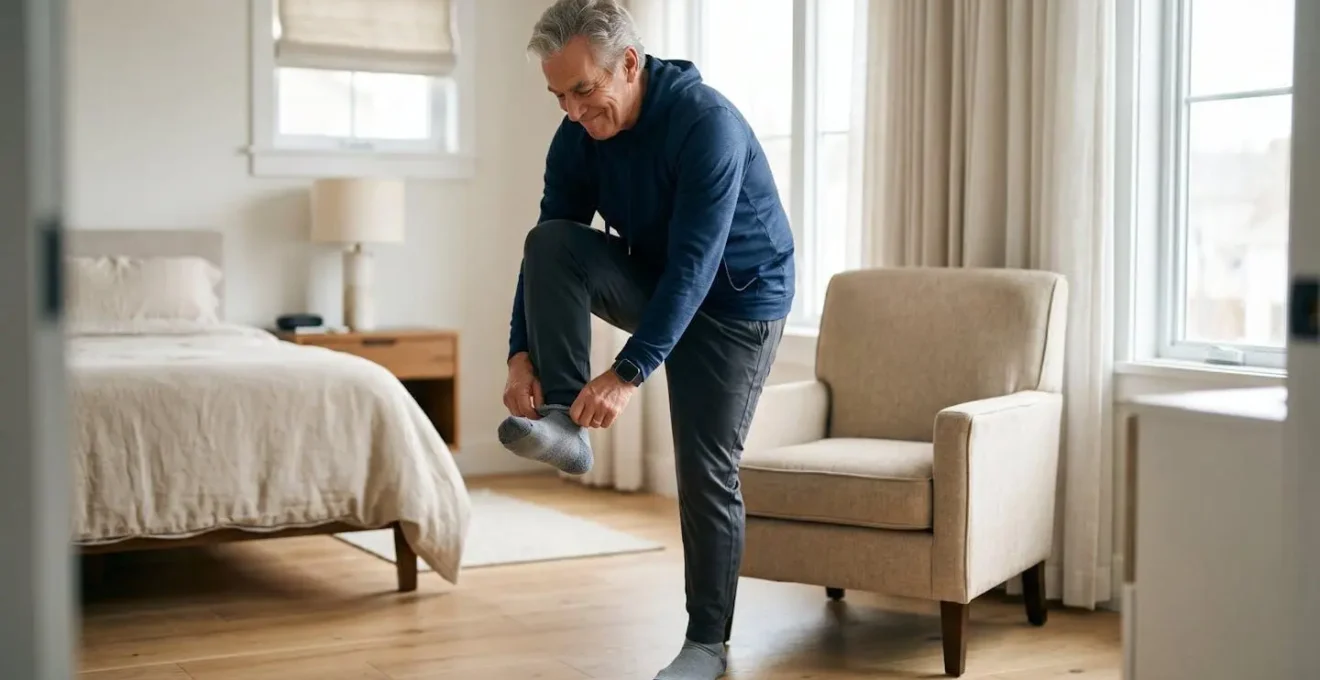
The difficulty of putting on a sock while standing is a critical warning sign of a broader decline in functional mobility, not just an isolated inconvenience.
- This simple act requires a complex sequence of hip flexibility, spinal mobility, and single-leg balance that erodes with disuse.
- Reclaiming this ability is possible by targeting the root causes, not just the symptom, through specific, safe, and functional exercises.
Recommendation: Shift your focus from generic stretching to “micro-dosing” targeted movements that restore the foundational range of motion required for daily independence.
There’s a quiet moment of frustration many people over 70 know well. It’s the pause before getting dressed, the calculation of whether to attempt putting on socks while standing or to simply give in and sit on the edge of the bed. It can feel like a small defeat, a concession to age. The common advice is predictable: buy a long-handled sock aid or just accept this new limitation. But this misses the point entirely.
This struggle isn’t about socks. It’s a critical signal from your body. It’s an early indicator of what can be called a “mobility cascade failure”—a chain reaction where the loss of one simple movement (reaching your foot) reveals underlying stiffness in the hips, a lack of mobility in the spine, and a decline in the balance and coordination needed to stand safely on one leg. These are the very foundations of staying active, independent, and avoiding falls.
But what if, instead of accommodating the loss, you could reverse it? The key is not to simply “stretch more.” The real solution lies in understanding the specific physical prerequisites for this task and rebuilding them with targeted, functional movements. It’s about restoring your body’s practical ability to move through the world with confidence.
This article deconstructs the challenge of putting on a sock. We will explore each component of the mobility cascade, from the brain’s internal map to the mechanics of your hips and spine. More importantly, we will provide safe, effective routines you can integrate into your day to systematically reclaim this skill and, with it, a vital piece of your independence.
Summary: A Functional Guide to Reclaiming the Mobility for Daily Tasks
- Why Reaching the Top Shelf Is a Use-It-or-Lose-It Skill?
- The 5-Minute Bed Routine to Unglue Stiff Hips Before Rising
- Yoga or Pilates: Which Is Better for Arthritic Spines?
- The Danger of Static Stretching Before Your Muscles Are Warm
- Why Do You Feel Stiffer When It Rains and How to Fix It?
- Why Weak Side-Glutes Cause Your Knees to Collapse Inward?
- The Cat-Cow Chair Variation: How to Loosen a Stiff Spine Safely?
- How to Get the Benefits of a Sun Salutation Without Leaving Your Chair?
Why Reaching the Top Shelf Is a Use-It-or-Lose-It Skill?
The ability to reach for something, whether it’s a can on the top shelf or your own foot, is more of a brain skill than a muscle skill. This ability is called proprioception: your brain’s internal map of where your body is in space. With age and inactivity, the resolution of this map can degrade. Your brain becomes less certain about the exact position of your limbs, leading to hesitant, less coordinated movements. This is a classic “use-it-or-lose-it” function.
A 2023 study highlighted this phenomenon, finding that aging significantly increases proprioceptive error in the upper limbs. The research revealed that older adults had higher endpoint and direction errors compared to younger individuals. This suggests the brain’s movement commands become less accurate, affecting the entire kinetic chain of reaching. When this “map” is blurry, the body compensates with slower, less efficient movements, and the risk of misjudgment increases.
This loss of proprioceptive accuracy has serious consequences beyond dressing. It is a primary contributor to fall risk. When your brain isn’t confident about where your foot will land, your balance system is compromised. Considering that approximately 30% of falls in adults aged 65+ result in grave injuries, maintaining and sharpening this brain-body connection is not a trivial pursuit. Every time you consciously reach, you are reinforcing these neural pathways and actively training your balance.
Therefore, practicing reaching in safe, controlled ways is a direct investment in your long-term stability and independence.
The 5-Minute Bed Routine to Unglue Stiff Hips Before Rising
Morning stiffness, particularly in the hips, is a major barrier to fluid movement and a key reason reaching your feet feels impossible. Before your feet even touch the floor, you can perform a simple routine to lubricate the hip joints and prepare your body for the day. The goal here is gentle, active movement, not aggressive stretching.
This gentle warm-up sends blood flow to the surrounding muscles and signals to your nervous system that you are about to move. Think of it as waking up your hips before you ask them to perform a complex task like bending and rotating.
As you can see, the focus is on slow, controlled motion within a comfortable range. Here is a simple 5-minute routine to perform while still lying in bed:
- Knee Hugs: Lie on your back. Gently pull one knee toward your chest, holding for 15-20 seconds. Feel the gentle stretch in your lower back and hip. Repeat 3 times on each side. This helps release the glutes and low back.
- Gentle Hip Circles: While still on your back with one knee bent toward your chest, use your hand to gently guide that knee in small, slow circles. Do 5 circles in each direction, then switch legs. This directly lubricates the hip socket.
- Windshield Wipers: Lie on your back with both knees bent and feet flat on the bed, about hip-width apart. Slowly let both knees fall to one side, keeping your shoulders on the bed. Hold for 10 seconds, then return to center and repeat on the other side. This promotes internal and external rotation of the hips.
By investing these few minutes before rising, you significantly reduce stiffness and improve the functional range of motion needed for activities like dressing.
Yoga or Pilates: Which Is Better for Arthritic Spines?
A stiff spine is another primary culprit preventing you from reaching your feet. When your spine can’t flex forward properly, your hips and hamstrings are forced to do all the work, which is often impossible. Both Yoga and Pilates are often recommended for improving flexibility, but when dealing with an arthritic or sensitive spine, the choice matters. While yoga offers immense benefits, the focus in Pilates on core stabilization and controlled, low-impact movements often makes it a safer and more effective starting point.
Pilates emphasizes strengthening the deep postural muscles that support the spine. This creates a “corset” of strength, which helps to de-load sensitive joints and vertebrae. As the IDEA Fitness Association points out in a case study on osteoarthritis:
Pilates is different from other exercise formats because its gentle movements are purposeful and stabilizing. Reclining on the apparatus is low-impact and helps prevent stress on joints, ligaments, and the cartilage surrounding joints.
– IDEA Fitness Association, Case Study: Pilates for Chronic Pain and Osteoarthritis
This focus on purposeful stability is key. Recent evidence supports this, as a 2023 randomized controlled trial on patients with ankylosing spondylitis, a type of inflammatory arthritis affecting the spine, found that practicing Pilates three times a week for eight weeks significantly improved strength, flexibility, and balance. The controlled nature of the exercises allows for spinal articulation without the high-impact or extreme ranges of motion that can sometimes aggravate arthritic conditions in yoga.
Ultimately, for seniors with spinal arthritis looking to regain flexion safely, Pilates often provides a more direct and controlled path to building the foundational core strength necessary for pain-free movement.
The Danger of Static Stretching Before Your Muscles Are Warm
A common piece of advice for stiffness is to “just do some stretches.” For many, this means sitting down, reaching for the toes, and holding a static stretch for 30 seconds. However, modern exercise science reveals this might be one of the worst things you can do for cold, unprepared muscles. Stretching a cold muscle doesn’t lengthen it; it can actually trigger a protective mechanism that makes it tighter and more prone to injury.
This protective mechanism is called the myotatic stretch reflex. As research from the National Strength and Conditioning Association explains, when you try to forcefully lengthen a cold muscle, its spindles send a danger signal to the spinal cord. The spinal cord’s immediate, involuntary response is to make the muscle contract to protect it from tearing. You are literally fighting against your own nervous system. Exercising on this now-tightened muscle increases the risk of strains.
Beyond the injury risk, pre-activity static stretching can temporarily reduce your muscle’s ability to produce force. While this might not matter for a casual walk, it’s critical for balance and stability. A comprehensive review of studies found that static stretching longer than 60 seconds per muscle group induces 4.0-7.5% declines in strength and power performances. For a senior, that small percentage can be the difference between catching your balance and falling.
The takeaway is clear: dynamic mobility, like the hip circles and knee hugs mentioned earlier, should precede activity. Save long, passive static stretches for after your walk or workout, when your muscles are warm and receptive.
Why Do You Feel Stiffer When It Rains and How to Fix It?
If you’ve ever felt that your joints can predict the weather, you are not alone. Many people, especially those with arthritis, report increased stiffness and achiness when it’s rainy or damp. While science is still exploring the exact mechanism, the leading theory relates to changes in barometric pressure. When a storm front moves in, the atmospheric pressure drops. This lower pressure may allow the tissues and fluids around your joints to expand slightly, putting pressure on nerves and causing a sensation of increased stiffness and pain.
However, there is also a significant behavioral component. On cold, rainy days, people are naturally less active. You are less likely to go for a walk, work in the garden, or run errands. This reduction in general movement means less blood flow, less joint lubrication, and more time spent in one position. This inactivity is a major contributor to the feeling of being “gummed up.”
The fix, therefore, is twofold. First, you can’t change the weather, but you can keep your body warm. Applying a heating pad to stiff areas or taking a warm bath can help soothe achy joints. Second, and more importantly, you must counteract the tendency to become sedentary. This is the perfect time for indoor “movement snacks.” Gentle, chair-based exercises or a few minutes of walking around the house can make a significant difference. The goal is to promote circulation and prevent your joints from “setting” in one position.
Instead of seeing a rainy day as a write-off, view it as an opportunity to practice your indoor mobility routines, ensuring that your joints stay as mobile as possible regardless of the weather outside.
Why Weak Side-Glutes Cause Your Knees to Collapse Inward?
To put a sock on while standing, you need to balance on one leg. One of the most common reasons this becomes difficult is a phenomenon called “knee valgus,” where the knee of your standing leg collapses inward. While it feels like a knee or ankle problem, the root cause is often located much higher up: in weak side-glute muscles, specifically the gluteus medius.
The gluteus medius is a fan-shaped muscle on the side of your hip. Its primary job is to keep your pelvis level when you stand on one leg. When this muscle is weak or isn’t firing correctly, it cannot counteract the force of gravity, so the hip on your lifted-leg side drops. To prevent you from falling over, your body finds a compensation: the knee of your standing leg dives inward to shift your center of mass back over your foot. This creates immense stress on the knee joint and makes balancing feel precarious.
Reactivating and strengthening this muscle is therefore crucial for single-leg stability. You don’t need heavy weights; the key is learning to engage the muscle in a controlled way. Simple, targeted exercises are highly effective at re-establishing this mind-muscle connection.
As illustrated, exercises that challenge your ability to keep your hips level are key. A simple standing leg lift to the side (abduction), while focusing on not letting your torso lean, is a perfect example. The goal is not to lift the leg high, but to feel the muscle on the side of your standing hip engage to keep you stable. This directly trains the skill needed for single-leg balance.
By strengthening these crucial stabilizers, you not only protect your knees but also build the solid foundation required to stand confidently on one leg while you attend to the other.
The Cat-Cow Chair Variation: How to Loosen a Stiff Spine Safely?
Segmental spinal mobility—the ability to move your spine vertebra by vertebra—is essential for the forward flexion needed to reach your feet. For many, the back moves as one rigid block. The classic Cat-Cow yoga pose is excellent for this, but getting on the floor can be a challenge. A chair-based variation provides all the benefits in a safe, accessible way, allowing you to focus purely on the movement of the spine.
This exercise gently mobilizes the entire spinal column, from the tailbone to the neck. It encourages blood flow to the discs between the vertebrae and helps to re-educate the muscles along the spine to allow for controlled flexion and extension. The key is to initiate the movement from the pelvis and let the rest of the spine follow in a wave-like motion, rather than just jutting your neck and shoulders.
Integrating your breath with the movement is not just a detail; it’s a critical component. A slow, controlled breath calms the nervous system, which can help release unconscious muscle guarding and allow for a greater, safer range of motion. Box breathing, in particular, can be highly effective.
Your Action Plan: Seated Cat-Cow for Spinal Health
- Starting Position: Sit in a sturdy chair with your feet planted firmly on the floor and your knees at a 90-degree angle. Sit towards the front edge of the chair.
- Hand Placement: Place your hands palm down on your knees, with your fingers pointing toward each other as much as is comfortable. Keep the heel of your hand on the outside of your lower thigh.
- Cow Phase (Inhale): As you inhale slowly, initiate the movement from your tailbone. Arch your spine, allowing your belly to move forward, your chest to lift, and your shoulders to roll back. Your gaze should lift naturally.
- Cat Phase (Exhale): As you exhale slowly, reverse the wave. Start by tucking your tailbone, then round your spine segment by segment. Let your chin drop toward your chest and allow your head to hang like a heavy pendulum.
- Breathing Integration: Sync the movement with your breath. Try a “box breath”: inhale for 4 counts during the Cow phase, hold briefly, exhale for 4 counts during the Cat phase, and hold briefly before repeating. Perform 8-10 slow cycles.
Practicing this daily will directly improve your ability to round your back in a controlled manner, bringing you one step closer to easily reaching your feet.
Key takeaways
- The struggle to put on a sock is a key diagnostic tool, revealing interconnected issues in your hips, spine, and balance.
- Focus on functional range of motion for daily tasks, not just passive flexibility. Your goal is to move better, not just stretch farther.
- Small, consistent, targeted “movement snacks” throughout the day are more effective and sustainable than infrequent, intense workouts.
How to Get the Benefits of a Sun Salutation Without Leaving Your Chair?
Now that we’ve addressed the individual components—hip mobility, spinal articulation, and balance—we can put them all together. A Sun Salutation in traditional yoga is a flowing sequence that links these movements. We can capture the essence of this sequence from the safety of a chair, creating a powerful mobility routine that warms up the entire body.
A chair sun salutation sequences movements for the spine, opens the hips, and activates the core, all while being supported. It’s a perfect way to integrate the principles we’ve discussed into a cohesive flow. It’s a form of moderate-intensity exercise that can help you meet established health guidelines without putting stress on your joints.
This kind of accessible, adaptable exercise is exactly what health organizations advocate for. In fact, according to CDC guidelines, adults age 65 and over should get at least 150 minutes per week of moderate-intensity exercise, including muscle-strengthening and balance activities. A chair sun salutation is a perfect example of an activity that checks all these boxes in a safe and sustainable way.
Start with one of the micro-routines in this guide. The goal is not perfection, but consistency. By re-engaging with these foundational movements, you are not just working towards putting on a sock while standing; you are actively rebuilding the foundation for a more mobile, confident, and independent life.