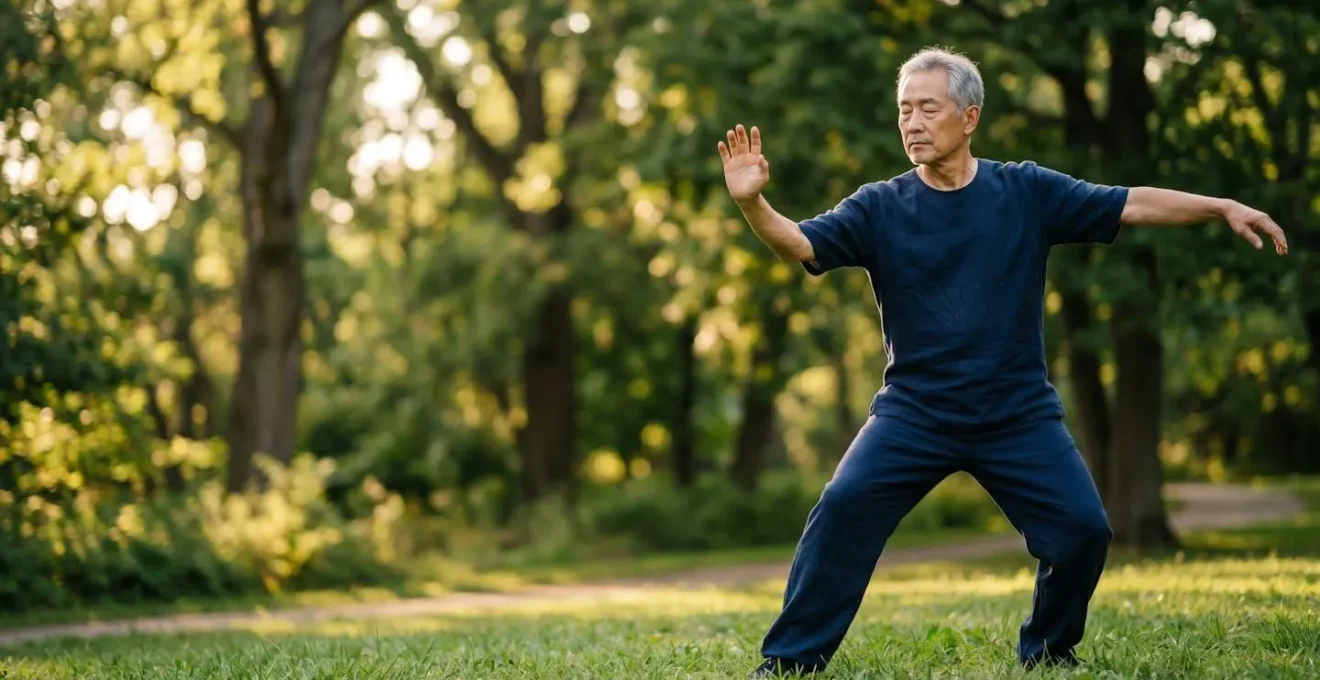
Tai Chi is more than just gentle exercise for seniors; it’s a powerful form of ‘neural re-education’ that rewires the brain to improve balance and reduce the perception of pain.
- It directly trains proprioception—your body’s internal sense of position—which is the root cause of many age-related falls.
- Memorising its slow, deliberate movements (“Forms”) is a proven way to increase brain volume and enhance cognitive functions like memory and decision-making.
Recommendation: Begin with the Sun style for its simpler, higher-stance movements, allowing you to focus on the essential mind-body connection without being overwhelmed.
For many seniors living with arthritis, the world can begin to feel smaller. Stiff joints, chronic pain, and a persistent fear of falling can transform simple activities into daunting challenges. In the search for relief, many turn to medication or resign themselves to a more sedentary life. Yet, a growing body of evidence, including recommendations from health bodies like the NHS, points towards an ancient practice: Tai Chi. It is often mentioned in the same breath as Qigong, another Eastern mind-body practice, but its specific methodology offers unique benefits.
The common advice is that Tai Chi is a “gentle, low-impact exercise,” which is true, but this description barely scratches the surface of its profound effects. It fails to explain *why* it is so uniquely effective for the challenges of ageing, particularly for arthritis and balance. The true power of Tai Chi lies not just in its gentle nature, but in its capacity to act as a form of deep, neural re-education.
This article moves beyond the platitudes. We will explore the specific mechanisms that make Tai Chi a potent tool for managing arthritis and reclaiming confidence. The key is not simply to move, but to learn to move with such profound awareness that you begin to retrain the very brain pathways that govern balance, pain perception, and even your sense of self in space. We will examine how this practice is not just a physical activity, but a form of brain training, an immunity booster, and a method for mastering your own perception of chronic pain.
This guide will walk you through the science and the soul of the practice, explaining how its core principles can be applied to improve your daily life. From choosing the right style to understanding its surprising cognitive benefits, you will discover why Tai Chi is one of the most powerful investments you can make in your long-term health and well-being.
Summary: The Science Behind Tai Chi for Arthritis and Balance
- Yang or Sun Style: Which Tai Chi Is Best for Senior Beginners?
- The 50% Statistic: How Slow Movement Retrains Your Brain to Stop Falls?
- Memorising the “Form”: Why Tai Chi Is Also Brain Training?
- Park or Hall: Why Practising Tai Chi Outdoors Boosts Immunity?
- How “Flow” State Reduces the Perception of Chronic Pain?
- The Biological Link Between Untreated Hearing Loss and Alzheimer’s
- Can You Really Fix BPPV Vertigo at Home with One Movement?
- Why Do You Keep Bumping Into Doorframes and How to Stop It?
Yang or Sun Style: Which Tai Chi Is Best for Senior Beginners?
Embarking on the path of Tai Chi begins with a simple question: where to start? With numerous family styles, each with its own history and emphasis, the choice can seem overwhelming. For seniors, especially those managing arthritis, the decision often narrows to two highly recommended styles: Yang and Sun. Both are excellent, but they serve the beginner in slightly different ways, focusing on different aspects of the practice.
The Yang style is the most popular and widely practised style in the world. It is characterised by its large, expansive movements, a relatively low stance, and a slow, even tempo. This style is excellent for developing strength, flexibility, and deep structural alignment. In fact, a 2023 meta-analysis of 24 randomized controlled trials found that Yang-style Tai Chi demonstrated greater effectiveness for fall prevention than Sun-style. Its emphasis on deep rooting and weight shifting provides a robust foundation for balance.
However, for a true beginner with significant joint stiffness, the lower stances and complex sequences of the Yang style can be challenging. This is where the Sun style shines. Developed by the master Sun Lutang, it incorporates elements from other internal martial arts, resulting in higher stances, more compact movements, and a lively, flowing quality. Its steps are agile, moving forwards and backwards like a gentle dance. This makes it physically less demanding and easier on the knees and hips, which is a primary concern for those with arthritis. As one of the world’s leading advocates for Tai Chi for health explains:
Sun style’s shorter, more repetitive forms are easier to memorise, making them ideal for beginners who want to focus on the mind-body connection without being overwhelmed by complex choreography.
– Dr. Paul Lam, Tai Chi for Health Institute – Tai Chi for Arthritis Program
Ultimately, the “best” style is the one you will practise consistently. For the senior beginner focused on pain relief and gentle mobilisation, the Sun style offers a more accessible entry point. For those with a bit more mobility and a focus on building deep stability, the Yang style provides a powerful path. The wisest approach is to find a qualified instructor and try a class, feeling which style resonates most with your body and your goals.
The 50% Statistic: How Slow Movement Retrains Your Brain to Stop Falls?
Headlines often report that Tai Chi can lead to a remarkable 50% reduction in injury-causing falls. While this figure is impressive, it often leads to the wrong conclusion: that Tai Chi is simply good “balance practice.” The reality is far more profound. Tai Chi doesn’t just improve balance; it fundamentally retrains the brain’s relationship with the body, a process of neural re-education that rebuilds a senior’s ability to remain stable from the ground up.
The true culprit behind many falls is a decline in proprioception—the body’s internal sense of its own position, motion, and equilibrium. It’s the silent sense that allows you to walk without looking at your feet. With age and arthritis, the signals from the nerves in our joints and muscles become weaker and less clear. Tai Chi directly addresses this by forcing the brain to listen intently. The extremely slow, deliberate movements act like a magnifying glass for sensation. You are asked to feel the precise transfer of weight from heel to toe, the subtle rotation of the waist, the exact position of your hand in space. This intense focus revitalises the neural pathways between your feet and your brain.
As you can see in the deliberate placement of the foot, this isn’t just movement; it’s a mindful dialogue with the ground. This practice rebuilds what is known as your “proprioceptive map,” giving your brain a clearer, higher-resolution picture of where your body is at all times. This allows for faster, more automatic corrections to minor wobbles before they become major falls. While the 50% figure is a powerful motivator, a comprehensive 2023 systematic review of 24 trials provides a more conservative but equally powerful finding: Tai Chi consistently reduces fall risk by about 24%, with benefits increasing the more you practice.
So, when you see a senior practising Tai Chi, you are not just watching gentle exercise. You are witnessing a deep process of neural recalibration. They are teaching their brain to trust their body again, rebuilding the subconscious foundation of balance one slow, mindful movement at a time. This, not a magical property, is the secret behind the dramatic reduction in falls.
Memorising the “Form”: Why Tai Chi Is Also Brain Training?
A Tai Chi class is a unique blend of physical activity and intense mental focus. The core of the practice involves learning a “Form,” a specific sequence of interconnected movements. To the observer, it looks like a slow, graceful dance. To the practitioner, it is a powerful cognitive exercise that has been shown to have measurable effects on the structure and function of the brain.
Memorising the Form—whether it’s the 24-step Yang style or a shorter Sun style sequence—is far more than rote learning. It requires a unique combination of cognitive skills. You must engage spatial memory (where your body is), sequential memory (what move comes next), and a high degree of focused attention to link each posture smoothly to the next. This constant mental workout stimulates the brain in a way that repetitive exercises like walking or cycling do not. It is this multi-layered cognitive engagement that makes Tai Chi a potent form of brain training.
The benefits are not just theoretical. Research is increasingly demonstrating Tai Chi’s positive impact on cognitive health. As a leading expert from Harvard Health points out, the practice specifically targets a crucial area of cognition:
In a meta-analysis of 20 studies on tai chi and cognition, tai chi appears to improve executive function—the ability to multitask, manage time, and make decisions—in people without any cognitive decline.
– Dr. Howard E. LeWine, Harvard Health Publishing
This improvement in executive function is critical for maintaining independence in later life. Even more strikingly, the practice appears to physically change the brain. Research published by Harvard Health highlights studies where brain volume increased the most in the Tai Chi group after 40 weeks of practice, outperforming groups that engaged in regular walking. This suggests that the complex interplay of mind and body required by Tai Chi stimulates neurogenesis, or the creation of new brain cells.
Therefore, learning the Form is not just about physical health. It is a direct investment in your cognitive reserve—the brain’s resilience to damage or decline. Every time you practice, you are not only lubricating your joints but also strengthening the neural architecture that supports a sharp and engaged mind.
Park or Hall: Why Practising Tai Chi Outdoors Boosts Immunity?
Tai Chi is often pictured being practised in serene parks at dawn, and this imagery holds a deeper truth than mere aesthetics. While the practice is beneficial anywhere, taking it outdoors, especially into a natural, green environment, can provide an additional, measurable boost to your immune system. This benefit comes from a hidden element in the air of forests and parks: phytoncides.
Phytoncides are antimicrobial volatile organic compounds released by trees and plants to protect themselves from insects and disease. When we walk through a forest or a park, we breathe in these invisible molecules. This practice of “forest bathing,” or *Shinrin-yoku* as it’s known in Japan, has been the subject of extensive scientific research, which has uncovered a remarkable effect on human immunity.
The key players here are our Natural Killer (NK) cells. These are a type of white blood cell that forms a crucial part of our innate immune response, acting as a first line of defence against viruses and even early-stage cancer cells. A cornerstone 2006 study demonstrated that exposure to phytoncides significantly increases both the number and the activity of these vital NK cells. The slow, deep, diaphragmatic breathing that is fundamental to Tai Chi practice is the perfect mechanism for drawing these beneficial compounds deep into the lungs.
Therefore, when you combine the mindful movement and deep breathing of Tai Chi with a natural setting, you create a powerful synergy. The Tai Chi itself reduces stress, which is known to suppress the immune system, while the forest air actively stimulates your body’s frontline defenders. You are not only cultivating internal balance but also absorbing an external, all-natural immunity booster. While practising in a hall is good, practising in a park is demonstrably better for your overall resilience. The serene environment calms the mind, and the air itself helps fortify the body.
How “Flow” State Reduces the Perception of Chronic Pain?
For anyone living with chronic arthritis pain, the idea of “mind over matter” can sound dismissive and unhelpful. Yet, the experience of Tai Chi offers a practical and profound demonstration of how the mind can genuinely alter the perception of pain. The mechanism lies in achieving a state of complete absorption known as “flow.”
The flow state, a concept popularised by psychologist Mihaly Csikszentmihalyi, is a mental state of being fully immersed in an activity, characterised by energised focus, full involvement, and enjoyment in the process. When you are “in flow,” your sense of time distorts, self-consciousness fades, and your attention is completely captivated by the task at hand. The continuous, circular, and interconnected movements of a Tai Chi Form are perfectly designed to induce this state. There is no start or stop, only a seamless transition from one posture to the next, requiring your complete concentration.
When the brain is in this deeply focused state, it has fewer cognitive resources available to process other signals—including chronic pain signals from arthritic joints. The pain may still technically be there, but the brain is too occupied to give it the spotlight. This isn’t just a distraction; it’s a neurological reprioritisation. The brain is learning to focus on the pleasant sensations of fluid movement, balance, and breath, rather than being held captive by the constant, nagging signals of pain. This experience can provide significant, if temporary, respite, and with consistent practice, it can help lower the baseline level of perceived pain over time.
The clinical evidence supports this experience. A 2016 systematic review in Scientific Reports analyzing multiple studies found that Tai Chi had a significant and immediate effect on reducing pain in patients with chronic conditions like osteoarthritis. The researchers concluded that Tai Chi was a viable and effective therapy for pain management. The practice gives individuals an active tool to manage their own condition, empowering them to find moments of relief and control that medication alone often cannot provide.
The Biological Link Between Untreated Hearing Loss and Alzheimer’s
At first glance, Tai Chi seems unrelated to complex neurological conditions like Alzheimer’s disease. However, when we look at the intersecting risk factors, a surprising and powerful connection emerges. One of the most significant, yet often overlooked, risk factors for dementia is untreated, age-related hearing loss. Tai Chi, with its unique cognitive and social demands, offers a protective benefit that is particularly valuable in this context.
Untreated hearing loss is believed to contribute to cognitive decline through several pathways. One is cognitive load: the brain has to work much harder to decode sounds, diverting mental resources that would otherwise be used for memory and thinking. Another is social isolation; difficulty in hearing can lead people to withdraw from social situations, which are crucial for cognitive stimulation. Tai Chi practice directly counteracts these issues. Learning a complex sequence of movements in a group setting provides robust cognitive and social stimulation that does not rely heavily on auditory processing.
A remarkable 2023 study published in JAMA Network Open provides strong evidence for this. Researchers followed adults with mild cognitive impairment and found that the group practising Tai Chi showed significantly greater cognitive improvements than groups that did fitness walking or received standard care. The study’s authors suggested that the visual learning and social interaction inherent in a Tai Chi class provide a rich cognitive environment that is highly accessible to those with hearing challenges.
Furthermore, Tai Chi has been shown to directly enhance brain connectivity. A separate study found that just 12 weeks of Tai Chi training significantly increased the functional connectivity between the prefrontal cortex (responsible for decision-making) and the hippocampus (crucial for memory). By strengthening these vital neural networks and providing an engaging, non-auditory path to cognitive stimulation, Tai Chi serves as a powerful tool to build cognitive reserve, potentially mitigating some of the very pathways through which hearing loss can accelerate cognitive decline.
Can You Really Fix BPPV Vertigo at Home with One Movement?
Benign Paroxysmal Positional Vertigo (BPPV) is a common and disorienting condition where small calcium crystals in the inner ear become dislodged, causing intense, brief episodes of dizziness. While specific manoeuvres like the Epley can physically reposition these crystals, Tai Chi addresses a different, equally important aspect of vertigo: the lingering fear of falling and the loss of confidence in one’s own balance.
Tai Chi does not “cure” BPPV in a mechanical sense. It cannot put the crystals back in place. What it does, however, is rebuild the brain’s trust in the body’s balance systems. The practice is a masterclass in managing equilibrium. By intentionally moving to the very edge of your stability and then recovering with slow, controlled precision, you are essentially giving your brain a safe, structured “training course” in balance recovery. This is profoundly different from the sudden, uncontrolled sensation of a vertigo attack.
This process of building what is known as “balance confidence” is critical. After a BPPV episode, it is common for individuals to become hyper-vigilant and fearful, restricting their movements to avoid triggering another spell. This fear can be more debilitating than the condition itself. Tai Chi offers a gentle, progressive way to challenge this fear. It teaches you that you can feel a slight wobble and not panic, that you can recover your center, and that your body is more resilient than you think. As Dr. Paul Lam notes, this psychological component is a key part of the practice’s success in fall prevention.
The results of this confidence-building are dramatic. Research from the Tai Chi for Health Institute has shown up to a 70% reduction in recurring falls among practitioners. For someone recovering from BPPV, this is a life-changing statistic. It means that even if the underlying mechanical issue is managed, Tai Chi provides the essential rehabilitation for the mind, restoring the confidence needed to move freely and without fear. It replaces the memory of chaotic dizziness with an embodied knowledge of calm, centered stability.
Key Takeaways
- Tai Chi is not just exercise; it’s a form of neural re-education that retrains the brain for better balance and pain management.
- Different styles serve different needs: Sun style is ideal for beginners with arthritis due to its higher stances, while Yang style is excellent for building deep stability.
- The practice directly improves proprioception (your body’s sense of position), which is the most effective way to prevent falls at a fundamental level.
Why Do You Keep Bumping Into Doorframes and How to Stop It?
It’s a subtle, often frustrating sign of ageing: misjudging space. You turn a corner and your shoulder clips the doorframe. You reach for a glass and knock it over. These small collisions are not just clumsiness; they are often the result of a slight decline in proprioception and spatial awareness. Your brain’s internal map of your body and the space it occupies is becoming less precise. Tai Chi offers a direct and elegant solution to this very problem.
The entire practice of Tai Chi is an exercise in dynamic spatial awareness. You are constantly required to know where your hands, feet, and torso are in relation to each other and to the space around you, all without looking. This strengthens the neural pathways responsible for that internal body map. A recent study confirmed this, finding that long-term Tai Chi students showed significantly superior inhibitory control and working memory compared to non-practitioners—key cognitive skills for navigating a complex environment.
The practice teaches you to move from your “Dan Tian,” or center, located just below the navel. You learn to move as a unified whole, rather than as a collection of separate limbs. This creates a strong sense of your own “bubble” of personal space. When you move with this centered awareness, you are less likely to let a stray arm or shoulder drift into an obstacle. You are moving your center through the world, and the rest of your body follows in a coordinated, protected way.
This abstract concept can be translated into a very practical, immediate technique you can use every day to stop bumping into doorframes. It’s a simple mindfulness exercise inspired by the core principles of Tai Chi.
Action plan: The Mindful Doorway Technique
- Pause: Before walking through a doorway, stop completely for one second. Resist the automatic urge to rush through.
- Breathe: Take one conscious breath. This simple act brings your attention out of your thoughts and into the present moment.
- Sense: Briefly feel the width of your own shoulders. Notice the position of your arms. This activates your proprioceptive awareness.
- Visualize: Imagine a “bubble” of personal space around your entire body, extending a few inches from your skin. Your goal is not to get your body through the door, but to guide this bubble through.
- Proceed: Walk through the doorway slowly and deliberately, focusing on guiding the center of your bubble through the center of the frame. Notice the feeling of clearing the space on both sides.
This technique transforms a mundane action into a moment of mindful practice. It takes only a few seconds, but it actively rehearses the very skills that prevent collisions. It is a perfect example of how the profound principles of Tai Chi can be applied to solve the small, everyday challenges of moving through the world with grace and awareness.