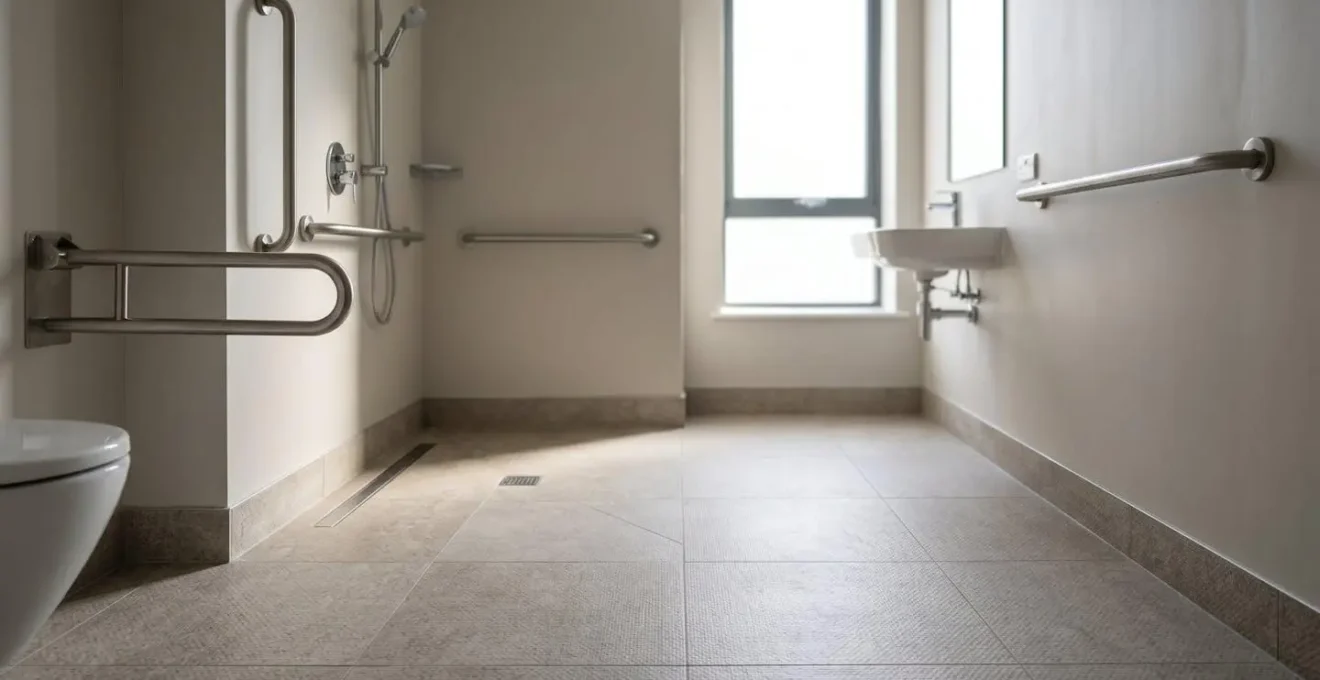
The decision between a wet room and a tray is secondary; the primary goal is creating a holistic ‘ecosystem of safety’ that anticipates future mobility needs.
- A true wet room offers zero-threshold access, eliminating the single greatest trip hazard, which is crucial for wheelchair use and preventing falls.
- While a wet room represents a higher initial investment, its universal design can increase home value by appealing to a growing demographic.
- The safety system extends beyond the floor to include correctly positioned grab rails, thermostatic valves, and appropriate seating.
Recommendation: Prioritize a true, professionally installed wet room for any renovation intended to be a ‘forever bathroom’, as it provides the only truly future-proof solution against mobility decline.
When planning a bathroom renovation with an eye on the future, the conversation often begins with a simple question: shower tray or wet room? Homeowners weigh the perceived cost and complexity of a wet room against the familiarity of a low-profile tray. This debate, however, misses the fundamental point. Designing a ‘forever bathroom’—one that remains safe, functional, and comfortable as mobility changes, potentially including wheelchair use—is not about choosing a single product. It’s about designing an integrated ecosystem of safety where every component works in concert to prevent the one fall that can change everything.
The true challenge isn’t just about creating a level-access shower. It’s about analysing every potential failure point in the room, from the risk of a scald due to decreased sensation to the stability of a grab rail during a difficult transfer. The most successful accessible bathrooms are those where the safety features are so elegantly integrated they become invisible, enhancing the space’s luxury and comfort rather than giving it a clinical feel. This approach requires a shift in mindset: from simply renovating a room to strategically engineering a long-term, independent living space.
This guide moves beyond the surface-level debate. We will dissect the critical components of this safety ecosystem, examining the technical details that make a genuine difference. From the science of trip hazards and the precise placement of supports to the financial implications and structural challenges in older homes, you will gain the forward-planning perspective needed to make an informed decision that ensures safety and peace of mind for decades to come.
To navigate this comprehensive overview, we will explore the interconnected elements that contribute to a truly future-proof bathroom. The following sections break down each consideration, providing the technical insights necessary for your project planning.
Summary: A Technical Guide to Future-Proofing Your Bathroom
- R10 or R11: Which Smartwatch Can Accurately Detect Atrial Fibrillation in Seniors?
- Vertical or Horizontal: Where Should Rails Go for Maximum Stability?
- Thermostatic Valves: Preventing Scalds When Sensation Fades
- Does Removing the Bath Devalue Your Family Home?
- Fold-Down or Freestanding: Which Shower Seat Is Safest?
- The Throw Rug: Why Is It the Number One Enemy of Senior Safety?
- VAT Relief: Can You Claim Back Tax on Accessibility Handles?
- How to Retrofit a Victorian Terrace for Safe Independent Living?
R10 or R11: Which Smartwatch Can Accurately Detect Atrial Fibrillation in Seniors?
While the headline feature of many smartwatches is heart-rate monitoring, for a bathroom safety ecosystem, their most critical function is fall detection. The title’s focus on non-slip ratings (R10/R11) and AFib detection is a distraction from the primary digital safeguard: automated emergency alerts. A waterproof smartwatch acts as a personal alarm, a silent guardian that can call for help even if the user is incapacitated. It is the digital layer of your safety net, extending protection beyond the physical installations of the room itself.
However, it’s crucial to approach this technology with a technical understanding of its limitations. Wrist-worn devices are not infallible. While one cross-sectional study showed a 77% sensitivity for fall detection, this means nearly a quarter of falls could be missed. The technology is far more effective at detecting severe, high-impact falls than slower, sliding falls, which are common in a wet environment.
As the SafeHome.org Research Team notes, this performance gap is significant when compared to other types of sensors. Their research highlights a key consideration for those requiring the highest level of assurance:
Research shows fall detection sensors worn on the head, torso, or pelvis can achieve approximately 95% accuracy — significantly higher than wrist-worn smartwatches.
– SafeHome.org Research Team, Smartwatch Fall Detection Accuracy Comparison Study
For a homeowner planning for the future, a waterproof smartwatch is an excellent, accessible first line of digital defence. But for those with immediate and high-risk mobility concerns, it should be seen as one component within a broader system that might include more specialised, body-worn sensors for maximum reliability.
Vertical or Horizontal: Where Should Rails Go for Maximum Stability?
Grab rails are the most visible component of a bathroom’s safety ecosystem, but their effectiveness is entirely dependent on correct placement. Incorrectly positioned rails are not just unhelpful; they can be dangerous, creating a false sense of security. The choice is not simply “vertical or horizontal,” but rather a strategic mapping of rails to specific movements and potential failure points within the bathroom. With 17.3% of falls with injury occurring in the bathroom, precision in this area is non-negotiable.
The orientation of a rail directly relates to the force being applied. A user pulling themselves up from a seat or into a shower requires a different type of support than someone pushing up or steadying themselves while standing. For future wheelchair use, the “transfer zone”—the area where a person moves from the chair to the toilet or shower seat—becomes the most critical location for support.
A combination of rail types is almost always the superior solution, creating a network of support throughout the room. Here are the core principles for maximum stability:
- Vertical Rails: These are primarily for pulling actions. They are essential at the entrance to the shower or bath, allowing a user to use their body weight to pull themselves over a small threshold or into the space. They provide a continuous gripping point through a range of motion.
- Horizontal Rails: These are designed for pushing up from a seated position or for providing support while standing or moving laterally. The most critical horizontal rail is next to the toilet, positioned at a specific height (typically 680mm from the floor) to aid in sitting and standing.
- L-Shaped or Angled Rails: These offer the benefits of both orientations and are exceptionally useful in corners or within the shower, providing a stable grip as a person changes position from standing to sitting.
- Drop-Down Rails: Essential for wheelchair transfers to a toilet, these must be robust enough to support full body weight and lock securely in place. They provide support on the open side of the transfer zone.
Finally, the most important consideration is anchorage. A rail is only as strong as its fixing. Installation into brick or block walls is straightforward with the correct plugs, but on stud walls, the rails must be fixed directly into the timber studs or onto a reinforced panel (such as marine-grade plywood) installed behind the wall finish. Never rely on plasterboard fixings for a safety-critical grab rail.
Thermostatic Valves: Preventing Scalds When Sensation Fades
While falls are the most discussed hazard in bathroom design, the risk of scalding is a serious, often overlooked danger, particularly for older adults or individuals with conditions that reduce skin sensation, like diabetes. A complete bathroom safety ecosystem must protect against all forms of potential harm. Installing a thermostatic mixing valve (TMV) is not a luxury upgrade; it is a critical safety component for any “forever bathroom.” With over 235,000 people needing emergency care for bathroom injuries annually in the US, mitigating every possible risk is paramount.
A standard shower mixer combines hot and cold water, but it cannot react to changes in the water supply. If someone flushes a toilet elsewhere in the house, the cold water pressure can drop suddenly, causing a surge of dangerously hot water from the shower head. For a person with delayed reactions or diminished sensation, this can lead to severe burns in seconds. A thermostatic valve entirely eliminates this risk.
The valve’s internal mechanism constantly senses the temperature of the mixed water. If it detects a fluctuation in the hot or cold supply, it instantly adjusts the mix to maintain the pre-set temperature, typically within a single degree. More importantly, high-quality TMVs have a fail-safe feature: if the cold water supply fails completely, the valve will automatically shut off the flow of hot water, preventing any water from exiting the shower head. As the experts at Absolute Mobility point out, this is a non-negotiable feature for accessible design:
Thermostatically controlled shower mixers deliver water at reliable temperatures – a key safety feature for wheelchair users.
– Absolute Mobility, Small Disabled Wet Room Layout Design Guide
When planning for future wheelchair use, consider shower controls that are easy to operate with limited hand strength or dexterity. Lever-style handles are preferable to small, round knobs. The placement of the controls is also vital; they should be reachable from both a standing and a seated position without requiring the user to lean into the water stream. This forward-thinking approach ensures the shower remains safe and usable, regardless of future changes in physical ability.
Does Removing the Bath Devalue Your Family Home?
One of the most common concerns homeowners face when considering a full wet room is the fear of devaluing their property by removing the only bathtub. For decades, estate agents have touted a “family bathroom” with a bath as a prerequisite for a successful sale. While this may have been true in the past, the market and its demographics are changing. The concept of “value” is shifting from a checklist of features to the quality and flexibility of the living space. A thoughtfully designed, accessible wet room can, in fact, be a significant value-add.
The key is to avoid a clinical, institutional look and instead embrace “invisible accessibility”—a design philosophy where safety and function are seamlessly integrated into a luxurious, high-end aesthetic. This approach not only creates a beautiful space for the current owner but also broadens its appeal to a much wider range of future buyers. The numbers support this: a universal design bathroom remodel has a tangible financial benefit. A report from Zonda found a 49% return on investment at resale for such projects.
The logic is simple demographics. As populations age, the demand for homes that support “aging in place” is growing rapidly. A home with a pre-existing, beautifully executed accessible bathroom is a powerful differentiator. It appeals not only to older buyers but also to multi-generational families looking for a flexible home that can accommodate relatives with mobility issues. An accessible bathroom is no longer a niche feature; it is becoming a mark of a premium, thoughtfully designed property.
Case Study: Aging-in-Place as a Market Advantage
An accessible, thoughtfully designed bathroom appeals to a broader range of future buyers. With the U.S. Census Bureau projecting the population aged 65+ to grow by almost 30% over the next 25 years, homes with well-designed accessible bathrooms increasingly appeal to buyers seeking safe, flexible spaces for multi-generational living, potentially increasing property value.
The fear of devaluing a home by removing the bath is outdated. The greater risk is creating a bathroom that is inaccessible and unsafe for a significant and growing portion of the housing market. A well-designed wet room is not a compromise; it is an investment in future flexibility, safety, and, ultimately, property value.
Fold-Down or Freestanding: Which Shower Seat Is Safest?
A shower seat is an essential component for anyone with balance issues, limited endurance, or for enabling a safe, seated transfer from a wheelchair. The choice between a wall-mounted, fold-down seat and a freestanding shower chair is a critical decision in the design of the safety ecosystem, with significant implications for stability, flexibility, and hygiene. As Robbins Construction notes, “Shower seating is especially helpful for homeowners with limited mobility or balance concerns. Built-in benches, fold-down seats, and portable chairs provide comfort and stability while showering.”
The primary determinant of safety in a wall-mounted seat is not the seat itself, but the wall it is attached to. A fold-down seat offers excellent space efficiency, but its weight capacity is entirely dependent on the quality of its installation and the strength of the underlying wall structure. If the wall cannot be adequately reinforced—for example, by fixing directly to multiple studs or installing a solid blockwork/plywood pattress—a wall-mounted seat poses a serious failure risk. A freestanding chair, by contrast, has an independent load rating and is often the safer choice for bathrooms with weak or uncertain wall structures.
This table outlines the core technical differences to guide your decision:
| Feature | Fold-Down Wall-Mounted | Freestanding/Portable |
|---|---|---|
| Installation Requirement | Requires reinforced wall structure, solid mounting to studs or masonry | No installation; immediate use |
| Weight Capacity Dependency | Limited by wall strength and fixing quality; failure risk with inadequate mounting | Independent load rating; superior for weak or uncertain wall structures |
| Positioning Flexibility | Fixed location dictates user’s final position | Can be positioned perfectly for optimal wheelchair transfer |
| Hygiene & Maintenance | Hinges and crevices prone to mould and bacteria accumulation | Fully cleanable; easy to sanitize all surfaces |
| Space Efficiency | Folds away when not in use, maximizing floor space | Occupies floor space; wheeled models offer compromise |
For future wheelchair use, flexibility is paramount. A freestanding chair can be positioned at the perfect angle and distance for a safe transfer, an advantage a fixed seat cannot offer. Furthermore, freestanding models are far easier to clean thoroughly, preventing the buildup of mould and bacteria in hinges and crevices, which is a common issue with wall-mounted units. While a fold-down seat appears sleeker, a high-quality, medically-rated freestanding chair is often the more practical and safer long-term solution.
The Throw Rug: Why Is It the Number One Enemy of Senior Safety?
In the context of a “forever bathroom,” the greatest risks often come from the smallest details. While we focus on major installations, the most frequent cause of falls is often a seemingly innocuous object: the throw rug or bath mat. The very concept of a level-access wet room is to eliminate transitions, yet adding a loose mat reintroduces the single most dangerous element back into the environment. Studies confirm the scale of the problem: over 80% of elderly falls occur in bathroom environments, and small, unexpected level changes are a primary catalyst.
The danger lies in a cognitive bias known as the “small step fallacy.” Our brains are adept at processing and navigating significant changes in elevation, like a full flight of stairs. However, we are notoriously poor at registering minimal height changes of just a few millimetres to a centimetre—the exact thickness of a typical rug edge or a shower tray lip. We don’t consciously register the hazard, so we don’t adjust our gait, leading to a toe catch, a stumble, and a fall.
This is not a matter of carelessness; it is a predictable neurological failure that becomes more pronounced with age as vision, balance, and proprioception naturally decline.
The Science of the Small Step Fallacy
Research demonstrates that more than a third of seniors over age 65 slip and fall each year. The ‘small step fallacy’ explains why our brains poorly judge minimal height changes—whether a 1-inch rug edge or shower tray lip—making both disproportionately dangerous. The National Safety Council confirms that the aging process affects vision, strength, and balance, making adults 65+ particularly vulnerable to these imperceptible elevation changes.
This is the fundamental argument for a true wet room over a low-profile tray for any long-term accessibility plan. A low-profile tray, even one that is only 20-30mm high, still presents that “small step” hazard. A properly constructed wet room with a built-in gradient and a linear drain has zero thresholds. The floor is a continuous, unbroken plane, completely eliminating the small step fallacy from the equation. The solution to slipping is not a rug; it is a high-quality, R11-rated non-slip tile finish across the entire floor.
Key Takeaways
- Think in Ecosystems: View your bathroom not as a collection of items, but as an integrated safety system where the floor, rails, valves, and even digital aids work together.
- Eliminate All Thresholds: The primary goal for future-proofing is to create a single, continuous floor level. A true wet room is the only way to completely remove the “small step” trip hazard.
- Plan for Failure Points: Analyse every movement—sitting, standing, transferring—and install specific supports (rails, seats) at those critical points to prevent falls.
VAT Relief: Can You Claim Back Tax on Accessibility Handles?
Creating a comprehensive bathroom safety ecosystem is a significant investment. Fortunately, in many regions, governments recognize the social and economic benefits of helping people live independently at home for longer. They often provide financial assistance through grants or tax relief for adaptations that are medically necessary. While the specifics vary by country, the underlying principle is the same: to reduce the financial barrier to creating a safe living environment. For example, in the UK, homeowners can sometimes access support like the Disabled Facilities Grant (DFG), which provides up to £30,000 for necessary accessibility adaptations.
The question of tax relief is often misunderstood. In jurisdictions like the UK that have a Value Added Tax (VAT), it’s typically not a case of “claiming back” tax after the work is done. Instead, the supply and installation of qualifying adaptations can be zero-rated for VAT, meaning the tax is never charged in the first place. This relief usually applies to the entire project—including materials, labour, and design—if the primary purpose of the work is to meet the needs of a person with a qualifying disability or chronic illness. It’s not limited to specific items like grab rails.
Navigating this process requires a structured approach. While you must consult local government resources and tax professionals for regulations specific to your location, the general pathway to exploring financial support follows a clear logic.
Your Action Plan for Exploring Financial Support
- Obtain a Professional Assessment: The first step is almost always an assessment from a qualified professional, like an Occupational Therapist (OT). Their report will document your mobility needs and formally recommend specific adaptations, forming the basis of your application.
- Confirm the Project’s Primary Purpose: The work must be for enabling accessibility, not primarily for aesthetic upgrades. The OT’s report is key evidence here.
- Engage with Your Installer Early: Discuss tax relief with your chosen bathroom installer before any work begins or deposits are paid. They will need the correct documentation (like a declaration form) to zero-rate the invoice. You cannot claim it back retrospectively.
- Understand the Scope of Relief: Clarify exactly what the grant or tax relief covers. In many cases, it includes the full wet room installation, specialized shower toilets, grab rails, and all associated building work.
- Maintain Meticulous Records: Keep a complete file containing the OT report, installer certifications (e.g., for waterproofing), invoices, and grant approval letters. This documentation is crucial for your records and for future property sale provenance.
How to Retrofit a Victorian Terrace for Safe Independent Living?
Implementing a modern wet room in a period property, such as a Victorian terrace, presents unique structural challenges. However, with expert planning and modern materials, it is entirely achievable. These projects highlight the core principles of holistic retrofitting, where the bathroom solution must be integrated with the building’s specific constraints. The most significant issue in older homes with suspended timber floors is managing weight and drainage.
Traditionally, wet rooms were formed using a heavy sand and cement screed to create the floor gradient, a method that is often too heavy for suspended timber joists. This is what’s known as the ‘joist problem’. Modern solutions completely bypass this issue. Lightweight, high-density foam formers or reinforced, low-profile trays can be installed directly onto the joists. These formers are pre-sloped, 100% waterproof, and strong enough to be tiled over directly, providing the structural base for the wet room without imposing dangerous weight loads on the old timber structure.
Solving the ‘Joist Problem’ in Period Properties
The primary challenge in Victorian terraces is the ‘joist problem’—suspended timber floors make traditional heavy screed wet rooms risky or impossible. Modern lightweight foam formers or reinforced low-profile trays offer expert solutions. Additionally, drainage is critical: wet rooms can be installed anywhere if services are suitably located, but careful planning of the drainage point influences gradient positioning, which affects furniture placement and layout flow. Professional design advice is crucial when planning accessible wet rooms in period properties.
Ventilation is another critical factor in a successful retrofit. Victorian homes are often less insulated and more prone to damp than modern constructions. As the experts at Age Care Bathrooms warn, proper mechanical extraction is not an optional extra:
Highlighting the crucial role of ventilation: in older, less-insulated homes prone to damp, installing a wet room without a powerful, humidistat-controlled extractor fan is a recipe for mould and long-term structural damage.
– Age Care Bathrooms, Elderly and Disabled Wet Rooms Installation Guide
Retrofitting a Victorian terrace is a masterclass in accessible design. It proves that with the right technical approach—addressing structure with lightweight formers, managing damp with powerful ventilation, and designing the space around a well-planned drainage point—a safe, effective, and beautiful safety ecosystem can be created in any home.
Ultimately, creating a “forever bathroom” is an act of foresight. It requires looking beyond immediate needs and designing a space that provides safety, dignity, and independence for years to come. By focusing on an integrated ecosystem of safety rather than isolated products, you invest not just in your home, but in your long-term quality of life. The next logical step is to consult with a specialist designer who can translate these principles into a tailored plan for your specific home and needs.