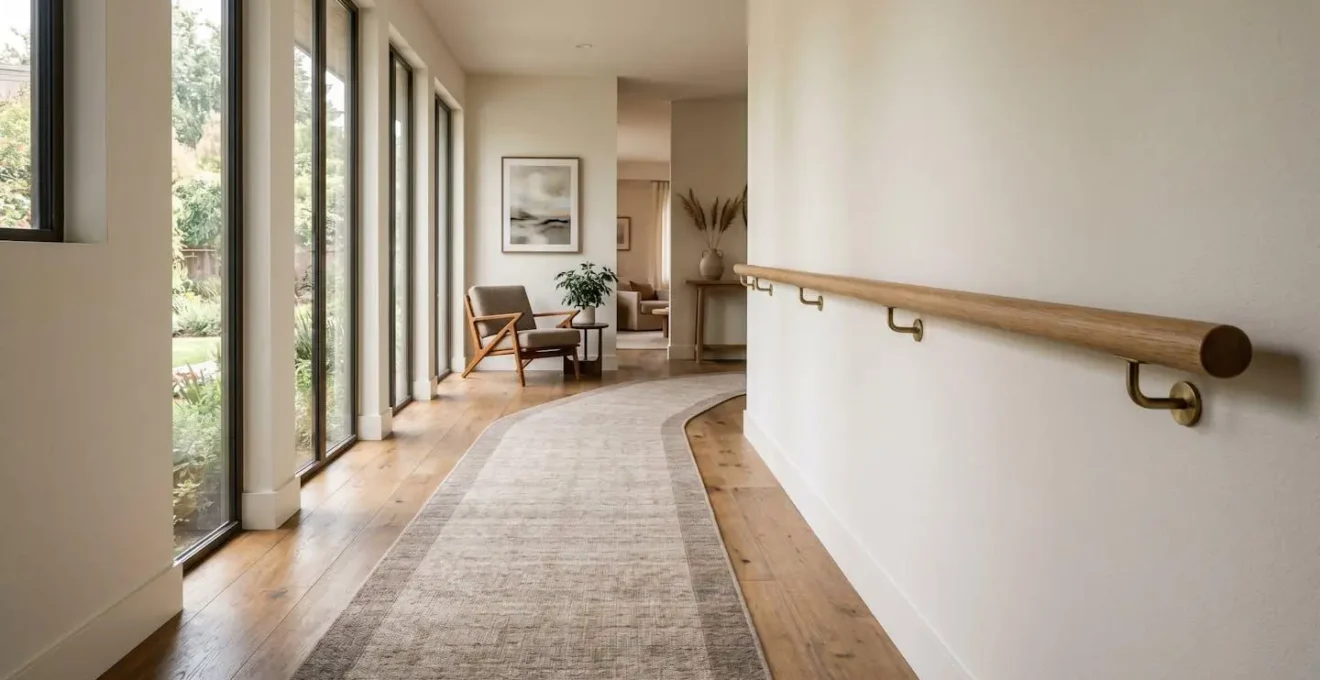
The belief that senior safety requires sacrificing your home’s beauty is a myth. True fall-proofing isn’t about adding sterile, clinical aids; it’s about seamlessly integrating smart, stylish, and behavioral safety measures into your home’s existing character. This guide reveals how an interior designer’s approach can transform potential hazards into elegant features, ensuring a home that is both beautiful and secure for independent living.
There’s a common fear that creeps in when we think about making a home safe for our senior years or for a beloved parent. It’s the image of a warm, personality-filled space being systematically stripped of its charm, replaced by cold plastic grab bars, stark industrial ramps, and the unmistakable, sterile ambiance of a medical facility. The very idea of “fall-proofing” often feels like a choice between safety and the soul of your home.
The conventional advice, while well-intentioned, often focuses solely on function over form. We’re told to remove rugs, add lights, and install supports, but rarely is there a discussion on how to do so with elegance and discretion. This approach overlooks a fundamental truth: a home is not a hospital. It’s a sanctuary, a reflection of a life lived, and it should remain that way.
But what if the key to safety wasn’t about bolting on ugly accessories, but about thoughtful, integrated design? What if we could achieve superior safety by making subtle, stylish modifications that are nearly invisible to the eye? This is the perspective of an accessibility-focused interior designer. It’s about shifting the mindset from reactive, clinical fixes to proactive, aesthetic solutions. Safety can, and should, be beautiful.
This guide will walk you through a new way of thinking about fall prevention. We will explore how to audit your environment and habits, from the ground up, to create a home that is not only safer but also more comfortable and stylish. We will move from identifying common household enemies to retraining our own bodies, and finally, to retrofitting even the most challenging spaces with grace and character.
Summary: How to Fall-Proof Your Hallway Without It Looking Like a Hospital?
- The Throw Rug: Why Is It the Number One Enemy of Senior Safety?
- Slippers vs Shoes: What Should You Wear on Carpet vs Tiles?
- The Midnight Loo Trip: How to Navigate the Dark Safely?
- The “Dizzy” Meds: Which Prescriptions Increase Your Fall Risk?
- If You Fall Alone: The “Crawl to a Chair” Technique You Must Know
- R10 or R11:Which Smartwatch Can Accurately Detect Atrial Fibrillation in Seniors?
- The Toothbrush Balance: How to Retrain Your Brain While Brushing?
- How to Retrofit a Victorian Terrace for Safe Independent Living?
The Throw Rug: Why Is It the Number One Enemy of Senior Safety?
The humble throw rug is a staple of home decor, often used to add a pop of colour, define a space, or provide a soft spot for our feet. From a design perspective, it seems innocuous. From a safety perspective, it’s a concealed threat. These rugs are a leading cause of trips and falls among older adults, responsible for a staggering number of injuries. In fact, CDC surveillance data indicates that they are implicated in incidents leading to an estimated 37,991 emergency department treatments annually for adults aged 65+.
The problem lies in their instability. Unlike wall-to-wall carpeting, throw rugs are prone to bunching, curling at the edges, and slipping on smooth surfaces. A retrospective analysis highlighted that the transition between a rug and a non-rug surface is a particularly high-risk moment. The study found that loose throw rugs are an environmental hazard in nearly 78% of older adults’ homes, making them a pervasive and often underestimated danger, especially in areas like the bathroom where hurrying is common.
So, does this mean your floors must be bare and cold? Not at all. The designer’s solution is to replace the “throw” rug with a “secured” runner. Instead of small, floating islands of fabric, opt for a low-pile runner that extends the length of a hallway. Secure it firmly with a high-quality, non-slip rug pad underneath and use double-sided carpet tape along all edges. The key is to create a smooth, trip-free transition between surfaces. Tapered-edge runners can further enhance this by creating a gentle slope rather than an abrupt edge, combining aesthetic elegance with integrated safety.
Ultimately, a secure and stylish home requires identifying and eliminating these hidden liabilities, starting with the floor.
Slippers vs Shoes: What Should You Wear on Carpet vs Tiles?
The choice of what to wear on our feet at home feels deeply personal, often prioritizing comfort above all else. We kick off our restrictive work shoes and slip into something soft. However, for an aging adult, this simple act has significant safety implications. Wearing the wrong type of indoor footwear—or none at all—is a major contributor to falls. Studies have shown that over 50% of falls among older adults are linked to being barefoot, wearing only socks, or, most commonly, wearing ill-fitting or non-supportive slippers.
The classic, backless, fluffy slipper is a primary culprit. While cozy, it offers no heel support, causing the foot to slide and altering one’s natural gait. On the other hand, going barefoot or wearing socks provides no grip or shock absorption. The ideal solution is a dedicated “indoor shoe” that provides the perfect balance of support, grip, and comfort for different surfaces. The goal is to achieve aesthetic ergonomics—footwear that feels good, looks good, and performs safely.
This is where surface-specific choices come into play. A shoe that is safe on tile might not be ideal for carpet. The key is to understand the interaction between the sole and the floor.
As the image illustrates, the right footwear provides a stable connection to the ground. For navigating a home with mixed flooring, a dedicated indoor shoe with the following features is paramount:
- A firm, non-slip sole: Look for a rubber sole with a good tread pattern that can grip on both tile and wood, but avoid overly thick, heavy rubber that can “catch” on carpets.
- A closed back: This is non-negotiable. A shoe must securely hold the heel to prevent it from slipping off.
- A supportive structure: Avoid overly soft, “squishy” slippers. The shoe should support the arch and prevent the foot from rolling.
- Easy to put on: Velcro or elastic closures are often more practical than laces for those with limited dexterity.
By investing in a proper pair of indoor shoes, you’re not just buying footwear; you’re investing in a foundational piece of your home safety system.
The Midnight Loo Trip: How to Navigate the Dark Safely?
The journey from the bed to the bathroom in the middle of the night is one of the highest-risk activities in any home. Disoriented from sleep, with vision impaired by darkness, the body is simply not at its most stable. This brief trip is a common scenario for falls, which are a serious public health problem. According to the CDC, approximately 36 million falls occur among older adults every year, with a significant portion happening during these dark, nighttime hours.
The typical solution—a single, bright night light plugged into a wall socket—is often inadequate and can even be counterproductive. The harsh, glaring light can cause temporary blindness by constricting the pupils, making it harder to see the darker areas of the room once you look away. The design-led solution is not just about adding light; it’s about creating an ambient lighting pathway that guides you safely without startling your senses.
Think of it as creating a “runway” to the bathroom. The best approach involves layers of low-level, motion-activated lighting:
- Under-Bed Lighting: Motion-activated LED strips placed under the bed frame cast a soft, indirect glow onto the floor the moment your feet touch the ground. This illuminates your immediate path without shining in your eyes.
- Baseboard Lighting: Low-profile, motion-sensor lights installed along the baseboards of the hallway create a continuous, illuminated path. They guide you without creating glare.
- Warm-Toned Bulbs: For all nighttime lighting, choose bulbs with a warm, amber, or red tone (around 2200K). These colours are less disruptive to your sleep cycle and night vision than harsh blue or white light.
- Toilet Bowl Lights: A simple, motion-activated light inside the toilet bowl provides enough illumination to use the facility without needing to turn on the main, blinding overhead light.
By designing a smart lighting system, the midnight trip becomes a safe, gentle, and almost automatic process, turning a high-risk moment into a non-event.
The “Dizzy” Meds: Which Prescriptions Increase Your Fall Risk?
While we often focus on the physical environment when fall-proofing a home, one of the most significant risk factors may be sitting in the medicine cabinet. Polypharmacy—the use of multiple medications—is common among older adults, and many prescriptions have side effects that can directly impact balance and stability. Dizziness, drowsiness, confusion, and blurred vision can all be byproducts of necessary treatments, creating a hidden, internal hazard.
Recognizing which medications carry a higher fall risk is the first step toward mitigating it. This is not about stopping essential treatments, but about opening a dialogue with healthcare providers to manage them safely. Certain classes of drugs are known to be particularly problematic. As the healthcare team at the Mayo Clinic states, a proactive approach is crucial:
Healthcare providers can help reduce fall risk by reviewing medications for side effects and interactions that may increase falling, including weaning patients off medications that cause tiredness or affect thinking, such as sedatives, antihistamines and some antidepressants.
– Mayo Clinic Healthcare Team, Fall prevention: Simple tips to prevent falls
This highlights the importance of a medication review as a core component of any fall prevention strategy. It’s an act of “internal” environmental control. Being an informed and active participant in your healthcare is essential. You can initiate this conversation with your doctor or pharmacist by asking targeted questions. This isn’t about second-guessing your doctor, but about being a collaborative partner in your own safety.
Here are key questions to bring to your next appointment:
- Deprescribing: “Could any of my current medications be stopped, or could the dosage be safely lowered?”
- Timing: “Would taking this medicine at a different time of day, like bedtime, reduce the risk of daytime dizziness?”
- Diuretics: For water pills, “Can I take this in the morning to reduce the need for nighttime bathroom trips?”
- Over-the-Counter (OTC): “Are there any OTC medications, like sleep aids or allergy pills containing diphenhydramine, that could be increasing my risk?”
- Supplements: “Do any of my herbal supplements, such as Valerian root, interact with my prescriptions or affect my stability?”
A well-managed medication plan is as important as a well-lit hallway; both are essential for safe, independent living.
If You Fall Alone: The “Crawl to a Chair” Technique You Must Know
Despite our best efforts, falls can still happen. When they do, the immediate aftermath can be just as dangerous as the fall itself, especially for someone living alone. A “long lie”—being unable to get up after a fall—can lead to serious complications like pressure sores, dehydration, hypothermia, and pneumonia. In fact, statistics show that a fall can result in a long lie lasting 24 hours for individuals who live alone, a situation that can have fatal consequences. Knowing what to do in the moments after a fall is a critical skill that is often overlooked in prevention plans.
The most important first step is to stay calm and assess for injury. Do not try to get up immediately. If you believe you are seriously injured, especially in the head or hip, do not move. Try to call for help using a phone or a medical alert device. However, if you feel you are uninjured but simply unable to stand, there is a specific, methodical technique to get yourself to a position of safety. This isn’t about brute strength; it’s about using leverage and stable objects to your advantage.
This technique, often called the “crawl to a chair” method, is a vital piece of self-rescue knowledge. It turns panic into a process, providing a clear set of actions to follow in a moment of vulnerability.
Your Post-Fall Action Plan: Getting Up Safely
- Assess and Rest: After a fall, take a few deep breaths. Check yourself for pain or injury before making any move. Do not rush.
- Get to All Fours: If you feel able, roll onto your stomach. From there, push up onto your hands and knees into a crawling position.
- Crawl to Stability: Crawl towards the nearest sturdy piece of furniture, like a heavy, solid chair, a sofa, or the side of a bed. Avoid chairs with wheels.
- Position for the Lift: Place your hands on the seat of the chair. Slide one foot forward so it is flat on the floor. Your other knee should remain on the ground.
- Execute the Lift: Using both your arms and your forward leg, push yourself up to a standing or sitting position on the chair. Take your time and rest once you are up.
This knowledge provides not just a practical skill, but a powerful sense of security, knowing you have a plan even for the worst-case scenario.
R10 or R11:Which Smartwatch Can Accurately Detect Atrial Fibrillation in Seniors?
The conversation around senior safety is increasingly moving into the realm of wearable technology. Smartwatches and medical alert devices are no longer just for fitness enthusiasts; they have evolved into powerful tools for independent living. These devices offer a discreet safety net, providing everything from automatic fall detection to sophisticated health monitoring. For seniors, a key concern can be cardiac stability, as conditions like Atrial Fibrillation (AFib) can cause dizziness or weakness, leading to falls. A watch that can monitor for irregular rhythms offers a layer of proactive stability.
However, the market is flooded with options, and not all devices are created equal, especially when considering the specific needs of an older user. A flashy interface and a dozen sports modes are irrelevant if the screen is unreadable or the charging mechanism is too fiddly. The “best” smartwatch is not necessarily the one with the most features, but the one with the most usable and relevant features for the person wearing it. When selecting a device, we must look at it through the lens of a Senior Usability Index, prioritizing practicality over novelty.
The following table breaks down the critical features to look for in a wearable intended for senior safety. This isn’t about choosing a specific brand, but about understanding the non-negotiable characteristics that make a device truly effective and user-friendly. It shifts the focus from “what can it do?” to “how well does it do what I need?”
This comparative framework helps to demystify the selection process, as detailed in this analysis of home safety measures.
| Feature | Critical for Seniors | What to Look For |
|---|---|---|
| Battery Life | Essential | Minimum 24+ hours to avoid daily charging |
| Screen Readability | High Priority | Large font size, high contrast display, adjustable brightness |
| Charging Mechanism | High Priority | Magnetic connection (not fiddly micro-USB) |
| Fall Detection | Essential | Automatic emergency call feature with GPS location |
| AFib Monitoring | Important | Irregular rhythm notifications to detect instability before falls |
| Heart Rate Variability | Important | HRV monitoring as indicator of stress/illness |
| Medication Reminders | Useful | Simple alert system with large notifications |
| User Interface | Essential | Simple navigation with minimal steps to key functions |
Ultimately, a well-chosen wearable acts as a silent guardian, offering peace of mind to both the wearer and their loved ones without ever feeling like a clinical burden.
The Toothbrush Balance: How to Retrain Your Brain While Brushing?
So far, we have focused on modifying the external environment—the floors, the lighting, the technology. But the most powerful fall-proofing tool we have is our own body. As we age, our proprioception—the brain’s sense of where our body is in space—can diminish, leading to instability. The good news is that balance is a skill, and like any skill, it can be improved with practice. The secret is not to add another “workout” to your day, but to integrate balance training into the routines you already perform. This is a concept known as behavioral design or “habit stacking.”
The twice-daily act of brushing your teeth offers a perfect, two-minute window to retrain your brain and strengthen the tiny stabilizer muscles that keep you upright. Instead of leaning on the counter, you can use this time to perform simple balance exercises. It’s an incredibly efficient way to make a significant impact on your stability over time, with zero extra minutes added to your schedule.
The key is to progress gradually. You are building a new neural pathway, so start slowly and only advance when you feel confident and stable. The bathroom provides a safe environment, with walls and a sturdy vanity to grab onto if you feel wobbly.
As this image suggests, the focus is on calm, controlled movement within a safe space. A progressive, four-week program is an excellent way to begin building this new habit and rewiring your brain for better balance:
- Week 1: Tandem Stance. While brushing, stand with one foot directly in front of the other, heel to toe, as if walking on a tightrope. Hold for one minute, then switch feet for the second minute.
- Week 2: One-Leg Stand. Stand on one leg for as long as you comfortably can, aiming for at least 5 seconds. Alternate legs throughout your two minutes of brushing. Keep a hand hovering over the counter for support.
- Week 3: One-Leg Stand with Eyes Closed. Once you are steady on one leg, try closing your eyes for just 3 seconds. This dramatically increases the difficulty and accelerates brain training. Build up to 10 seconds.
- Week 4: Expand the Habit. Now that you’re in the habit, find other opportunities. Perform calf raises while the kettle boils, or stand on one leg while washing a single dish. Each small act reinforces your stability.
By making balance training an automatic part of your daily life, you are building a resilient foundation against falls from the inside out.
Key Takeaways
- True home safety is about seamless integration, not clinical additions. Prioritize stylish, secured runners over hazardous throw rugs.
- Stability is built from the ground up with proper indoor footwear and from the inside out with daily balance-training habits.
- Smart, discreet technology—from ambient motion-sensor lighting to user-friendly wearables—can provide a powerful, non-intrusive safety net.
How to Retrofit a Victorian Terrace for Safe Independent Living?
The ultimate test of the “safety with style” philosophy comes when facing a home with inherent character and architectural quirks, like a Victorian terrace. These homes are beloved for their high ceilings, intricate details, and solid construction, but they also present unique challenges for safe aging: narrow hallways, steep stairs, uneven floorboards, and often, poor natural light. The standard, one-size-fits-all safety solutions would feel particularly jarring here, risking the destruction of the very character that makes the home special.
The goal is not to fight against the home’s character but to work with it. A character-preserving approach to retrofitting is about finding materials, finishes, and solutions that feel like they belong. It requires thinking like a restoration expert as much as a safety consultant. Instead of a chrome grab bar, could we use one made of aged brass or wrought iron? Instead of a plastic ramp, can we re-grade a walkway or add a custom wooden one? Every safety intervention should be viewed through a design lens.
This is where creativity and craftsmanship come into play, transforming potential hazards into beautiful, functional features. The key is to source or commission items that complement the home’s existing aesthetic. Here are several ways to tackle common challenges in a period home without compromising its integrity:
- Narrow Hallways: Standard handrails can feel bulky. Instead, install low-profile, wall-mounted wooden handrails with finishes like aged brass or oil-rubbed bronze that match the home’s hardware.
- Steep Stairs: Enhance grip without sacrificing appearance by applying high-contrast, anti-slip stair nosing in a wood-tone finish that complements the original treads. A high-quality, low-pile runner, securely fastened, can also add grip and a touch of elegance.
- Bathroom Safety: Forego the clinical look by commissioning custom grab bars in materials that match your tapware and other fixtures. A walk-in shower with a zero-threshold entry and a built-in, tiled bench is both safer and more luxurious than a tub with add-ons.
- Lighting: Replace outdated fixtures with period-appropriate wall sconces and chandeliers that use bright, energy-efficient LED bulbs. Use dimmer switches to adjust the ambiance and ensure rooms are always well-lit.
By applying these design-led principles, you can ensure that any home, regardless of its age or style, can be a safe, comfortable, and beautiful sanctuary for years to come.