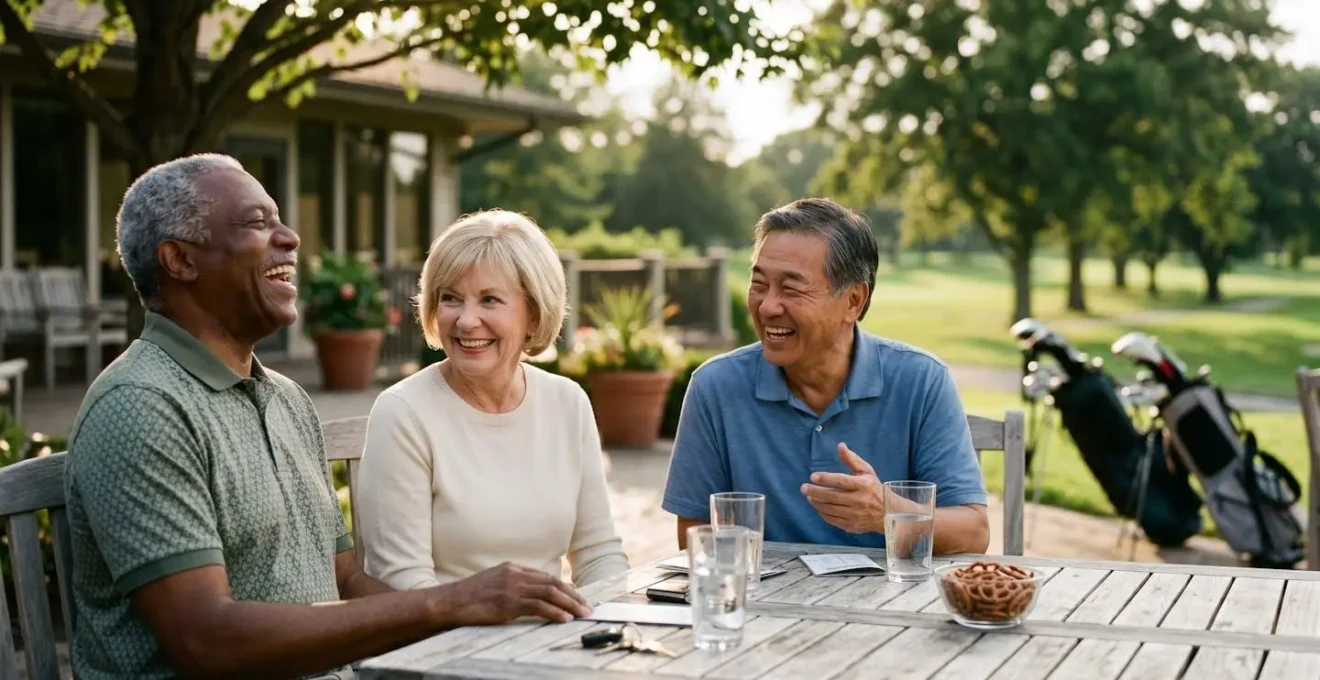
Contrary to what many dedicated golfers believe, a declining handicap isn’t a sign of failure; it’s an opportunity to unlock the most powerful health benefit of the game: the profound social connection of the 19th hole.
- The game provides proven cardiovascular and mental health benefits that are independent of your final score, focusing on movement and environment.
- The real health risk isn’t a few extra strokes, but the dangerous loneliness and isolation that can follow when you quit a social activity.
Recommendation: Shift your primary goal from lowering your score to strengthening your social ties. This simple change transforms golf into a sustainable, lifelong source of holistic well-being.
The familiar frustration hits on the 14th green. Another missed putt. You feel your shoulders slump, the joy of a sunny day on the course evaporating, replaced by a nagging sense of decline. For many senior golfers, this moment is a crossroads. The love for the game clashes with the reality of a body that no longer cooperates as it once did, and the thought of giving it all up becomes increasingly tempting. We’re often told that golf is good for us because it’s exercise, it gets us outdoors, and it keeps the mind sharp. These are all true, but they miss the most critical point.
If you’re considering hanging up your clubs because your scorecard is a source of stress rather than satisfaction, you’re focusing on the wrong metric. The real danger isn’t a higher handicap; it’s the loss of the laughter in the clubhouse, the shared stories, and the simple, human connection that comes with it. What if the true purpose of playing golf in your senior years isn’t to beat your personal best, but to actively build a defense against one of the most significant health threats we face: loneliness? This isn’t about ignoring the game; it’s about reframing it. The first 18 holes are the activity, but the 19th hole—the social bond—is the real prize for your long-term health.
This article will guide you through this new perspective. We will explore how to adapt your physical game to play comfortably for years, but more importantly, we will focus on how to leverage golf as a powerful tool for building the mental resilience and social fabric essential for a vibrant, healthy life. We’ll shift the focus from performance anxiety to the profound benefits of process and connection.
To help you navigate this holistic approach to the game, the following guide breaks down everything from the physical benefits and technical adjustments to the crucial science behind social connection. It’s a roadmap to rediscovering your love for golf by changing the way you measure success.
Summary: A Holistic Guide to Golf for Senior Health and Social Vitality
- Carry, Trolley or Buggy: Which Balance of Effort Suits Your Heart?
- How to Integrate into a Golf Club If You Are a Solo Senior?
- The Senior Handicap: How to Enjoy the Game When Your Swing Slows Down?
- The Senior Swing: Adjusting Your Technique to Save Your Lower Back
- Green Space Effect: Why 4 Hours on the Course Lowers Cortisol?
- Gardening or Hoovering: Which Housework Counts as Moderate Cardio?
- Why Is Loneliness As Dangerous As Smoking 15 Cigarettes a Day?
- How to Admit You Are Lonely and Take the First Step Back to Society?
Carry, Trolley or Buggy: Which Balance of Effort Suits Your Heart?
The first mental hurdle to overcome is the idea that “real” golfers walk the course. As a sports psychologist, I encourage players to see this choice not as a matter of pride, but as a strategic health decision. The goal is sustainability. Whether you carry your bag, use a trolley, or ride in a buggy (cart), you are engaging in a valuable form of physical activity. The key is to find the right balance of effort that allows you to complete the round comfortably and, most importantly, consistently. Don’t let an all-or-nothing mindset push you out of the game.
Thinking that using a buggy negates the health benefits is a common misconception. While walking an 18-hole course burns significantly more calories, riding is far from sedentary. The act of getting in and out of the cart, walking to your ball, taking practice swings, and the swing itself all contribute to your daily energy expenditure. The most critical factor is participation. If a buggy is what keeps you on the course, playing regularly and engaging socially, then it is unequivocally the best choice for your holistic health.
Furthermore, the physical benefits of golf extend beyond simple calorie burn. A 2023 study found that golf burned more than twice as many calories as equivalent walking activities, highlighting its unique combination of walking, swinging, and carrying. This makes it a potent form of moderate-intensity cardiovascular exercise, improving heart health, lowering blood pressure, and enhancing circulation. The choice between carrying, using a trolley, or riding is simply a way to modulate that intensity to match your personal fitness level and daily energy, ensuring you can play for years to come.
Ultimately, the best option is the one that prevents injury and ensures you have enough energy left to enjoy the crucial social interactions at the 19th hole. This isn’t giving in; it’s playing smarter for your long-term well-being.
How to Integrate into a Golf Club If You Are a Solo Senior?
For a senior who is playing alone, or perhaps new to an area, a golf club can feel like an intimidating, closed-off social circle. The thought of breaking into established groups can be a significant barrier, often more daunting than any sand trap. However, seeing the club as a “social ecosystem” rather than a private party is the first step. It is a place designed for connection, and there are low-pressure pathways to becoming a part of its fabric. The key is a gradual, observational approach that builds familiarity and confidence.
Instead of the high-pressure scenario of trying to join a random foursome on the first tee, start at the periphery. The clubhouse, the driving range, and group clinics are your allies. These are neutral zones where interaction is expected but not forced. Becoming a regular face, even for a coffee at the same time each week, lowers the social barrier. It transforms you from a stranger into a familiar presence, making the first “hello” much easier for both you and other members.
This approach puts you in control, allowing you to engage at your own pace. Club professionals and staff are also an underutilized resource; their job is not just to teach the swing but to foster the community. They often know the personalities within the club and can make introductions to members who might be a good fit for your temperament and skill level. You don’t have to do it all on your own.
Your Action Plan for Joining a New Club
- Become a familiar face: Visit the clubhouse for a coffee at the same time each week to build passive recognition.
- Observe from a safe space: Spend time at the driving range, practicing in a low-pressure setting while observing club dynamics.
- Join a structured group: Sign up for a group clinic or lesson to meet other players in a facilitated, learning-focused environment.
- Leverage club tradition: Use the 19th hole as a social entry point by offering to buy a round for a group you’ve played near.
- Ask for help: Work with club professionals, explicitly asking them to help facilitate an introduction to a compatible playing partner or group.
Remember, many other members were once in your exact position. By taking these small, consistent steps, you are not imposing; you are participating in the very social lifeblood that keeps the club alive.
The Senior Handicap: How to Enjoy the Game When Your Swing Slows Down?
The handicap system is designed to allow players of all abilities to compete fairly. Yet, for many seniors, watching that number slowly creep up can feel like a personal failing. This is where the psychological aspect of the game becomes paramount. The frustration with a slowing swing or a shorter drive stems from a deeply ingrained focus on score as the sole measure of success. To truly enjoy golf in your later years, you must consciously shift your focus from a performance mindset to a process mindset.
A performance mindset is fixated on the outcome: the final score, the handicap, winning the match. A process mindset, however, finds satisfaction in the execution of the moment: the feeling of a well-struck shot (regardless of where it lands), the beauty of the course, the camaraderie with your playing partners, and the simple joy of being outdoors and moving your body. It’s about letting go of the demand for perfection and embracing the quality of the experience itself. This isn’t about giving up on playing well; it’s about redefining what “playing well” means.
This mental shift is eloquently captured by one of the game’s legends. As Bobby Jones famously said, the most important course is the one between your ears.
Golf is mainly played on a five-and-a-half-inch course, the space between your ears.
– Bobby Jones, BAYADA Home Health Care
To cultivate this, set new goals for your round. Instead of “I want to shoot below 90,” try “I want to have three meaningful conversations,” “I want to appreciate the design of three different holes,” or “I want to execute my pre-shot routine perfectly on every swing.” These are goals entirely within your control, and achieving them provides a sense of accomplishment that a volatile score cannot. The handicap becomes just a number, a tool for matches, not a measure of your worth or your enjoyment.
When you free yourself from the tyranny of the scorecard, you open the door to a more profound and lasting appreciation for everything the game has to offer, especially the connections it fosters.
The Senior Swing: Adjusting Your Technique to Save Your Lower Back
Physical limitations, especially lower back pain, are a primary reason seniors step away from golf. The powerful, high-torque swing of a professional is simply not sustainable or safe for most aging bodies. The good news is that an effective swing and a “pro” swing are not the same thing. Adjusting your technique isn’t about weakness; it’s a sophisticated bio-mechanical adaptation to preserve your body and prolong your playing career. The goal is to create a more efficient, repeatable motion that relies on rhythm and timing rather than brute force.
The core principle of a senior-friendly swing is to reduce the rotational stress on the lumbar spine. This is achieved by making a few key adjustments. First, adopt a slightly wider stance for a more stable base. Second, allow your lead heel (the left heel for a right-handed player) to lift off the ground during the backswing. This classic move, used by legends like Jack Nicklaus, promotes a fuller hip turn, which takes enormous pressure off the lower back. It may feel “old-fashioned,” but it is a biomechanically sound way to generate power without injury.
The focus must shift from generating torque through a restricted lower body to creating a fluid, rhythmic motion. As one expert in sports medicine points out, the source of a healthy swing comes from specific areas of mobility.
When it comes to golf, we need plenty of mobility in our hips and thoracic spine (mid-back where your ribs attach to the spine)
– Dr. Naveed Shan, Banner Sports Medicine Scottsdale, Doctor of Physical Therapy
Working with a teaching professional who specializes in senior golfers can be transformative. They can help you build a swing that works *with* your body, not against it. This might mean a shorter backswing, a greater focus on “swinging within yourself,” and leveraging the technology in modern clubs designed for slower swing speeds. The result is often not just less pain, but surprisingly better consistency and, ultimately, more enjoyment.
This isn’t about hitting the ball 300 yards; it’s about being able to walk off the 18th green pain-free, ready to share a laugh and a drink with your friends.
Green Space Effect: Why 4 Hours on the Course Lowers Cortisol?
Beyond the physical exertion and the mental challenge, one of the most powerful, yet often overlooked, health benefits of golf is simply the environment in which it is played. Spending several hours immersed in a green, natural landscape has profound, scientifically-backed effects on our stress physiology. This phenomenon, often called the “Green Space Effect,” is a major reason why a round of golf can feel so restorative, even on a day when your putting is off.
Our bodies respond to our environment on a chemical level. Urban, noisy, and crowded settings can subconsciously elevate our levels of cortisol, the primary stress hormone. In contrast, natural environments have the opposite effect. The combination of open space, natural light, the color green, and the sounds of nature sends signals to our nervous system to relax. It triggers a shift from the “fight-or-flight” sympathetic response to the “rest-and-digest” parasympathetic response. The result is a measurable decrease in cortisol levels, lower blood pressure, and a reduced heart rate.
This is not just a feeling; it’s a documented physiological event. Extensive research has found that higher levels of neighborhood green space are associated with healthier cortisol profiles and lower perceived stress among residents. A golf course is, in essence, a large, meticulously maintained park. A four-hour round provides a prolonged dose of this “nature therapy,” far exceeding the minimum threshold required to see significant health benefits. The simple act of being present in that environment for an extended period is a powerful form of stress management.
So, the next time you find yourself frustrated by a shot, take a moment. Look around at the trees, the fairway, the sky. Take a deep breath. You are participating in a powerful wellness activity just by being there, regardless of what your scorecard says.
Gardening or Hoovering: Which Housework Counts as Moderate Cardio?
When we think about meeting our weekly exercise goals, we often compartmentalize. There’s “exercise time” (like a gym session or a brisk walk) and then there’s “the rest of life” (like doing chores or hobbies). Golf brilliantly blurs this line, providing a significant dose of moderate cardiovascular activity that feels more like leisure than a workout. To put its value into perspective, let’s compare it to other common activities. Is it more like light housework, or does it count as “real” cardio?
Activities like hoovering (vacuuming) or light gardening can certainly contribute to an active lifestyle, but they typically fall into the category of low-intensity exercise. They elevate the heart rate, but often not sustainably enough to meet the criteria for moderate cardio, which is defined as activity that noticeably raises your heart rate and makes you breathe harder. This is where golf, even when riding in a cart, distinguishes itself. The intermittent walking across greens and fairways, combined with the full-body motion of the swing, provides a more sustained cardiovascular challenge.
The sheer volume of movement in a round of golf is often underestimated. While the game feels leisurely, the accumulated distance and effort are substantial. An average round of golf involves several miles of walking, even with a cart. This easily surpasses the physical demands of most household chores. It solidifies golf’s position not as a simple pastime, but as a legitimate form of moderate-intensity exercise, crucial for maintaining heart health, managing weight, and improving overall stamina in seniors.
Therefore, when you book a tee time, you are not skipping a workout; you are engaging in one of the most enjoyable and socially enriching forms of moderate exercise available.
Why Is Loneliness As Dangerous As Smoking 15 Cigarettes a Day?
We’ve established that letting frustration drive you away from golf means losing a valuable source of physical and mental exercise. But the stakes are much, much higher than that. Quitting a primary social outlet like a golf club can open the door to a far more insidious health risk: chronic loneliness. As a society, we are beginning to understand that social connection is not a “nice-to-have” luxury; it is a fundamental biological need, and its absence is devastatingly harmful.
The comparison to smoking is not hyperbole; it is a stark, evidence-based warning. A landmark meta-analysis revealed that the mortality risk associated with loneliness and social isolation has a health impact comparable to smoking up to 15 cigarettes a day and is even more dangerous than obesity. Chronic loneliness triggers a sustained stress response in the body, leading to widespread inflammation, elevated cortisol levels, and a weakened immune system. This chronic state of alert significantly increases the risk of heart disease, stroke, and mental health disorders.
This is not a niche problem. The issue is particularly acute among older adults, who often face a shrinking social circle due to retirement, relocation, or the loss of loved ones. A startling 2020 report found that a quarter of Americans 65 and older are considered socially isolated. The cognitive consequences are just as severe as the physical ones, as demonstrated by a compelling long-term study.
Case Study: The Johns Hopkins Dementia Risk Finding
A 2022 Johns Hopkins study that tracked over 5,000 older Americans for nine years provided a chilling look at the cognitive dangers of isolation. The research found that individuals experiencing objectively measured social isolation had a nearly 30% greater risk of developing dementia during the study period. This starkly illustrates that prolonged loneliness directly harms the brain, accelerating cognitive decline and eroding memory, independent of other physical health factors.
From this perspective, every round played, every conversation in the locker room, and every drink at the 19th hole is an active, powerful step in safeguarding your long-term physical and cognitive health.
Key Takeaways
- The true goal of senior golf is not a low score, but sustainable participation for its powerful social and health benefits.
- The social connection fostered at the “19th hole” is a critical defense against loneliness, a health risk as dangerous as smoking.
- Adapting your swing for comfort and using a cart are smart strategies for longevity, not signs of weakness.
How to Admit You Are Lonely and Take the First Step Back to Society?
Recognizing the profound danger of loneliness is one thing; admitting you feel it is another. For many, especially from a generation that values self-reliance, acknowledging loneliness can feel like admitting a personal failure. It carries a weight of shame that can be paralyzing. But as a psychologist, I can assure you it is not a personal failing. It is a human condition, a signal from your brain and body that a fundamental need—the need for connection—is not being met. It’s no different from the hunger you feel when you need food or the thirst you feel when you need water.
The first step, and often the hardest, is to reframe this feeling. Loneliness is not a character flaw; it is a catalyst for action. It is a powerful motivator to take a deliberate step back towards community. You do not need to make a grand announcement or a dramatic change. The first step is often small, quiet, and practical. It’s about choosing one single action that puts you in proximity to other people in a low-pressure environment.
This is where an activity like golf becomes an incredible tool. It provides a pre-built structure for social interaction. You don’t have to invent a reason to talk to someone; the game itself is the reason. Booking a tee time, even as a single player with the hope of being paired up, is a concrete, powerful first step. Going to the driving range, joining a group clinic, or simply having a coffee in the clubhouse—as we discussed earlier—are all tangible actions that break the inertia of isolation. This isn’t just about playing golf; it’s a form of social prescription, an intentional act to improve your health.
The solution doesn’t require you to become a social butterfly overnight. It simply requires you to acknowledge the need for connection and take one step towards the ready-made community waiting at your local golf club.