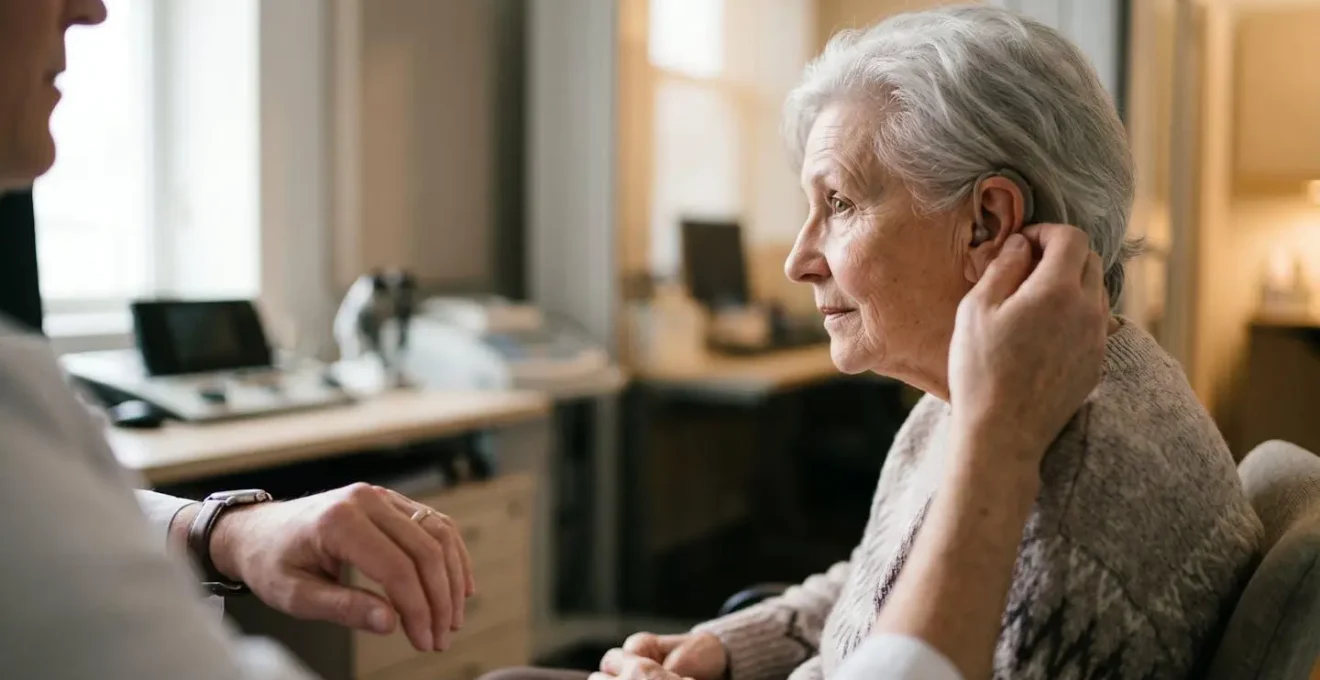
The exhaustion you feel after social events isn’t a personal failing; it’s a neurological symptom of untreated hearing loss called ‘cognitive load’.
- Untreated hearing loss forces your brain to work overtime just to decode sound, draining your mental energy and making socialising feel like a chore.
- This cognitive overload is not just tiring; it has a direct, scientifically-proven link to an increased risk of dementia, depression, and social isolation.
Recommendation: Treating your hearing loss isn’t admitting defeat; it’s a proactive, strategic decision to protect your brain, reclaim your energy, and restore your social life.
That feeling of profound exhaustion after a family dinner or a catch-up with friends is becoming more frequent, isn’t it? You might blame the noisy restaurant, people mumbling, or simply feel you’re becoming less social with age. Well-meaning relatives might have even suggested you “get your hearing checked,” which can feel like another way of saying “you’re getting old.” You find yourself withdrawing, not because you want to, but because the effort to stay engaged is simply too much. Your social battery drains in minutes.
But what if that exhaustion isn’t a personality change or a sign of ageing, but a direct, physiological symptom? What if the true issue isn’t your ears, but the immense strain being placed on your brain? The conventional wisdom about hearing loss often focuses on the obvious—missing words and asking people to repeat themselves. It rarely touches upon the silent, energy-sapping neurological process happening in the background.
This article will reframe your perspective. We are going to move beyond the platitudes and explore the science of why untreated hearing loss is a primary cause of social fatigue and isolation. We will demonstrate that scheduling a hearing test is not a concession to age, but a critical, proactive intervention to protect your cognitive health, preserve your mental well-being, and ultimately, get your social life back. We’ll explore the direct biological links to serious health conditions, demystify the process of getting help, and provide the clear, firm encouragement you need to make the single most important social appointment of your year.
This guide will walk you through the undeniable evidence, explain the practical steps you can take, and empower you to move from isolation back to connection. Explore the sections below to understand the full picture.
Summary: Your Guide to Reclaiming Your Social Life Through Hearing Health
- The Biological Link Between Untreated Hearing Loss and Alzheimer’s
- How to Get High-Quality Digital Hearing Aids on the NHS?
- Invisible Aids vs Behind-the-Ear: Which Works Best for Dexterity Issues?
- The “Dinner Party Syndrome”: How Hearing Loss Leads to Depression
- How Often Should You Test Hearing If You Worked in Loud Industry?
- Why Is Loneliness As Dangerous As Smoking 15 Cigarettes a Day?
- Can You Really Fix BPPV Vertigo at Home with One Movement?
- How to Admit You Are Lonely and Take the First Step Back to Society?
The Biological Link Between Untreated Hearing Loss and Alzheimer’s
Let’s start with the most serious, and perhaps most motivating, reason to address hearing loss immediately. The connection between your ears and your brain is not just about hearing; it’s about cognitive survival. When your hearing is diminished, your brain doesn’t simply receive less information. It goes into overdrive, constantly straining to fill in the gaps and decode the muffled sounds it receives. This intense, non-stop effort is known as high cognitive load.
Think of your brain’s processing power as a finite budget. When a huge portion of that budget is spent just on the task of hearing, there is less capacity for other crucial functions like memory formation and recall. This neurological starvation is not a theory; it’s a measurable process. Over time, this chronic strain can lead to changes in the brain’s structure and function. The evidence is stark and undeniable.
A landmark 2024 meta-analysis published by the Lancet Commission confirmed that hearing loss in midlife is a major modifiable risk factor for dementia. Specifically, the data shows that even mild hearing loss is associated with a significantly higher risk of cognitive decline. Research has quantified this, showing that untreated hearing loss can increase the likelihood of developing dementia. In fact, one major study confirms that there is a 37% increased risk of dementia for those with hearing loss compared to those without. This risk isn’t static; it escalates with the severity of the hearing loss. Ignoring this is not a passive choice; it’s an active risk to your long-term brain health.
How to Get High-Quality Digital Hearing Aids on the NHS?
One of the most persistent myths—and a common excuse for inaction—is the belief that hearing aids are either prohibitively expensive or that the ones available on the NHS are subpar, bulky, and outdated. Let’s be very clear: this is false. All hearing aids provided by the NHS today are modern, digital devices. They are programmable to your specific hearing loss and come equipped with essential features like noise reduction technology.
The barrier, therefore, is not technology or cost, but navigating the system. Knowing the right steps and, crucially, how to frame your concerns, can make all the difference. The NHS provides a clear and fully-funded pathway to receiving high-quality care. It’s about taking the first step with the right information.
Your Action Plan: The NHS Hearing Aid Pathway
- Initiate Contact: The journey begins with your GP. Book an appointment and ask for a referral to your local NHS audiology service. In some areas, you may even be able to self-refer, so check your local NHS trust’s website first.
- Frame the Impact: During your consultation, it’s vital to communicate the full impact of your hearing loss. Don’t just say, “I can’t hear the TV.” Explain the social and emotional toll. Use phrases like, “I’m feeling increasingly isolated,” or “It’s causing me significant anxiety in social settings.” This provides a crucial diagnostic clue for your doctor.
- Attend the Assessment: Your NHS audiology appointment will be a comprehensive assessment. A qualified audiologist will test your hearing and, based on those results, fit you with a suitable digital hearing aid from a top manufacturer like Phonak, Oticon, or Signia.
- Receive Your Device: You will be fitted with a high-quality digital aid. Features often include automatic program switching for different environments and, in some cases, Bluetooth connectivity for streaming audio directly from your phone or TV.
- Access Ongoing Support: The NHS service doesn’t end when you walk out the door. You will receive ongoing support for adjustments, maintenance, and a continuous supply of free batteries or charging accessories, all at no cost.
The pathway is there, and it is designed to provide you with the best possible technology to manage your hearing loss effectively. The only thing required is for you to take that first step.
Invisible Aids vs Behind-the-Ear: Which Works Best for Dexterity Issues?
A common concern, especially for those with arthritis, tremors, or neuropathy, is the practical handling of hearing aids. The idea of manipulating tiny devices and changing fiddly batteries can be a significant deterrent. People often assume that the smallest, “invisible” aids are best, but when it comes to ease of use, the opposite is often true. For anyone facing dexterity challenges, Behind-the-Ear (BTE) models are almost always the superior choice.
Modern BTE devices, particularly those with rechargeable options, are designed with user-friendliness as a priority. They are larger, easier to grip, and eliminate the most challenging task: replacing tiny batteries every few days. The illustration below shows the simplicity of a modern rechargeable BTE aid docking for a charge—a single, simple motion.
As you can see, the design prioritizes simplicity over invisibility, which translates to greater independence and less frustration for the user. Instead of struggling with tiny components, you simply place the device in its dock overnight. This fundamental design difference is critical when making a choice, as outlined in the comparison below.
This table, based on guidance from hearing care professionals, breaks down the key differences for those with handling difficulties, as detailed in a recent comparative analysis of hearing aid types.
| Feature | Behind-the-Ear (BTE) Models | Invisible/In-Canal Models |
|---|---|---|
| Battery Type | Available in rechargeable options eliminating tiny battery changes | Typically require frequent small battery replacements |
| Physical Handling | Larger, easier to grip and position; robust design | Very small; requires precise finger movements and good tactile sensation |
| Smartphone Control | Compatible with apps for volume and program changes without device manipulation | Often requires on-device buttons or specialized tools |
| Suitability for Arthritis | Excellent – minimal fine motor skills needed | Poor – challenging for reduced grip strength or tremors |
| Suitability for Neuropathy | Very good – larger contact surface compensates for reduced sensation | Difficult – requires intact fingertip sensation |
| NHS Availability | Widely available across all NHS trusts | Rarely offered; typically requires private payment |
The “Dinner Party Syndrome”: How Hearing Loss Leads to Depression
The “Dinner Party Syndrome” is a term audiologists use to describe the unique and frustrating situation of being unable to follow a conversation in a noisy environment. It’s the classic scenario: you’re at a table with friends, chatter and laughter fill the air, but the sounds all blend into an incomprehensible wall of noise. You try to keep up, smiling and nodding, but the mental effort is immense. Eventually, you give up, retreat into silence, and feel utterly isolated despite being surrounded by people.
This is not just social awkwardness; it is the breeding ground for anxiety and depression. The constant strain of trying to hear, combined with the fear of mishearing or responding inappropriately, creates significant mental distress. Over time, the simplest solution seems to be avoiding these situations altogether. A dinner invitation becomes a source of dread, not joy. This self-imposed isolation is a direct consequence of the hearing loss, and its impact on mental health is well-documented.
The link is not trivial. A comprehensive 2024 analysis in the journal *Healthcare* highlighted the stark reality, finding that around 40% of people with hearing loss experience significant anxiety, and a substantial portion suffer from depression. This isn’t a sign of weakness; it’s a predictable psychological response to a breakdown in our most fundamental human need: communication. As experts in the field note, the process is a vicious cycle.
Communication difficulties can cause social isolation and loss of support, contributing to depression.
– Multiple researchers in hearing loss psychosocial impact studies, Healthcare Journal – When Sound Fades Study
Recognizing that your feelings of sadness and anxiety are not a character flaw, but a direct symptom of a treatable medical condition, is the first step toward breaking this cycle.
How Often Should You Test Hearing If You Worked in Loud Industry?
For individuals who spent their careers in noisy environments—such as manufacturing, construction, mining, or the military—hearing loss is not a question of ‘if’ but ‘when’ and ‘how much’. Prolonged exposure to high-decibel noise causes irreversible damage to the delicate hair cells in the inner ear, particularly those responsible for processing high-frequency sounds. This type of damage, known as noise-induced hearing loss (NIHL), is insidious. It creeps in slowly, often first affecting your ability to understand speech clarity, especially in noisy backgrounds, long before you notice a change in overall volume.
Given this high risk, the standard advice of “get tested when you notice a problem” is inadequate. For this group, a proactive and regular testing schedule is not just recommended; it is essential preventative care. Despite this, an astonishingly small number of adults get their hearing checked regularly. If you have a history of noise exposure, you cannot afford to be part of that statistic.
So, how do you know if your past work puts you in the high-risk category? Ask yourself these simple questions:
- During a typical workday, did you have to shout to be heard by someone standing an arm’s length away?
- Did your ears ever ring or feel ‘full’ for hours after leaving your work environment?
- Did you work in a high-noise sector for more than five years?
If you answered ‘yes’ to two or more of these questions, annual hearing tests are strongly recommended. If you answered ‘yes’ to all three, you should consider a comprehensive audiological evaluation every 6 to 12 months. This is crucial for establishing a baseline and tracking any changes, allowing for intervention at the earliest possible stage, before the damage significantly impacts your quality of life.
Why Is Loneliness As Dangerous As Smoking 15 Cigarettes a Day?
The comparison is not hyperbole; it is a stark, scientific fact backed by extensive research. While we readily accept the health risks of smoking, we tend to view loneliness as a purely emotional state—a sad but not physically dangerous condition. This is a profound and dangerous misunderstanding. Chronic loneliness and social isolation trigger a physiological stress response in the body that is as damaging over the long term as a heavy smoking habit.
When we are socially isolated, our bodies go into a persistent “fight or flight” mode. This leads to increased inflammation, elevated stress hormone levels, and higher blood pressure. It’s a cascade of negative effects that directly harms our physical health, particularly our cardiovascular system. The data is clear: our social connections are as vital to our physical health as diet and exercise.
The numbers are sobering. Research from Harvard Health, published in the journal *Heart*, showed that social isolation is linked to a 29% increased risk of heart attack and a 32% greater risk of stroke. This isn’t an abstract risk; it’s a measurable, physical toll on your most vital organs. Untreated hearing loss is a primary driver of this social isolation. By making it difficult and exhausting to connect with others, it pushes individuals onto a path that is demonstrably harmful to their health. Treating hearing loss is therefore not just about improving communication; it is a critical intervention to reduce your risk of serious cardiovascular events.
Conversely, taking steps to reconnect, as shown in the image above, has a protective effect. It reduces stress, lowers inflammation, and supports overall health. Your hearing test is the first step on that path back to connection.
Can You Really Fix BPPV Vertigo at Home with One Movement?
Questions about Benign Paroxysmal Positional Vertigo (BPPV) and home remedies like the Epley maneuver are common. While specific vertigo treatments should always be done under the guidance of a GP or a vestibular specialist, the very question highlights a critically important, and often overlooked, connection: the one between hearing and balance. It’s no coincidence that these two functions can cause so much disruption.
Your hearing and balance systems are not separate neighbours; they are intimate roommates, living together in the delicate and complex structure of the inner ear. The same fluid-filled canals and tiny sensory organs that process sound are also responsible for telling your brain how your head is positioned in space. As audiology specialists frequently note, this shared anatomy means a problem in one area can be a red flag for the other.
The same delicate system (the inner ear) governs both hearing and balance, so a problem in one area can signal a risk in another.
– Audiology and vestibular health specialists, Inner Ear Health Educational Resources
Therefore, even if your primary concern is dizziness or vertigo, a comprehensive hearing test is an essential part of the diagnostic process. It provides a complete picture of your inner ear health. An audiologist can identify if there are underlying issues that might be contributing to both hearing and balance problems. Dismissing a hearing test because “it’s my balance that’s the problem” is to miss a crucial piece of the puzzle. It’s all connected, and a hearing test is the most comprehensive way to start understanding the health of this entire intricate system.
Key Takeaways
- Untreated hearing loss is not a passive condition; it’s an active strain on your brain (cognitive load) with direct links to dementia risk.
- Modern, high-quality digital hearing aids are available for free on the NHS, and rechargeable models are ideal for those with dexterity issues.
- Social withdrawal due to hearing loss is a major driver of depression, anxiety, and a level of physical health risk comparable to smoking.
How to Admit You Are Lonely and Take the First Step Back to Society?
Admitting “I am lonely” can feel like one of the hardest things to say. It can feel like an admission of failure or a personal shortcoming. But as we’ve seen, the loneliness driven by hearing loss is not a character flaw. It is a predictable symptom of a medical condition. The most crucial reframe you can make is this: admitting loneliness is not a sign of weakness; it’s giving your doctor the most important diagnostic clue. It’s no different than saying “my knee hurts” or “I have a cough.” It is the starting point for finding the right solution.
The first step back to society begins with a single conversation. It may be with a family member, a trusted friend, or your GP. The goal is to articulate the link between your hearing and your feelings of isolation. Here are a few scripts you can adapt to make that conversation easier:
- To a family member: “I’ve been feeling a bit disconnected lately, and I think my hearing is a big part of it. I’m going to book a hearing test. Would you be willing to come with me for support?”
- To your GP: “I’m not just struggling to hear—I’m feeling increasingly isolated and it’s causing me significant anxiety in social settings. I’d like a referral for a comprehensive hearing assessment.”
- To a friend: “I’ve been avoiding social events because I find it exhausting to follow conversations. I’m finally taking action with a hearing test, and I’m actually hopeful about reconnecting.”
This isn’t wishful thinking; the positive impact of taking action is proven. The landmark ACHIEVE clinical trial demonstrated that for individuals at risk, treating hearing loss significantly reduced social isolation over three years. Taking this step is an act of courage and self-preservation.
That first call, that first conversation, is the most powerful move you can make. It is the moment you stop letting hearing loss dictate your social life and start taking back control.
The evidence is overwhelming, and the conclusion is clear. The fatigue, the frustration, and the loneliness you’re experiencing are real, they are physiological, and most importantly, they are treatable. Stop accepting social withdrawal as your new normal. Take the first, most crucial step. Book your hearing test today. It isn’t just an appointment; it’s your first step back to the conversation, back to your friends and family, and back to your life.